

Carbon (SN116) first gained wider attention during Exploit Summit 2026 in Montreal, where the team won Pitchtensor. The project raised 500 TAO in under twenty minutes through Bitstarter, giving Carbon an early community-backed launch.
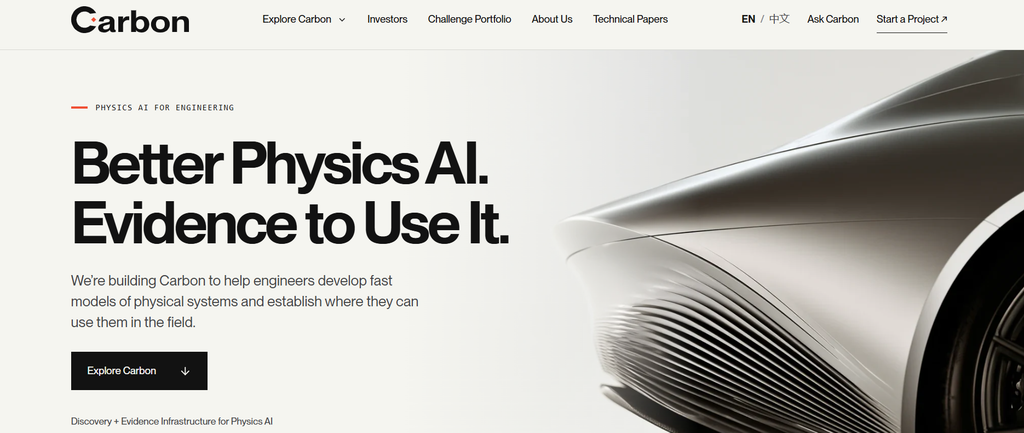
Its pitch focused on a practical problem facing Physics AI adoption. Faster predictions are useful, but engineers still need confidence that those predictions remain reliable under real operating conditions. Carbon was created to combine model discovery with independent testing, reproducibility, and clear evidence around performance.
Why Physics AI Matters
Engineering depends heavily on simulation, but traditional numerical methods can take hours or days for complex physical systems. Physics AI offers a faster approach by learning system behaviour and producing predictions without repeating every expensive calculation.
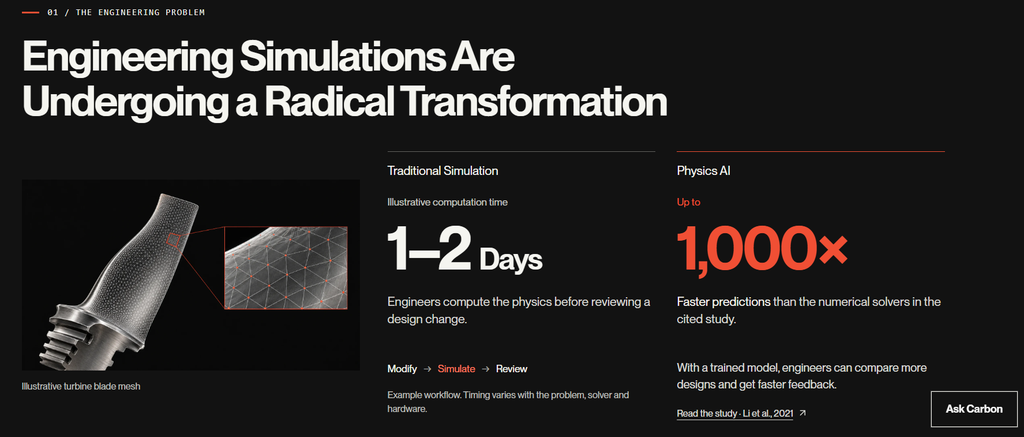
That speed can help engineers test far more designs and shorten development cycles, but reliability remains critical. Models can fail when operating conditions change, so engineers need clear evidence showing where each prediction can be trusted. Here’s where Carbon comes in.
What Is Carbon?
Carbon (SN116) is a Bittensor-based solution focused on discovering stronger Physics AI models and independently validating their performance. It combines open research competition with structured evaluation built around real engineering requirements and physical constraints.
Companies can bring Carbon to an existing model or a problem that needs a better modelling approach. Carbon then tests whether the model works, identifies where it fails, and checks whether claimed improvements can be reproduced. This makes evidence a core product instead of relying only on benchmark scores.
What Carbon Can Be Used For
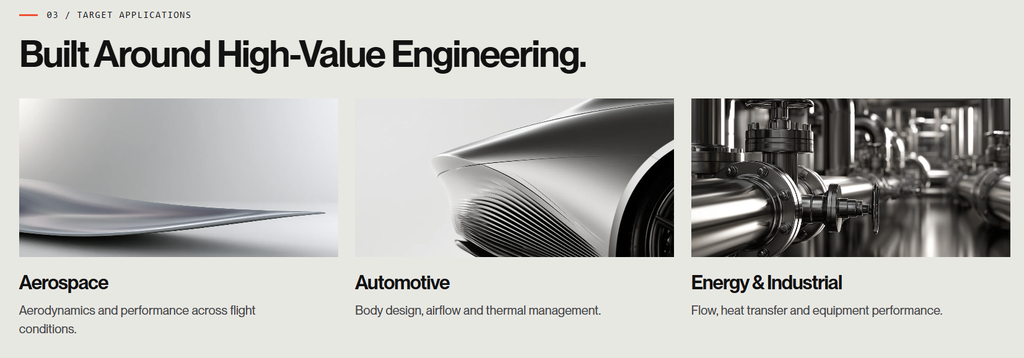
Carbon can support engineering problems where companies need to model physical systems before making expensive real-world decisions. Potential applications include aerospace, automotive engineering, batteries, robotics, energy, semiconductors, acoustics, and advanced manufacturing.
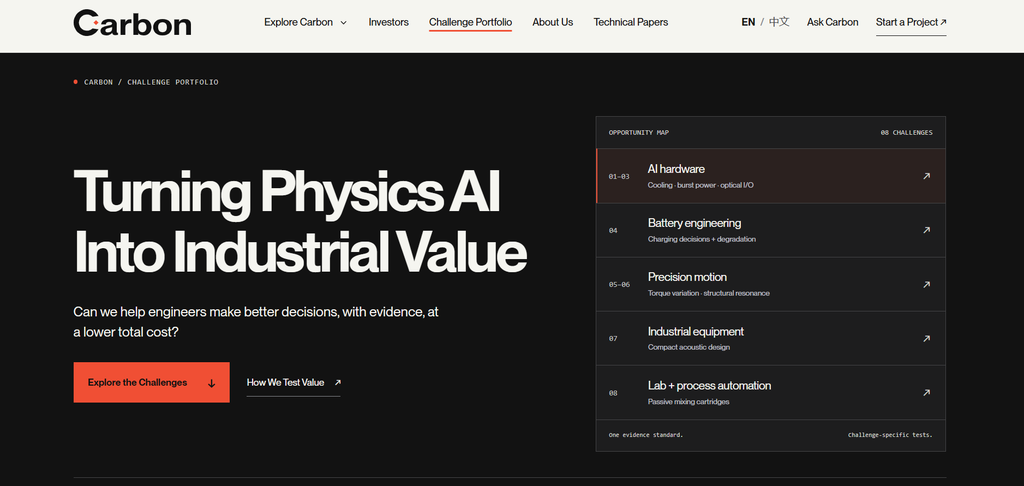
Its challenge portfolio shows how this could work in practice. One example focuses on cooling AI hardware by testing cold-plate designs across temperature and pumping requirements. Another explores battery charging while balancing speed, heat, voltage limits, and long-term degradation.
Other proposed areas include electric motors, silicon photonics, structural resonance, fluid mixing, and industrial noise. Across these use cases, Carbon combines faster model-driven experimentation with independent testing against predefined engineering requirements.
How Carbon Operates
Each Carbon engagement begins by defining the engineering problem, operating conditions, reference data, and success criteria. If a customer already has a model, Carbon can move directly to evaluation; otherwise, the problem becomes a structured research challenge on Bittensor.
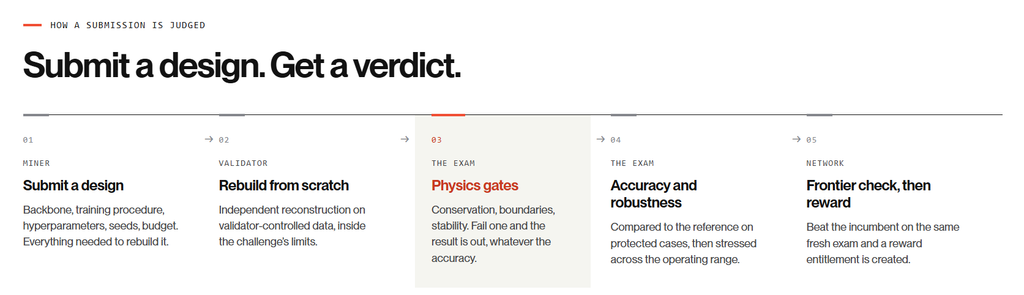
1. Customers provide the engineering problem, commercial demand, and the conditions that define success.
2. Miners act as researchers, developing reproducible Physics AI methods and submitting the details needed to reconstruct them.
3. Validators independently reproduce and test submissions under controlled conditions.
4. Evaluation can include physics checks, accuracy, robustness, and performance on unseen conditions.
5. Frontier comparison tests promising models against the current best method using fresh independent evaluation.
6. Rewards are based on verified research progress, with overall score, frontier improvement, and rewards treated separately.
Carbon currently focuses on neural-operator methods such as Fourier Neural Operators and DeepONet, with plans to support a broader range of approaches over time. By separating model development from final evaluation, the process reduces reliance on self-reported benchmarks and gives customers evidence they can independently examine.
Carbon Services
Carbon is building its commercial offering around two main services. Evidence Audit is for teams that already have a Physics AI model. Carbon tests the model against predefined operating conditions and evidence requirements. The aim is to show where the model is reliable and where more testing is needed.
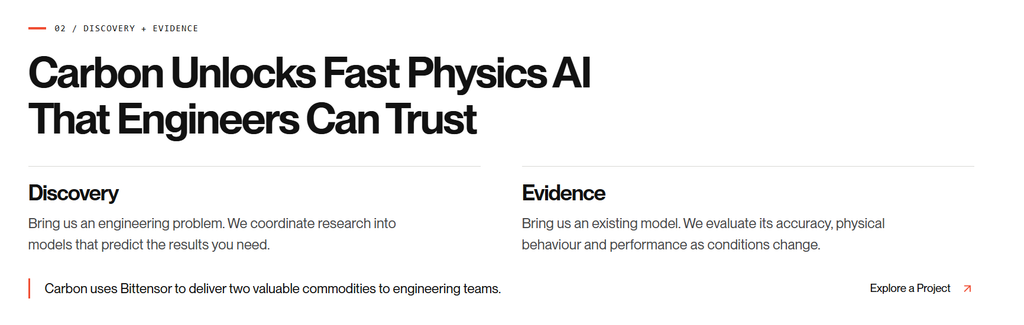
Model Discovery is for customers looking for better approaches to a defined engineering problem. Carbon turns the problem into a structured competition, and validators check whether new methods are real improvements. It also plans ongoing requalification as hardware, environments, or datasets change. Those results can feed into an Evidence Landscape showing which methods work under specific conditions.
Ask Carbon
Carbon also offers Ask Carbon, an LLM interface for questions about Carbon and Physics AI. Carbon handles the user interface, project knowledge, and request flow, while Chutes (SN64) provides the confidential inference infrastructure that runs the model.
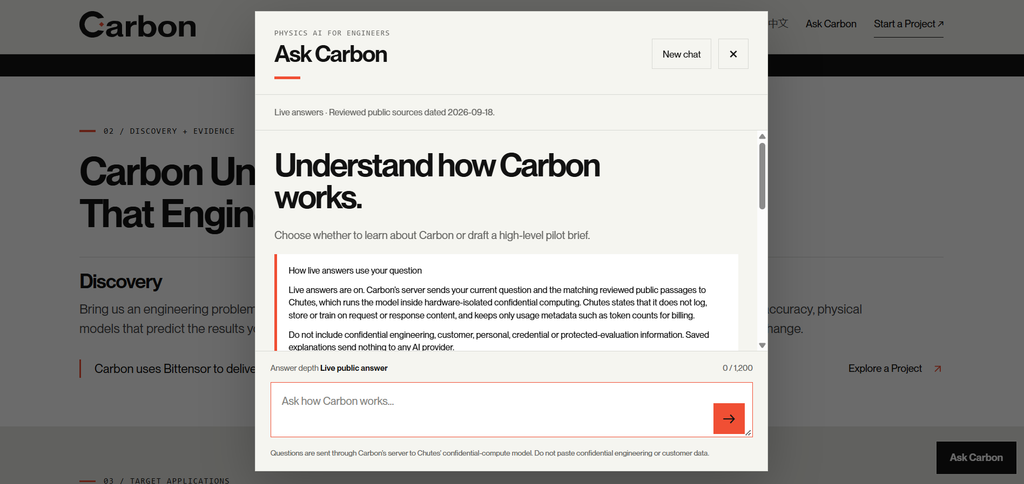
This gives users a simpler way to explore Carbon’s technical information through conversation. It also shows how one Bittensor subnet can use another subnet’s infrastructure to power a customer-facing product.
SN116 Tokenomics
Carbon plans to connect the success of its commercial products back to the subnet and its Alpha token. Its tokenomics currently center on three mechanisms:
1. Revenue Buybacks: A portion of Carbon’s revenue will be used to buy back SN116. The team plans to automate these purchases for defined revenue streams.
2. Contributor Rewards: Carbon is developing a Contributor Awards program for miners, builders, and long-term holders who contribute to the subnet’s growth.
3. Carbon Council: Committed miners, builders, and holders are expected to have a role in strategic decisions through the Carbon Council.
Carbon aims to tie Alpha directly to its commercial growth by directing part of its revenue and value back into the subnet and its contributors.
Carbon’s Long-Term Potential
Carbon is built around a key challenge in Physics AI adoption. Faster models can improve design cycles, but engineering teams still need proof that their predictions are dependable.
Carbon addresses this by separating model development from testing. Miners improve methods, validators verify them, and customers provide real engineering problems.
If the model works as intended, Carbon could become an important evidence layer for Physics AI. Its long-term value may come from combining model discovery, qualification, and verified performance records in one network.
Useful Links
1. Website: https://carbonphysics.ai/
2. Carbon (SN116) X Handle: https://x.com/carbonphysicsai
3. About Carbon: https://carbonphysics.ai/about/
Enjoyed this article? Join our newsletter
Get the latest TAO & Bittensor news straight to your inbox.
We respect your privacy. Unsubscribe anytime.
Enjoyed this article?
Join our newsletter
Get the latest TAO & Bittensor news straight to your inbox — every morning before markets open.

No comments yet — be the first.