
Innovation within the Bittensor ($TAO) ecosystem continues to accelerate as builders explore new ways to expand decentralized machine intelligence.
One of the latest initiatives pushing this momentum forward is the Bittensor Subnet Ideathon (organized by OpenTensor Foundation and HackQuest), a community-driven program designed to surface high-quality subnet ideas and mechanism designs from across the ecosystem.
After reviewing more than 150 submissions, the organizers have now revealed the results of Round I, announcing the teams advancing to the next stage of the competition.
Both the Top 7 ideas and a group of Honorable Mentions will now move forward to Round II, “the Testnet Phase,” where ideas begin transitioning from concept to implementation.
From Ideas to Infrastructure
The ideathon was created to identify subnet concepts capable of strengthening the Bittensor network through robust mechanism design, practical use cases, and sound engineering architecture.
Participants were asked to propose new subnet frameworks that could contribute meaningful capabilities to the ecosystem while maintaining the incentive integrity that Bittensor is known for.
With over 150 proposed projects, the judging process was highly competitive. Only a handful of ideas demonstrated the combination of technical clarity, credible use cases, and resilient incentive models required to advance.
The Top 7 Teams Advancing to Round II
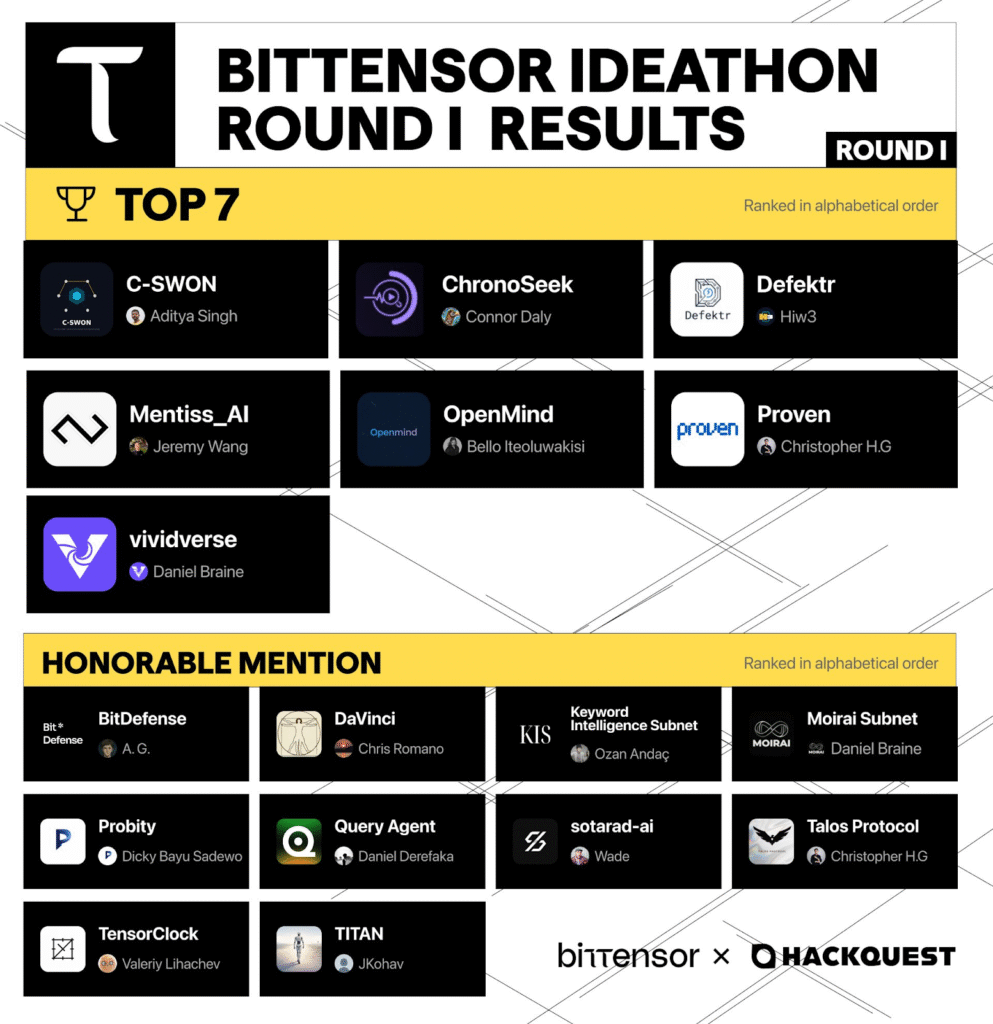
Seven projects stood out among the submissions and were selected as the leading teams moving into the next phase. These teams are (in alphabetical order):
a. C-SWON by Aditya Singh,
b. ChronoSeek by Connor Daly,
c. Defektr by Hiw3,
d. Mentiss AI by Jeremy Wang,
e. OpenMind by Bello Iteoluwakisi,
f. Proven by Christopher H.G, and
g. Vividverse by x.com/vividverseai,
Each of these projects demonstrated strong subnet concepts that align with the design philosophy of the Bittensor network.
Their proposals will now enter the testnet implementation phase, where ideas would begin interacting with real network infrastructure.
Honorable Mentions Also Moving Forward
In addition to the top-ranked teams, several other projects impressed the judging panel and were awarded “Honorable Mention” status.
These teams will also advance to Round II (listed in alphabetical order):
a. BitDefense by A.G.,
b. DaVinci by Chris Romano,
c. Keyword Intelligence Subnet (KIS) by Ozan Andaç,
d. Moirai Subnet by x.com/ai_moir,
e. Probity by Dicky Bayu Sadewo,
f. Query Agent by Daniel Derefaka,
g. Sotarad-ai by Wade,
h. Talos Protocol by Christopher H.G,
i. TensorClock by Valeriy Lihachev, and
j. Titan by JKohav.
Together with the Top 7 teams, these builders represent some of the most promising subnet concepts emerging from the ideathon.
How Submissions Were Evaluated
The judging panel used a set of criteria designed to reflect the technical priorities of the Bittensor ecosystem.
Projects were evaluated across five key dimensions:
1. Mechanism Quality: The incentive model had to be coherent, robust, and aligned with decentralized competition,
2. Role Clarity: Successful proposals clearly defined the responsibilities and specifications for both miners and validators,
3. Use-Case Fit: Ideas needed to demonstrate a meaningful, credible application that felt native to the Bittensor network,
4. Integrity: Scoring systems had to be verifiable and resistant to gaming or collusion, and
5. Engineering Judgment: Architectures and implementation strategies were expected to demonstrate sound technical planning.
These criteria ensured that the selected projects were not just creative ideas, but subnet concepts capable of functioning in real decentralized environments.
The Judges Behind the Selection
The evaluation process was conducted by a panel of ecosystem contributors and builders who reviewed all the submissions submitted while the Phase I period was live.
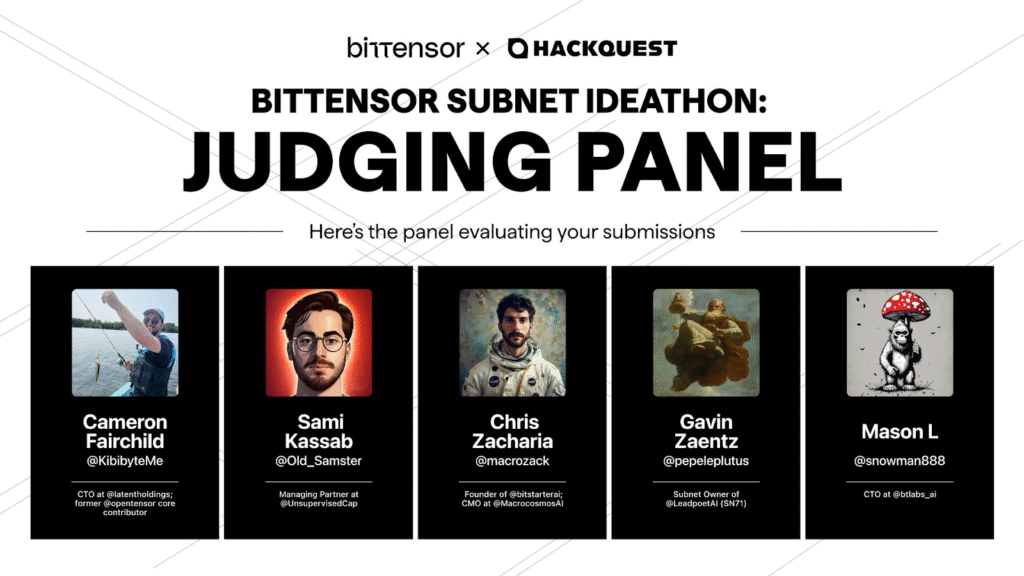
Judges included Cameron Fairchild (CTO at Latent Holding), Sami Kassab (Managing Partner at Unsupervised Capital), Chris Zacharia (CMO at Macrocosmos), Gavin Zaentz (CEO at Leadpoet AI), and Mason Levey (CTO at BTLabs).
Their feedback played an important role in identifying those ideas that demonstrated the strongest potential for real-world subnet deployment.
What Happens in Round II
With Round I complete, the ideathon now moves into its next phase. At this point, already started on March 2 according to the official schedule, advancing teams will start building and testing their subnet concepts on Bittensor’s testnet.

During this stage:
a. Teams will begin implementing their subnet designs,
b. Prototypes will interact with the testnet environment, and
c. Mechanisms and architectures will be tested in practice.
Participants will also receive guidance and coordination from HackQuest, which will work directly with teams to prepare them for the upcoming Subnet Hackathon Testnet Phase.
Support for Builders Across the Ecosystem
Even teams that were not selected for Round II still have opportunities to continue developing their ideas. HackQuest has encouraged builders to reach out for:
a. Feedback on their submissions,
b. Guidance on deploying ideas on the Bittensor testnet, and
c. Technical direction for refining their subnet designs.
This open support reflects a broader goal to encourage experimentation and growth throughout the ecosystem.
The Bigger Picture for Bittensor
Subnet ideathons like this one highlight a defining characteristic of the Bittensor network: Its ability to evolve through open experimentation.
Unlike traditional AI development environments controlled by a handful of institutions, Bittensor enables independent builders to propose new architectures, incentive mechanisms, and AI applications directly at the protocol level.
Events such as the Subnet Ideathon provide a structured way to identify and accelerate those ideas.
With Round II here, the focus shifts from concept to execution as these teams begin transforming their proposals into working decentralized infrastructure, and if the diversity of submissions in Round I is any indication, the future of subnet development within the Bittensor ecosystem is only just beginning.



Be the first to comment