


Bittensor has officially increased its subnet limit from 128 to 160, adding 32 new slots in a 25% expansion of the network’s capacity.
The change, confirmed by Taostats, has been executed on-chain and marks another step toward making Bittensor more accessible to developers building decentralized AI products.
The network initially supported just 32 subnets before gradually expanding to 128. The latest increase allows more projects to launch without immediately competing for an existing slot.
For Bittensor, where each subnet operates as an independent marketplace for products such as AI inference, computing, robotics and data, the expansion creates room for more experimentation and potential commercial breakthroughs.
However, additional slots do not guarantee rewards. Subnet registration still requires TAO, and projects must attract sufficient market demand to earn meaningful emissions.
Bittensor’s emission gate, introduced earlier this year, concentrates rewards around the strongest 32 subnets while substantially reducing allocations to weaker ones. Subnets also remain subject to deregistration once their immunity period expires, meaning expansion does not eliminate competition.
The move aligns with a broader ambition championed by Bittensor co-founder Jacob Steeves (Const) to eventually support as many subnets as the network can handle while bringing registration costs closer to zero.
Increasing capacity without proportionally rewarding inactive projects could allow Bittensor to grow without unnecessarily diverting emissions from its strongest performers.
James Altucher, an advisor to TAO Synergies and a prominent Bittensor advocate, has long supported expanding subnet capacity.
In an earlier post, he argued that subnet success follows the Pareto principle, where 80% of value could come from 20% of projects, and 64% from just 4%.
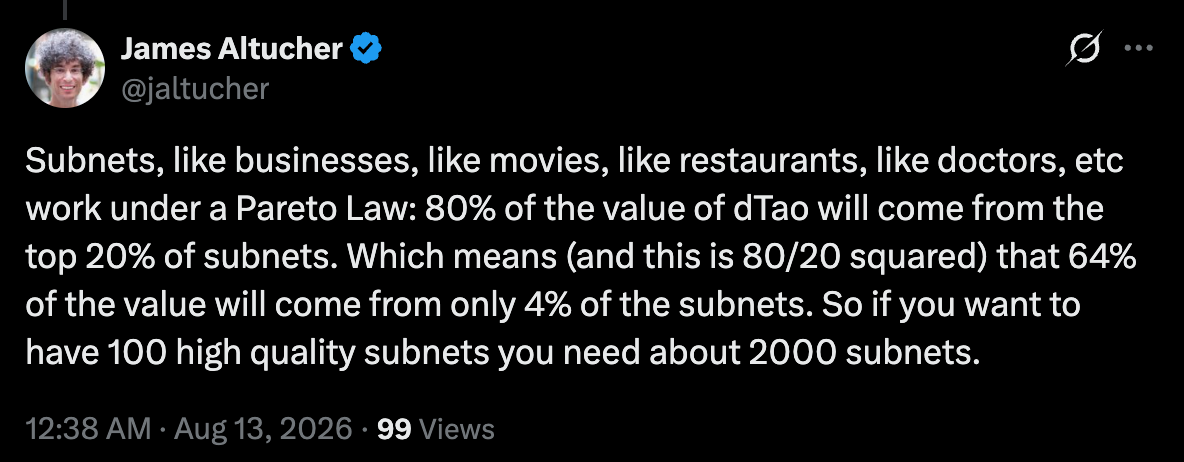
Under that reasoning, Bittensor might need roughly 2,000 subnets to produce 100 high-quality winners. The expansion to 160 moves the network further in that direction.
For Bittensor, the potential benefits extend beyond accommodating new builders. More subnets could attract additional developers, investors, and customers, creating new opportunities for TAO demand and commercial activity across the ecosystem.
The trade-off is that more projects could also fragment liquidity and introduce weaker competitors without necessarily increasing the network’s overall economic value.
Ultimately, the expansion reflects a move toward a larger, more competitive decentralized AI economy. Bittensor is opening the door to more builders while maintaining mechanisms that favor stronger projects.
Whether those additional slots translate into meaningful growth will depend on how many new subnets develop products that people use and pay for.
Enjoyed this article? Join our newsletter
Get the latest TAO & Bittensor news straight to your inbox.
We respect your privacy. Unsubscribe anytime.
Enjoyed this article?
Join our newsletter
Get the latest TAO & Bittensor news straight to your inbox — every morning before markets open.



No comments yet — be the first.