

In this video, TAO Templar (Travis) walks through a complete framework for investing in subnet alpha tokens.
It’s part mental model, part practical risk guide, and part product walkthrough of his own dashboard, Tao Flute.
The most useful takeaway is the framework he opens with, which forces you to decide what kind of investor you are before picking subnets.
The mental model: all subnets are slices of one pie
The most important concept in the video, and the thing that distinguishes Bittensor from every other crypto ecosystem, is that all subnet prices sum to roughly 1 TAO (currently 1.34 across all 128 subnets at the time of recording).
- The value of subnets is relative to each other, not absolute.
- This is structurally different from chains like Ethereum, where a Pepe coin pumping doesn’t lift ETH’s price. On Bittensor, every subnet contributes to TAO’s value.
- That makes it essential to think of subnet investing as competing for slice size in a finite pie.
The 4-quadrant investor framework
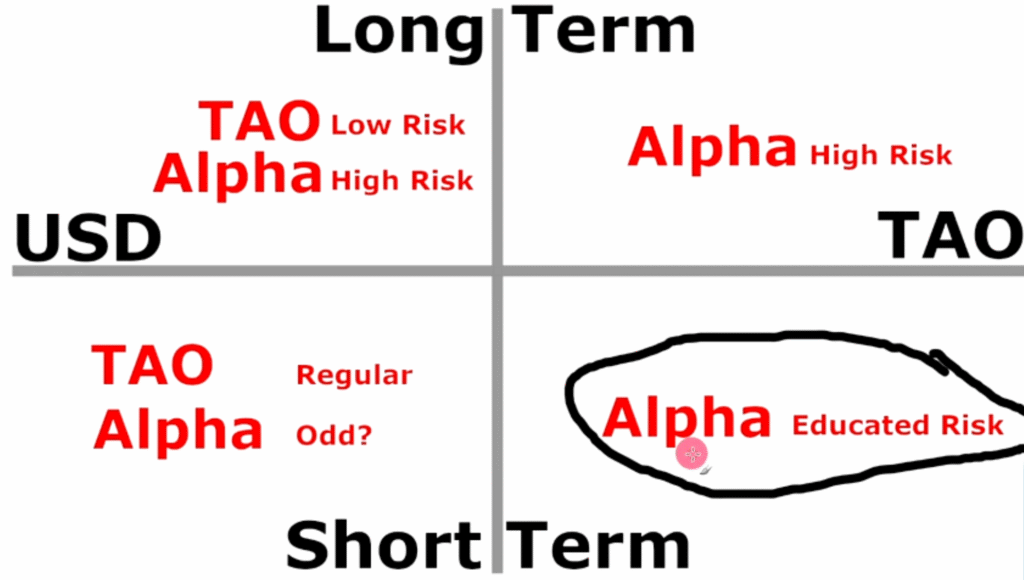
Before picking any alpha, Travis insists you should know which quadrant you’re playing in:
| Long-term | Short-term | |
|---|---|---|
| Want USD returns | Just buy TAO. Low risk, set-and-forget. Stake to root, earn dividends (APY). | Use regular TA on TAO itself. |
| Want TAO returns | High risk. Only viable if a subnet has a clear revenue → buyback flywheel. | Where Travis spends most of his time. Educated risk through dashboard tooling. |
His own positioning:
- Long-term USD goal? Just buy and stake TAO. Don’t touch alpha.
- Long-term TAO accumulation? Better to choose subnets that fully offset miner emissions with revenue.
- Short-term TAO accumulation (0–60 days)? This is where the rest of the video lives.
Why long-term alpha is dangerous
Travis is unusually blunt here. The dTAO world isn’t static:
- Subnets get deregistered, sold, renamed, redirected.
- New subnets show up with ideas you and I cannot predict.
- A fresh narrative-driven subnet can eat a giant share of the emissions in weeks.
- Holding alpha long-term means betting your specific subnet maintains or grows its slice against an unknown future field.
His verdict: for most people, long-term alpha is worse than just staking TAO to root. The one exception is subnets with a proven revenue flywheel.
The deregistration risk (and the liquidation haircut)
This is the single most actionable concept in the video for short-term alpha traders.
- When a new subnet registers, the subnet with the lowest EMA price gets deregistered.
- When a subnet is deregistered, its TAO liquidity pool is distributed pro-rata to alpha holders at the liquidation price.
- The gap between current price and liquidation price is the liquidation haircut, and it can be positive or negative.
Worked example from the video:
- Hermes at 0.00317 has a liquidation price of 0.00228, a –28% haircut. Hold it and you eat a 28% loss if it deregisters.
- Sparket AI, however, has a liquidation price above its current price, a +7% haircut. If it deregisters, you actually gain 7%.
That single difference changes the whole calculation. Travis uses the liquidation haircut column on Tao Flute as one of his primary screening tools. When two subnets look similar but have very different haircuts, he picks the safer one.
Reading higher-priced subnets differently
For blue chips like Chutets (0.085), the liquidation haircut means something different:
- A high haircut on a blue chip just means it’s nowhere near deregistration. Safe, but with a price ceiling. Chutets doubling in price is structurally much harder than a newer subnet doubling.
- A low or negative haircut on a blue chip is a warning sign about how much TAO is backing the price.
- Subnet 78 currently shows a –100% liquidation haircut at price 0.03, an instance Travis explicitly says to stay away from.
The red flags Tao Flute automates
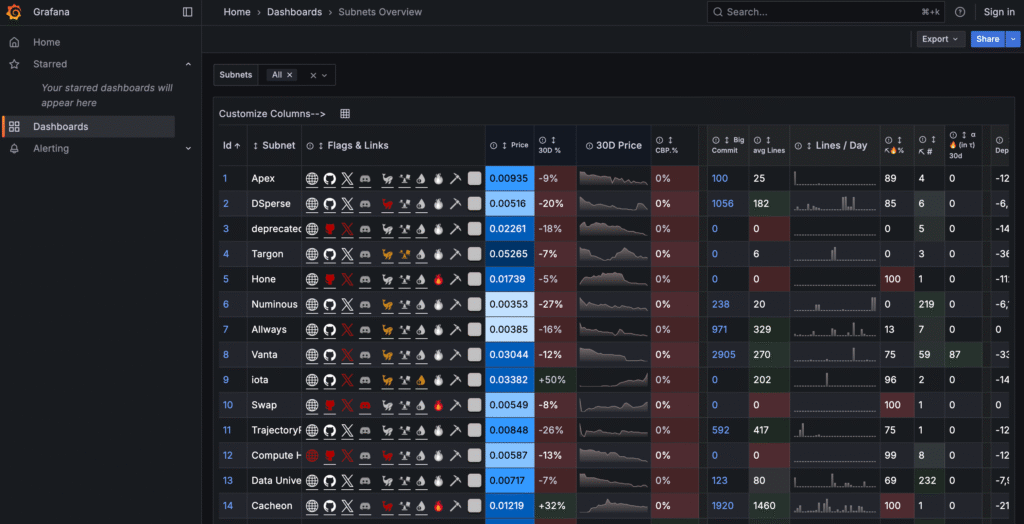
Travis built Tao Flute specifically to make this kind of analysis fast. The flags it surfaces include:
- Whale concentration — e.g., Distill shows a 60% whale (the subnet owner). If they dump, the alpha price crashes 60%. This is the flag that would have warned about the Tenex exploit.
- Emission centralization — emissions going disproportionately to a single key (potentially nefarious unless it’s a winner-take-all design).
- 100% miner burn — the subnet isn’t actually producing anything. Sometimes legitimate (incentive mechanism being patched), sometimes not.
- Missing website / GitHub / Discord activity — basic team-existence signals.
- GitHub commits per day — visualized as a 30-day bar chart so you can see actual work cadence.
How Travis screens subnets
A typical short-term workflow he describes:
- Sort by average GitHub commits per day descending — find subnets actually shipping.
- Filter for strongly negative 30-day price change — potential mispricing.
- Check the liquidation haircut to understand downside risk.
- Check the immunity period flag — newly registered subnets are immune from deregistration for 4 months, which caps downside in a useful way.
- Hop into the Bittensor Discord to read pinned messages — the subnet owner’s most important context lives there.
Bottom line
Alpha investing is high risk at any horizon, but the risk can be educated. The single biggest mistake retail alpha traders make is investing in subnets without understanding the liquidation mechanics, which means a bad pick can lose 28% on deregistration alone, before any other risk is factored in.
Travis’s recipe:
- Long-term TAO accumulation? Stake to root.
- Long-term alpha? Only if the subnet covers miner emissions with revenue.
- Short-term alpha? Use the liquidation haircut as your primary downside filter, layer in GitHub activity and whale flags, and never invest in something you wouldn’t be comfortable sitting next to in Discord.
Full video below:
Enjoyed this article? Join our newsletter
Get the latest TAO & Bittensor news straight to your inbox.
We respect your privacy. Unsubscribe anytime.
Enjoyed this article?
Join our newsletter
Get the latest TAO & Bittensor news straight to your inbox — every morning before markets open.
No comments yet — be the first.