


Open a Bittensor wallet on-chain and the numbers can look strange, with balances in the billions where you expected a handful of $TAO. The reason is $RAO, the smallest unit of the native token, and it works the same way cents sit under dollars or $SATOSHI sit under $BTC.
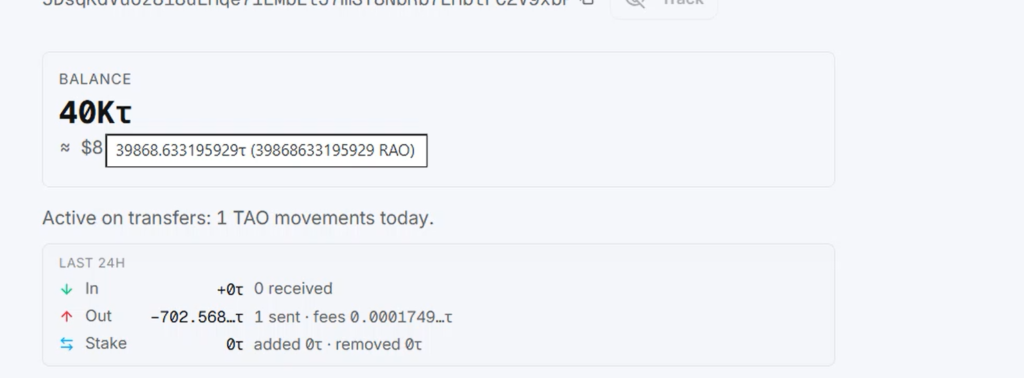
1 $TAO equals 1 Billion $RAO, and every balance on the network is stored as a whole number of $RAO before anything is displayed on top. That precision runs through $TAO and every subnet ‘$ALPHA’ token on every subnet, giving Bittensor a consistent accounting base no matter which currency is being tracked.
What $RAO Is
$RAO is the atomic unit of the Bittensor economy. Every wallet, every transaction, and every on-chain balance resolves to a whole number of $RAO under the hood, even when the interface shows $TAO to two decimal places.
1. 1 TAO = 1,000,000,000 RAO (10⁹): The conversion is fixed and hardcoded into the protocol.
2. Every $ALPHA uses the same base: Each subnet token follows the same 10⁹ divisibility, so the precision layer is identical across the whole network.
3. No rounding, no floating-point drift: Because balances are integers of the smallest unit, calculations never lose precision to decimals or currency rounding.
4. The 21 million supply cap holds at both levels: The cap translates to a fixed number of $RAO across the entire economy.
$RAO vs $SATOSHI
The concept mirrors Bitcoin’s $SATOSHI, but the two units differ in a way that matters as subnet economies scale.
| Bitcoin | Bittensor | |
| Base unit | $SATOSHI | $RAO |
| Conversion | 1 $BTC = 100,000,000 $SATOSHI | 1 $TAO = 1,000,000,000 $RAO |
| Divisibility | 10⁸ | 10⁹ |
| Supply cap | 21 million $BTC | 21 million $TAO |
| Beyond the base token | Single-token network | 128+ subnet alpha tokens, each with identical 10⁹ divisibility |
Bittensor’s base is ten times more granular than Bitcoin’s. That extra digit exists because the network has to account for $TAO plus a growing set of $ALPHA, each trading against $TAO in its own pool.
The 21 million supply cap is identical between the two networks, but $RAO gives Bittensor more precision headroom to work with as subnet economies compound.
Where $RAO Shows Up in Practice
Most participants never touch $RAO directly, but two floors pull it into practical view.
1. Existential deposit (~500 $RAO): If a wallet drops below this floor, the account is deactivated and the remaining dust is destroyed.
2. Minimum stake of 2,000,000 $RAO (0.002 $TAO): Staking operations below this threshold are rejected, and un-stakes have to leave either zero or above the same floor.
Anyone reading balances directly from the chain state sees $RAO, while anyone using a wallet interface sees $TAO with the conversion happening automatically underneath.
Small Numbers, Clean Books
The design principle is that every position, every stake, every fee, and every emission resolves to a whole number of the smallest possible unit. That is how Bittensor keeps all of its 128 subnets tokens accounting cleanly against $TAO without rounding errors creeping in over time.
$RAO is not something most users need to think about, but it is what makes every number the network produces trustworthy at the base layer. Small numbers, clean books.
Enjoyed this article? Join our newsletter
Get the latest TAO & Bittensor news straight to your inbox.
We respect your privacy. Unsubscribe anytime.
Enjoyed this article?
Join our newsletter
Get the latest TAO & Bittensor news straight to your inbox — every morning before markets open.



No comments yet — be the first.