


AI video generation is advancing quickly, but access to capable models still comes with trade-offs. High-quality generation can be expensive, many leading services operate through proprietary APIs, and open models can be difficult to serve efficiently at scale.
Attelier (SN126) is building a complete video generation stack to address these challenges. It brings model optimization, decentralized GPU infrastructure and user-facing applications together, with the goal of making open video generation more affordable and practical for creators and developers.
What Is Attelier?
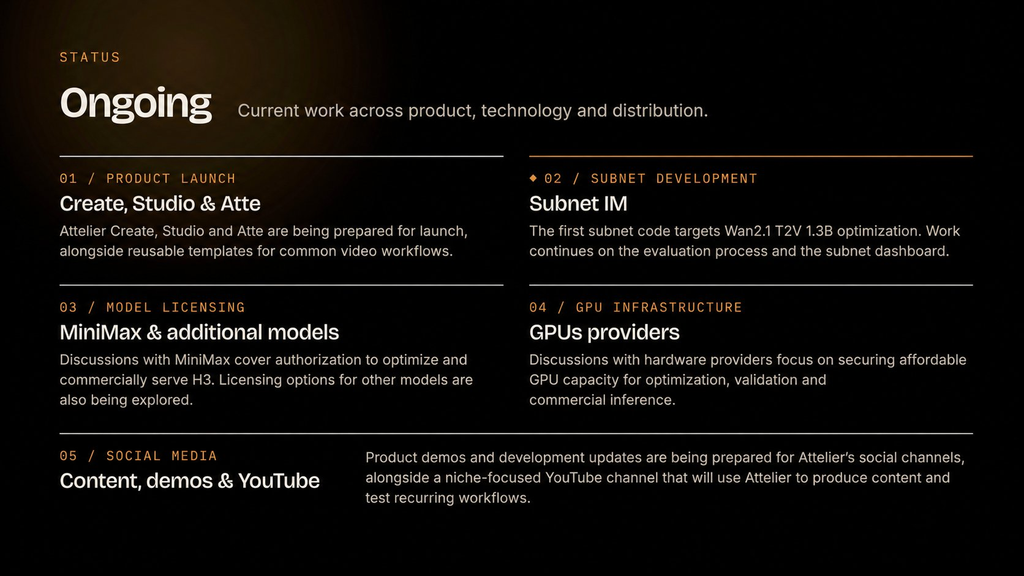
Attelier is a Bittensor subnet focused on decentralized video gen. It operates across three connected layers:
1) Model optimization: Improves open video models through techniques such as quantization, distillation, caching, and custom kernels, with the aim of reducing generation costs while preserving quality.
2) Decentralized inference: Routes generation requests to independent GPU providers and rewards them for successfully delivered video.
3) Applications: Turns that computing capacity into usable products, including its live Create interface and planned Studio, Atte editor, Templates and Pipelines.
The idea is to improve models, serve them efficiently, and make that capacity accessible through one platform. Its Lab page provides more information about this work.
How Attelier Generates and Delivers Videos
Attelier uses a controlled request and verification process to make sure providers are rewarded for completed work, not simply for registering GPUs or claiming to have available capacity.
A video generation request moves through the following stages:
1) Request submission: A user submits a generation request through Attelier’s application or API. The Gateway receives the request, checks it and determines its pricing.
2) Provider selection: The Gateway selects an admitted GPU provider capable of handling the job. Providers run supported video models on their own hardware, but they must first pass admission trials that test cold starts, normal running performance and advertised concurrency.
3) Generation and delivery: The selected provider generates the video and returns the output. The Gateway holds the result and determines whether the job has been completed successfully.
4) Verification and recordkeeping: Completed work is checked and recorded. The system creates signed records of eligible deliveries, giving the network an auditable history of the work performed.
5) Provider rewards: Rewards are calculated over fixed windows and distributed according to eligible completed video seconds, subject to service requirements such as generation time and minimum success rates.
This setup ensures providers cannot earn rewards simply by connecting idle hardware; their GPUs must deliver usable results that meet strict network standards.
To keep provider performance comparable, Attelier standardizes outputs using fixed generation profiles such as duration, resolution, and step count while routing retries through the original job record so requests are never double-counted.
In its early phase, the network relies on a permissioned group of providers alongside bounded synthetic demand to stress-test infrastructure as real activity grows.
Live customer requests always take priority, and private prompts remain protected and are not exposed in signed delivery records.
Looking ahead, Attelier plans to introduce deeper execution verification via trace checks before opening the network to permissionless provider admission.
What Can You Do With Attelier?
Attelier is developing its product layer alongside the infrastructure, so users do not have to interact with the network only through technical tools.
Its current and planned offerings include:
1) Create: The live generation hub where creators can browse supported models, adjust their custom settings, and see exact upfront pricing before rendering a clip.
2) Studio and Atte: The planned editing environment, intended to let users work with generated videos and refine their content.
3) Templates: A planned set of reusable formats and workflows to make video creation easier.
4) Pipelines: An upcoming feature aimed at automating repeatable content workflows and series.
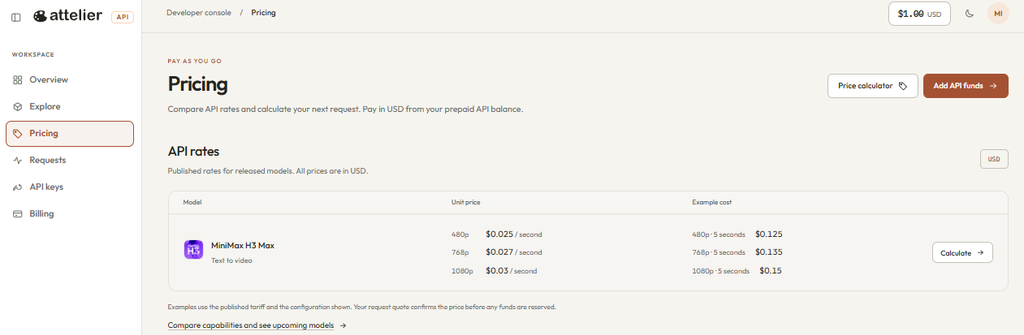
Attelier’s model selection includes options such as MiniMax H3, Seedance, Kling, Wan, FLUX, LTX, and PixVerse, with availability depending on the live API and Create interface.
The project also publishes model cost and quality comparisons to help users assess different options.
How to Participate in the Network
There are several ways to engage with the subnet:
1) Creators: Visit Attelier Create, select a supported model and configure a generation. Check the displayed price before running a job, as promotional free generations may also be available.
2) Developers: Use the API console to explore programmatic access and build applications around Attelier’s video generation capabilities.
3) GPU providers: Apply through the provider dashboard. Accepted providers run supported models and can earn rewards based on eligible video that is successfully delivered to the network.
4) Miners and validators: Follow the subnet’s participation and reward mechanisms as Attelier develops its provider admission and verification systems.
5) Researchers and ecosystem participants: Read the inference whitepaper and track subnet activity through Taostats and Bittensor.ai.
Attelier’s Roadmap
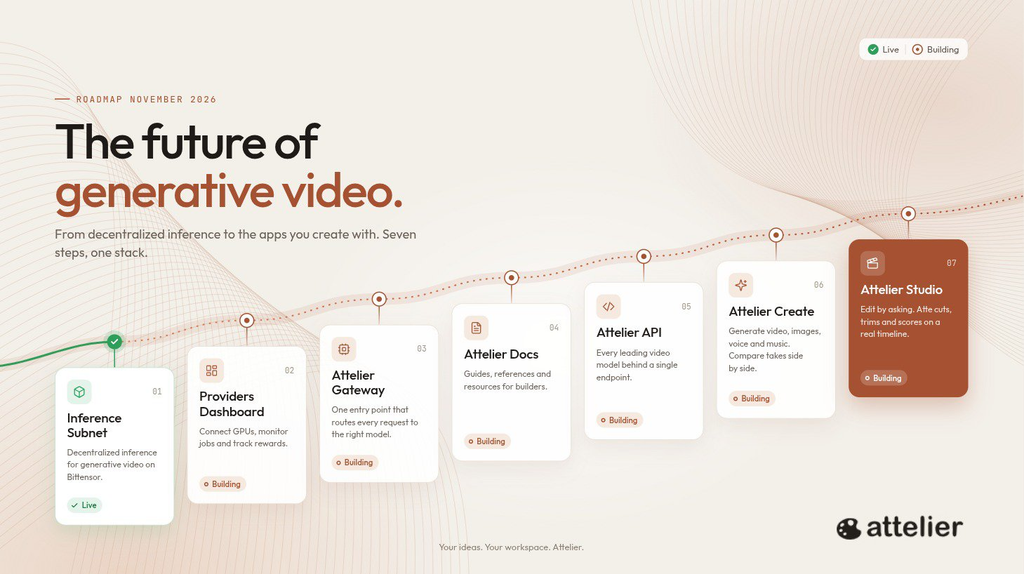
Its roadmap moves through four stages:
1) Permissioned Gateway and approved providers.
2) Public API access.
3) Verified execution through trace replay.
4) An open provider market.
The current focus is on developing the inference network and expanding access through Create and the API, while building towards a more open system.
Note that because the subnet is still developing, its provider requirements, model availability, and participation rules may change as these stages progress.
What Attelier Could Bring to Bittensor
Attelier is not the first Bittensor subnet to tackle video or AI generation infrastructure, as several projects already explore different corners of the space.
While Vidaio (SN85) enhances existing footage through AI upscaling and compression, Attelier generates new videos from scratch and builds the creator applications around them.
Similarly, Affine (SN120) centers primarily on reasoning, training, and efficiency competitions, whereas Attelier focuses on serving optimized models via independent GPU providers to power a complete consumer product.
Beyond general infrastructure, KubeTEE AI (SN90) prioritizes hardware-backed security and confidential compute, and Chutes (SN64) offers broad, serverless GPU inference. By contrast, Attelier is purpose-built for the heavy demands of generative video, measurable delivery, and end-user creative tools.
Together, these projects show that Bittensor already covers various pieces of video production and model serving, yet Attelier stands apart by connecting them into a single vertical stack.
It optimizes open video models, coordinates independent providers to run them, verifies the speed and quality of the output, and builds applications directly on top of that infrastructure.
Crucially, its reward mechanism ties provider earnings to eligible video delivered rather than just raw hardware connected.
The challenge ahead is pure execution. Attelier must scale reliable provider capacity, keep generation costs competitive, attract active users, and ship its planned applications.
If these pieces click together, Bittensor gains a specialized video network built for both creators and developers, ultimately making open video generation practical at scale by uniting better models, distributed compute, and intuitive tools in one ecosystem.
≫ Read our earlier coverage on Affine (SN120)’s work on video generation:
Enjoyed this article? Join our newsletter
Get the latest TAO & Bittensor news straight to your inbox.
We respect your privacy. Unsubscribe anytime.
Enjoyed this article?
Join our newsletter
Get the latest TAO & Bittensor news straight to your inbox — every morning before markets open.


No comments yet — be the first.