

Bittensor uses digital signatures to verify that an account has authorized a transaction. A wallet signs with a private key, and the network checks that signature against the corresponding public key.
The existing classical signature schemes Bittensor uses, Sr25519 and Ed25519, rely on elliptic curve mathematics to make recovering the private key from the public one computationally impractical.
A sufficiently powerful quantum computer running Shor’s algorithm could solve the mathematical problem that protects those keys.
An attacker with the public key could recover the private signing key and use it to authorize transactions. The recovery phrase could stay offline throughout the attack because it targets the mathematics behind the key rather than the device storing it.
The consequences depend on which key is compromised. A compromised coldkey could let an attacker transfer TAO or change staking positions.
A compromised validator hotkey could let someone submit unauthorized weights that affect how a subnet allocates rewards to miners. A subnet could therefore face disruption even if the attacker never gains access to the validator’s staked funds.
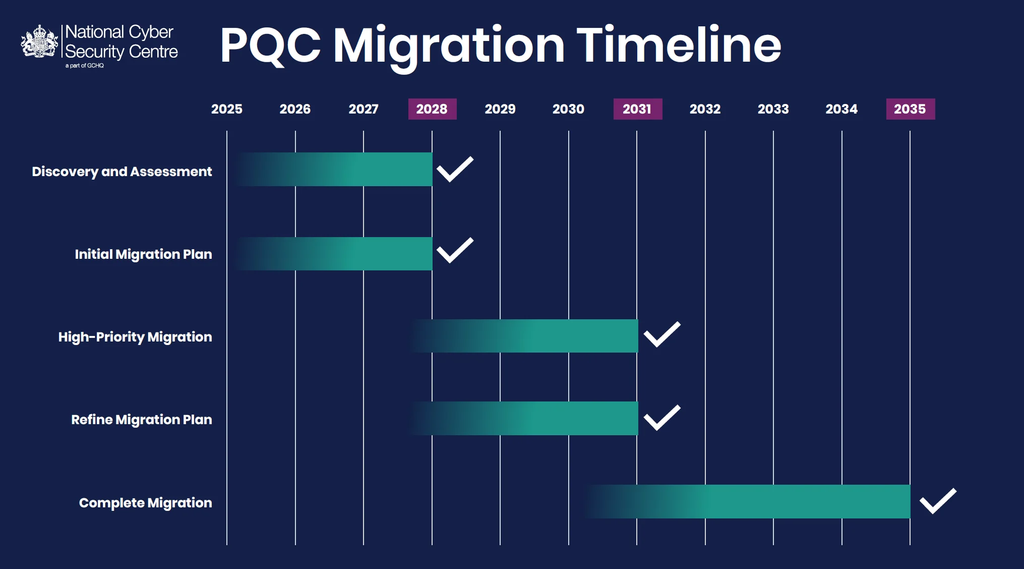
Today’s quantum computers lack the capacity to carry out that attack, and the timeline remains uncertain. The UK’s National Cyber Security Centre (NCSC) recommends planning for migration by 2028, upgrading priority systems by 2031, and completing the transition by 2035.
The schedule gives organizations several years to identify where they use vulnerable cryptography and replace it across their systems.
Runtime 488 brought three post-quantum signature schemes to Bittensor’s Finney mainnet. ML-DSA-65, Falcon-512, and Falcon-1024 rely on lattice problems believed to resist quantum attacks.
The signatures take up more space in each signed transaction. For example, ML-DSA-65 uses 3,309 bytes per signature, compared with 64 bytes for Sr25519. Bittensor supports the new schemes for both coldkeys and hotkeys.
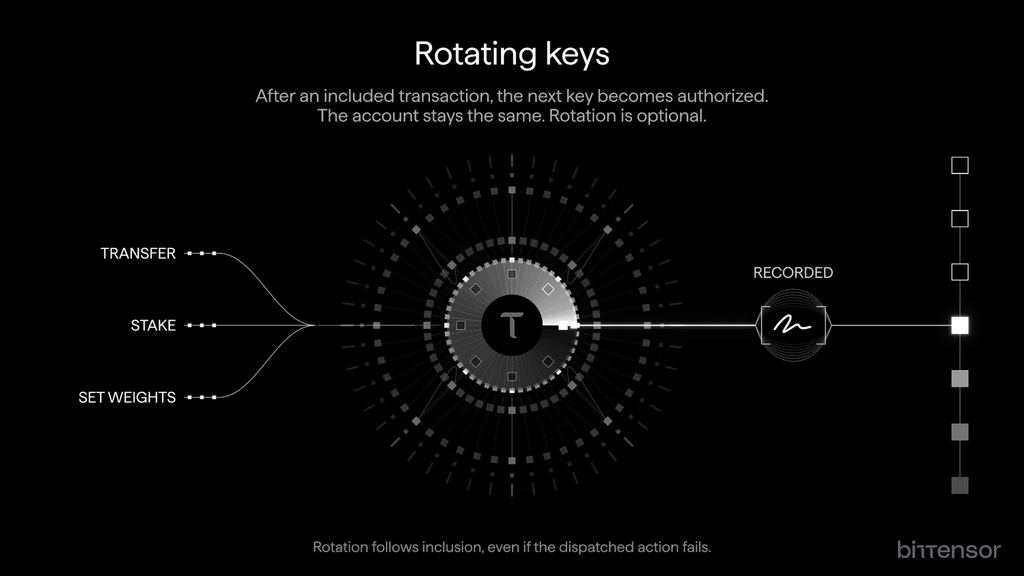
The upgrade also introduced optional key rotation. A rotating account retires its signing key after a transaction is recorded while keeping the same address. A fixed account continues to use the same signing key.
Both modes can use post-quantum signatures, and TAOApp Wallet v0.6.0 is one of the early clients to support all three schemes in both modes.
Existing wallets remain valid, so holders can choose when to create a compatible account and move their TAO.
Miners and validators need to consider how to update their signing keys around live subnet operations. Adding the new account types early gives participants time to test their wallet software and manage that transition while their current accounts still work.
➛ Catch Up on Bittensor’s Quantum-Resistant Wallets Here:
Enjoyed this article? Join our newsletter
Get the latest TAO & Bittensor news straight to your inbox.
We respect your privacy. Unsubscribe anytime.
Enjoyed this article?
Join our newsletter
Get the latest TAO & Bittensor news straight to your inbox — every morning before markets open.

No comments yet — be the first.