


You have an old family video that looks terrible on a modern screen, a beautiful clip that takes forever to upload, or an AI-generated video that would look much better in 4K.
Video is the internet now. According to Ericsson, video made up around 75% of all mobile data traffic at the end of 2025, and it remains the single biggest driver of modern digital growth.
Yet fixing video, making it sharper or making it smaller without wrecking it, has always been a job for specialists with expensive software and even more expensive graphics cards.
Vidaio (SN85), an AI video processing platform built on Bittensor, wants to remove those barriers. Users can now improve, restore, and compress videos directly from a browser, or even ask ChatGPT and Claude to handle the processing.
The headline product is Vidaio Studio, which begins by examining your video and identifying what needs improvement.
Instead of figuring out yourself which editing tool or technical setting to use, you can follow its recommendations or let the AI apply fixes automatically.
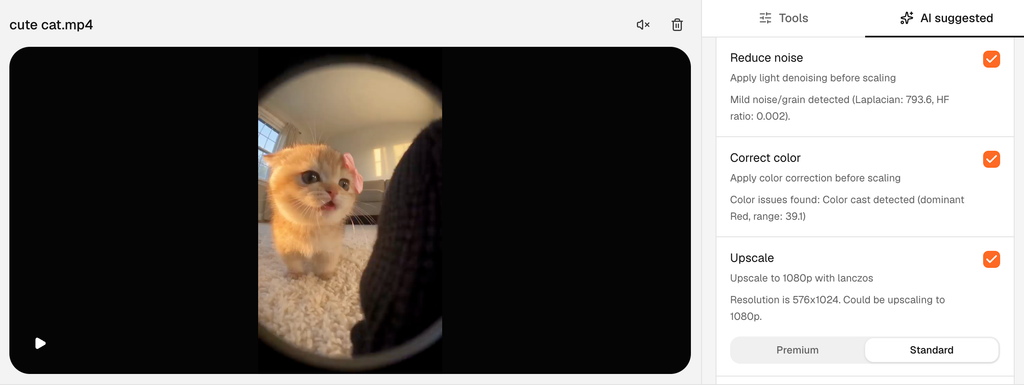
The Studio supports upscaling low-resolution footage, compressing oversized files, restoring damaged visuals, and comparing the results before downloading or sharing.
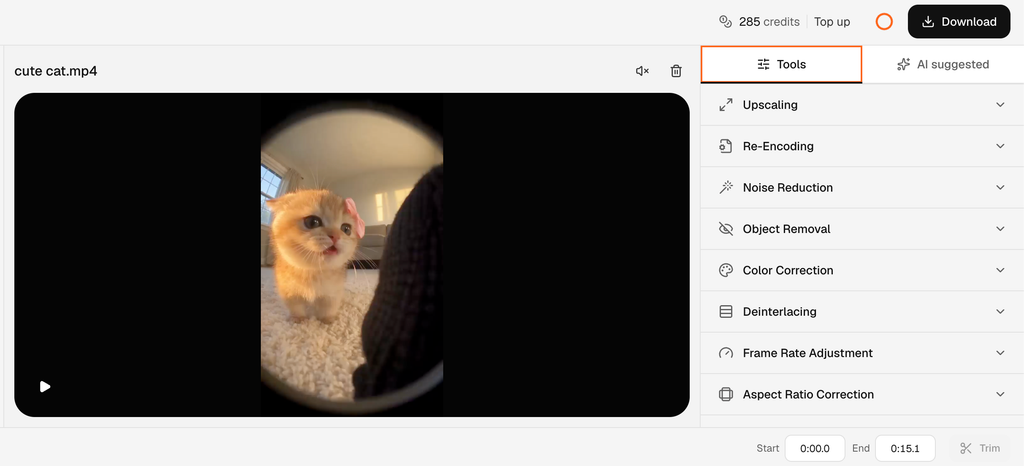
The product also introduces Pro upscaling and object removal, while Vidaio’s broader toolset includes colorization and language localization. Users can work with selected portions of a clip instead of processing everything.
These capabilities have practical value beyond professional filmmaking. Someone can improve an old wedding recording, sharpen a blurry phone video, or reduce a large file before sharing it with friends.
Content creators can enhance footage for YouTube, TikTok, and Instagram without investing in expensive hardware.
For people generating videos with tools such as Kling or Seedance, Vidaio also opens up another possibility: generate footage at a lower resolution and upscale it afterward, potentially reducing the overall cost of producing high-resolution videos.
The experience extends beyond the Studio. Through its Model Context Protocol (MCP) integration, Vidaio can connect to ChatGPT, Claude, Cursor, and VS Code.
Once configured, users can provide an accessible video link and make requests such as “Upscale this video to a higher resolution” or “Compress this clip while keeping the quality as close to the original as possible.”
Vidaio then processes the request and returns the result. Developers can also use its public API to integrate upscaling and compression directly into applications, websites, or automated production workflows.
Pricing makes the offering especially interesting. Under Vidaio’s rates, compressing a three-minute video with its Standard service costs approximately $0.25 at the entry credit-bundle price. Upscaling the same duration at Standard 2× costs about $0.75, while Standard 4× costs approximately $1.88, subject to input limits.
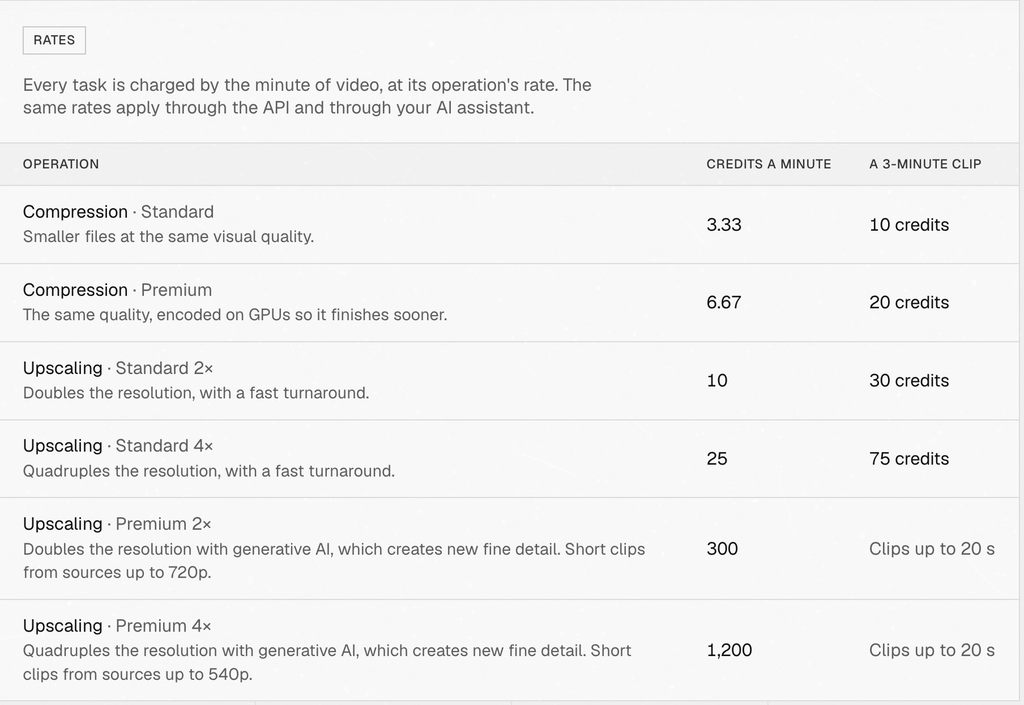
Every new user receives 10 starter credits after verifying their email, can see pricing before processing, and pay nothing for failed or cancelled jobs.
Premium generative upscaling costs considerably more and currently supports much shorter clips, but users who only need an occasional enhancement can avoid committing to a monthly subscription.
That puts Vidaio in competition with established products such as Topaz Video, HitPaw VikPea, and CapCut. Topaz offers a sophisticated collection of enhancement models, extensive controls, unlimited local processing under its subscriptions, and cloud options.
HitPaw provides an accessible desktop experience with restoration, stabilization, colorization, and upscaling to 8K.
CapCut remains convenient for quick edits and social content. Vidaio’s appeal lies in bringing video diagnostics, enhancement, compression, usage-based pricing, and developer integrations together in one accessible service, without requiring local GPU processing.
Vidaio has also published benchmark results comparing its base upscaling model against these established tools.
In a May 2025 test using the ClipIQA+ perceptual quality metric, Vidaio scored 0.4697, slightly ahead of Topaz at 0.4658 and HitPaw at 0.3637.
That result is worth paying attention to. A Bittensor subnet outperforming two established video enhancement products on the tested quality metric challenges the assumption that industry-leading results must come from expensive, proprietary software.
This engine behind Vidaio also deserves attention. Instead of relying on a single fixed AI model, Subnet 85 creates competition among independent miners developing and running video processing models.
Validators evaluate results using quality measurements and reward stronger performance. Better models can replace existing ones as the competition progresses.
For users, the incentive system is designed to keep improving video quality and processing efficiency, while the same infrastructure can serve creators, developers, media archives, and organizations managing large volumes of footage.
High-quality video processing is moving out of specialist software and onto the open web, where anyone can use it on demand, pay only for what they need, or simply ask their AI assistant to handle it.
Vidaio has positioned right at the front of that shift, and it is one of the clearest examples yet of a Bittensor subnet building something ordinary people will use.
≫ You can try it with free starter credits at vidaio.io. Read our earlier coverage of Vidaio below:
Enjoyed this article? Join our newsletter
Get the latest TAO & Bittensor news straight to your inbox.
We respect your privacy. Unsubscribe anytime.
Enjoyed this article?
Join our newsletter
Get the latest TAO & Bittensor news straight to your inbox — every morning before markets open.

No comments yet — be the first.