

Artificial intelligence is becoming cheaper and easier to access. For investors, that raises a question. If powerful models become widely available, where will the lasting value sit?
Stillcore Capital believes it could exist in the marketplace coordinating their production. Its latest thesis paper positions Bittensor as an open economy where independent teams supply computing power, train models, and sell AI services, with TAO connecting those markets.
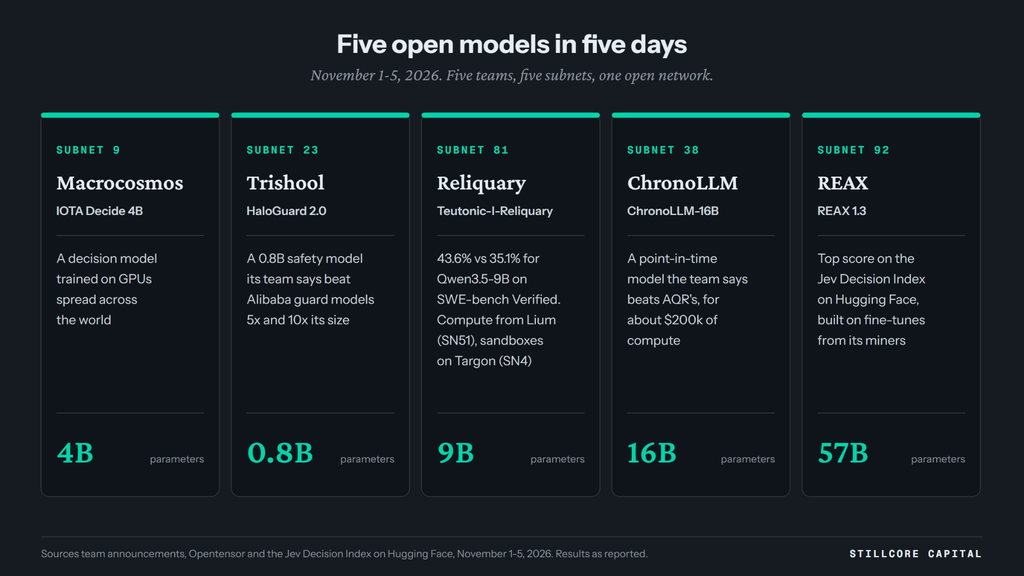
Stillcore points to five open models released by Bittensor teams in the first five days of November. Four published results placed them among the strongest for their size, while REAX (SN91)’s 57-billion-parameter decision model topped the Jev Decision Index. The company sees this as evidence of a functioning production system whose economic potential remains underpriced.
The Opportunity Beyond Individual Models
The thesis draws on The Commanding Heights, an essay by Will Manidis and Joe Roberts exploring who benefits when intelligence becomes abundant. Its premise is that model developers may not capture the largest share of the rewards.
Competition and open releases can quickly erode a model’s advantage, forcing developers to keep spending while customers pay less. Stillcore argues that the marketplace connecting suppliers and buyers could become more valuable as the products within it become cheaper.
That is the foundation of its TAO thesis. The opportunity spans an economy of competing AI businesses, each able to build on services supplied by others.
How Independent Subnets Build Together
Bittensor divides specialized work into markets called subnets. Miners produce outputs, validators assess quality, and incentive systems distribute rewards. Together, these markets cover services from computing power and storage to model training and inference.
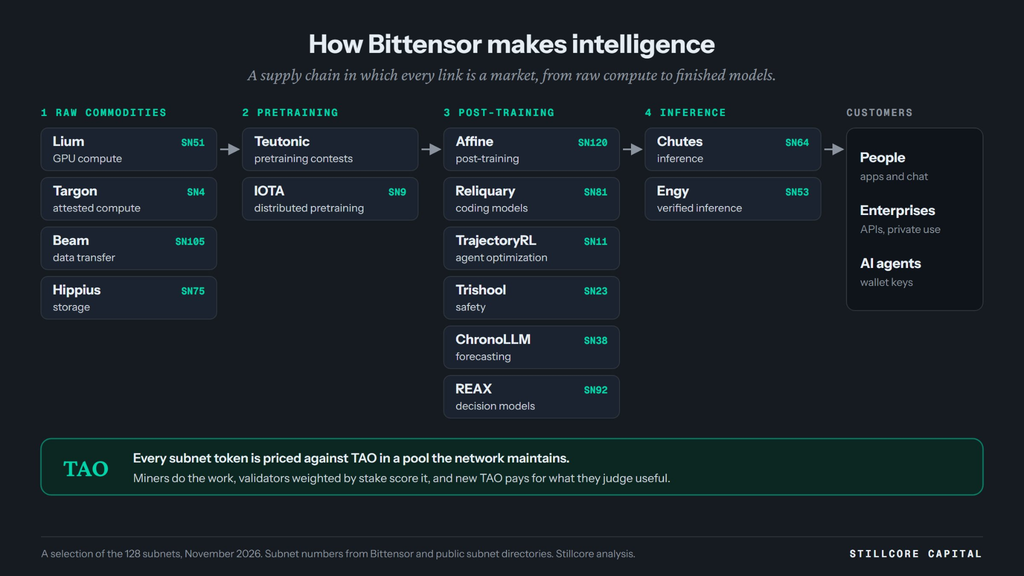
Reliquary’s 9B coding model illustrates how they connect. Its development combined Teutonic (SN3)’s base model, GPUs rented through Lium (SN51), Targon (SN4)’s sandboxes, and post-training by Reliquary (SN81) miners. It scored 43.6% on SWE-bench Verified, compared with 35.1% for Qwen3.5-9B.
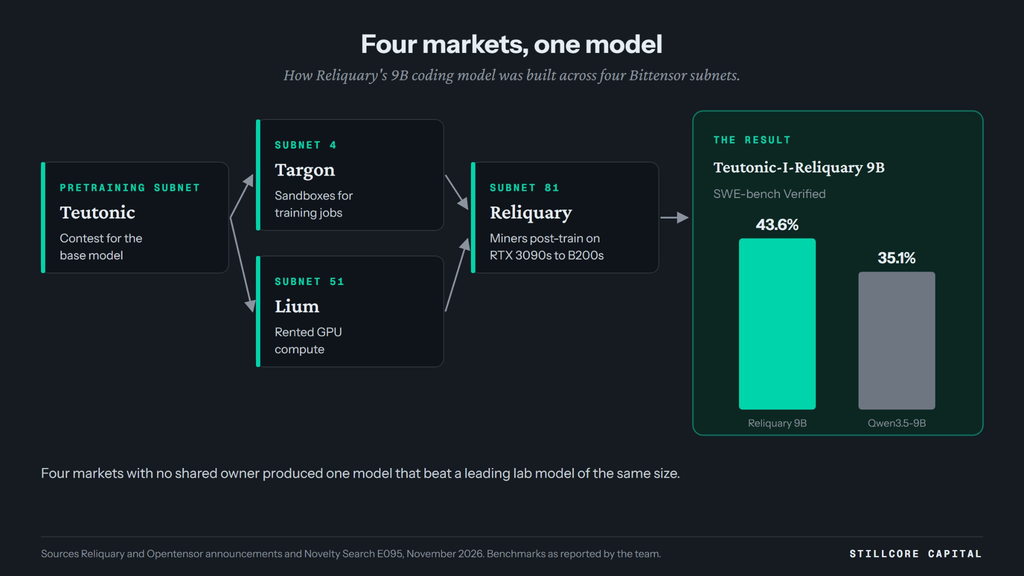
Several independent services helped produce one competitive model. Stillcore believes these production relationships could become a lasting advantage, giving new teams an expanding set of capabilities to build with.
Revenue Gives the Thesis Something to Measure
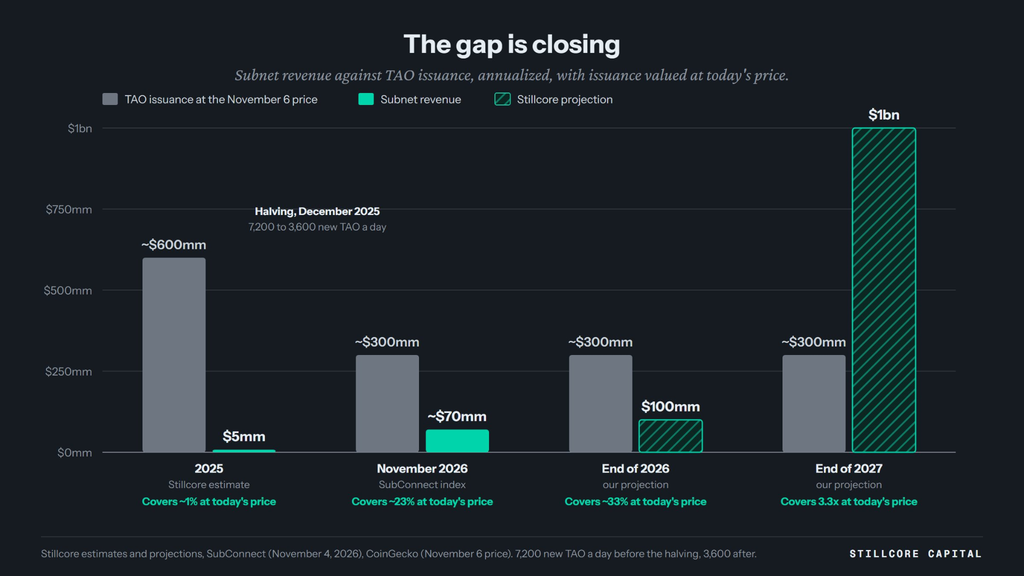
Customer spending adds a commercial foundation to those technical results. Citing SubConnect estimates, Stillcore puts annualized subnet revenue at approximately $70 million by early November, up from $28 million to $35 million in late summer. Lium (SN51) alone reported $2.32 million in October GPU rental billings.
The firm believes a meaningful share comes from customers paying in dollars without handling alpha tokens, extending Bittensor’s reach beyond crypto users. Revenue nevertheless remains below the roughly $300 million in annualized token issuance estimated in the thesis.
Stillcore forecasts annualized revenue reaching $100 million by the end of 2026 and $1 billion by the end of 2027. Meeting those projections will require technical progress to translate into repeat customer spending.
Where TAO Fits
Subnet tokens trade against TAO through Bittensor’s native liquidity pools, placing it at the center of the network’s markets. Stillcore believes that position could become more valuable as customers, developers, and capital enter the ecosystem.
At the roughly $2.5 billion market capitalization currently, the firm argues that TAO’s price does not fully reflect this opportunity. The key question is how growing service usage translates into demand for the asset.
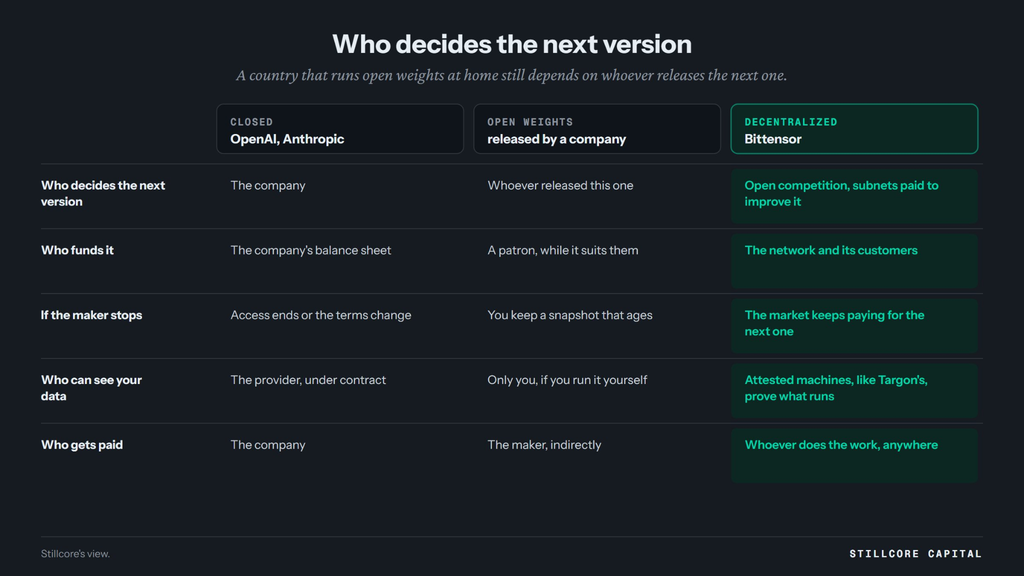
The proposed Gamma mechanism could strengthen that connection by allowing subnet tokens to be burned for dollar-denominated service credits. As described in the thesis, this would let customers, including AI agents, access services without conventional accounts.
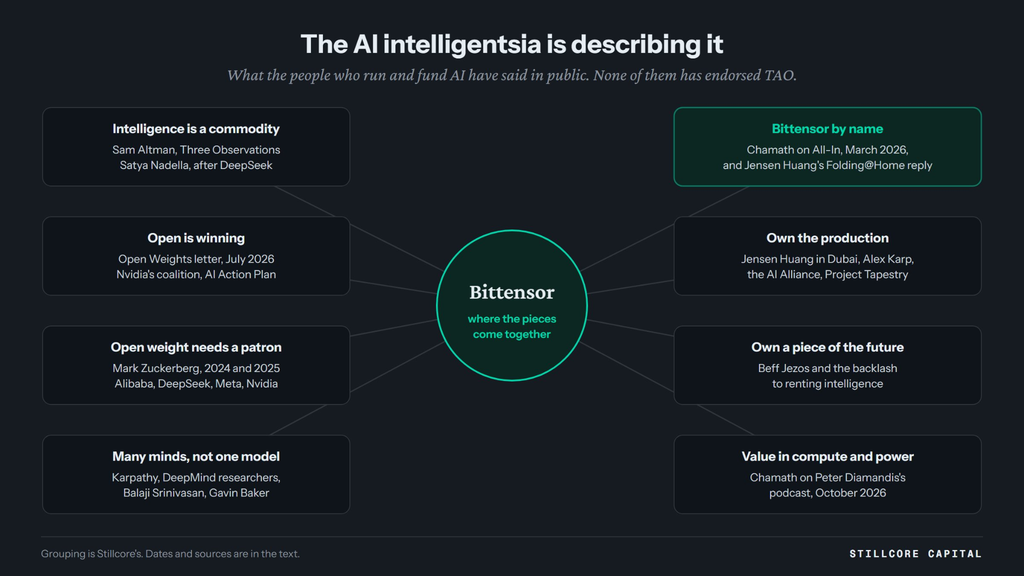
Stillcore’s argument rests on a shift in where AI creates value. As individual models become easier to reproduce, the marketplace coordinating their production could occupy a stronger position. Bittensor’s models, revenue, and shared production pipelines give investors something concrete to assess.
Enjoyed this article? Join our newsletter
Get the latest TAO & Bittensor news straight to your inbox.
We respect your privacy. Unsubscribe anytime.
Enjoyed this article?
Join our newsletter
Get the latest TAO & Bittensor news straight to your inbox — every morning before markets open.



No comments yet — be the first.