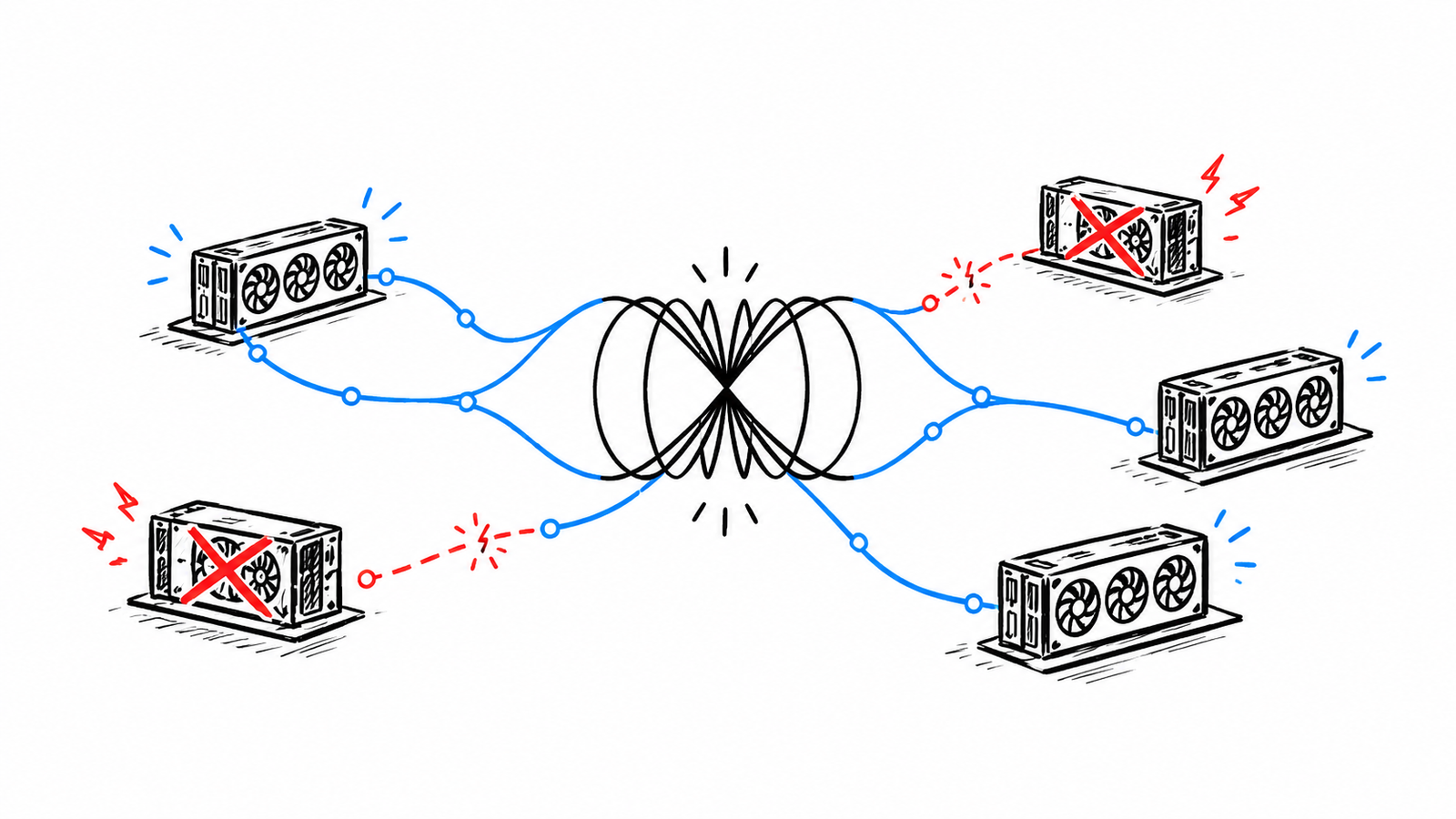
What happens when a GPU crashes halfway through training an AI model? And can developers trust the results when hundreds of machines are working together across different locations?
These are among the concerns raised about the reliability of decentralized AI training. Macrocosmos has now shared experimental results showing how its IOTA SDK addresses these challenges.
In seven independent training runs of a 16-billion-parameter model, approximately 140 GPUs participated in each experiment.
Across the runs, workers experienced 585 crashes, preemptions, and rejoins. Yet all seven experiments produced nearly identical training loss curves, showing that the model’s learning progress remained consistent despite repeated interruptions.
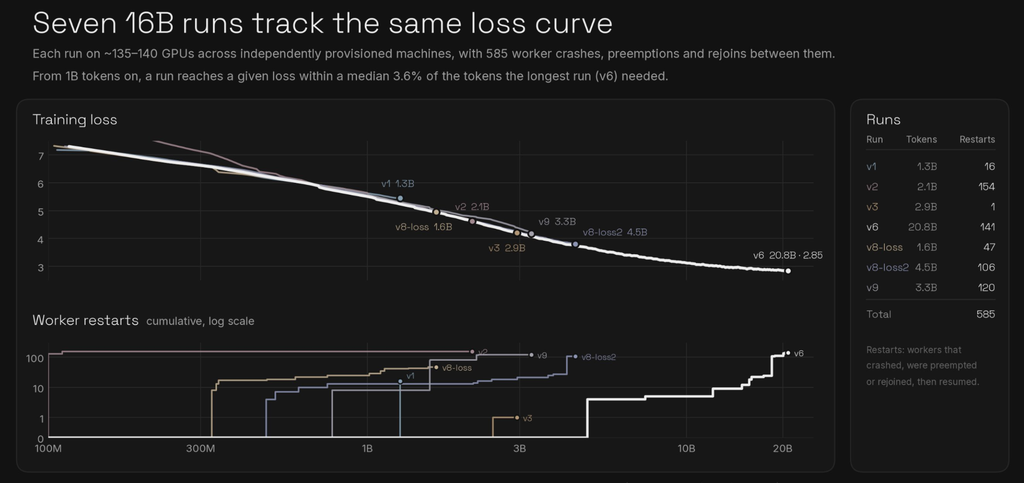
This consistency is particularly important for researchers and companies paying to train AI models.
If the same experiment produces significantly different results because machines disconnect, it becomes harder to verify findings or justify training expenses.
IOTA’s results demonstrate reproducibility in training behaviour, although they do not establish that the resulting model weights were identical.
IOTA (SN9), developed by Macrocosmos, is designed to coordinate AI training across independently operated GPUs. It uses data parallelism and pipeline parallelism to divide training work among machines, allowing them to process different portions of a model without each GPU needing enough memory to hold the entire model.
The subnet also accounts for unreliable hardware. When a participating GPU becomes unavailable or abruptly disconnects, IOTA’s orchestration system manages the disruption and coordinates recovery so training can continue.
This capability was central to the seven experiments, which tested whether repeated worker failures would significantly affect training outcomes.
Macrocosmos introduced the IOTA SDK at the Exploit Summit in Montreal to make this infrastructure accessible to developers. Through an interface designed around familiar PyTorch workflows, teams can specify their model, dataset, and training objectives while the underlying network manages distribution, execution, monitoring, and recovery.
The SDK also complements IOTA’s Train at Home initiative, which allows individuals with compatible consumer GPUs to contribute computing power to larger training workloads.
The system combines resources from multiple contributors without requiring every participant to own expensive enterprise hardware. The SDK gives developers a way to use that distributed capacity.
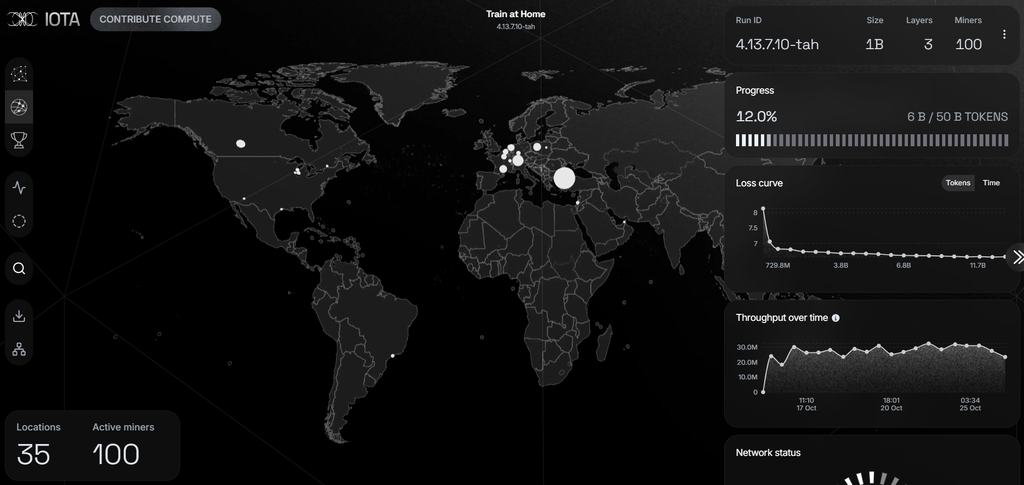
For AI companies, the potential advantage is access to large-scale training infrastructure without having to assemble and operate an entire GPU cluster.
However, the seven experiments primarily demonstrate training consistency under worker disruptions. They do not independently establish lower costs or superior performance compared with conventional training infrastructure.
The significance of Macrocosmos’ demonstration is that it addresses a practical requirement for decentralized AI training to become useful beyond individual experiments.
Training a large model once is an achievement, but consistently reproducing the results despite worker failures is more significant. It provides stronger evidence that IOTA can support serious AI research.
➛ Register Your Interest in the IOTA SDK Here.
Enjoyed this article? Join our newsletter
Get the latest TAO & Bittensor news straight to your inbox.
We respect your privacy. Unsubscribe anytime.
Enjoyed this article?
Join our newsletter
Get the latest TAO & Bittensor news straight to your inbox — every morning before markets open.
No comments yet — be the first.