

Most conversations about crypto and AI still revolve around tokens, models, and theoretical possibilities. During the inaugural Khala Research media chat, Michaela Bazo and Pedro Penna of Metanova Labs discussed what they’re building.
Their Bittensor subnet, NOVA (SN68), is moving beyond predicting potential drug candidates to producing and testing them in real laboratories.
Metanova began approximately 18 months ago as an experimental decentralized drug screening platform. Today, it runs three continuous competitions focused on small molecules, chemical search algorithms, and nanobodies.
These operate like ongoing research hackathons, allowing miners to compete on pharmaceutical problems while helping the team develop valuable discoveries and tools for the wider industry.
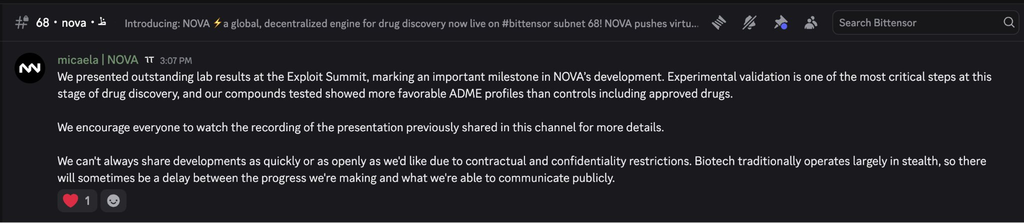
At the Exploit Summit in Montreal, Metanova presented its first experimental results. Molecules developed with significant input from miner submissions were synthesized and compared with recently FDA (U.S. Food and Drug Administration)-approved compounds.
According to the team, most demonstrated better properties, including longer half-lives and greater stability. While these findings do not establish clinical effectiveness, they mark an important step from virtual predictions to physical experiments.
Bridging the gap between computer simulations and laboratory results is difficult, but Metanova sees that challenge as a competitive advantage.
The team believes verifiable scientific results offer a compelling way to demonstrate Bittensor’s value beyond purely digital applications. Compounds discussed as theoretical miner submissions approximately eight months earlier have now reached laboratory validation.
Metanova is also building a portfolio of pharmaceutical intellectual property. Its strategy involves discovering promising compounds and developing patentable assets that could eventually be licensed to larger pharmaceutical companies.
This follows a familiar biotechnology model, where smaller research teams develop early assets before partnering with organizations equipped for advanced trials and commercialization.
The project is advancing at a time when pharmaceutical companies are investing heavily in AI research. Major AI laboratories are also expanding into biotechnology through investments, acquisitions, and partnerships.
Metanova’s team believes the combination of commercial opportunities, complex scientific challenges, and increasingly accessible open-source models is accelerating innovation across the industry.
The miners reflect this intersection of technology and pharmaceutical science. Some have backgrounds in drug discovery, while others bring expertise in data science and engineering.
Metanova designs its competitions to accommodate these different skills, supported by modern AI tools. The project itself operates with a core team of approximately four people, complemented by its decentralized miner workforce.
The conversation also explored healthcare data security, China’s growing pharmaceutical research capabilities, and challenges such as finding suitable patients for clinical trials.
Looking ahead, Metanova plans to expand its competitions and introduce laboratory validation directly into the mining process. Its commercial ambitions remain tied to the longer development timelines typical of pharmaceutical research.
In an industry where meaningful breakthroughs often take years, Metanova is betting that open competition and experimental validation can accelerate discovery.
Its early results suggest that decentralized AI can contribute to real scientific research, although substantial testing remains ahead.
The coming years will reveal whether this approach can consistently produce valuable pharmaceutical assets and establish a sustainable business around them.
Enjoyed this article? Join our newsletter
Get the latest TAO & Bittensor news straight to your inbox.
We respect your privacy. Unsubscribe anytime.
Enjoyed this article?
Join our newsletter
Get the latest TAO & Bittensor news straight to your inbox — every morning before markets open.



No comments yet — be the first.