


When choosing an AI gateway, the biggest model catalogue is not always the best deal.
You might want access to the latest models, but you also need to consider what you pay, how your prompts are protected, and whether you can use each provider’s native features.
That is the comparison behind a new head-to-head between SayGM (Bittensor Subnet 28) and OpenRouter. SayGM presented a six-round comparison in which it scored four wins against OpenRouter’s two.
Six Rounds, Two Different Approaches
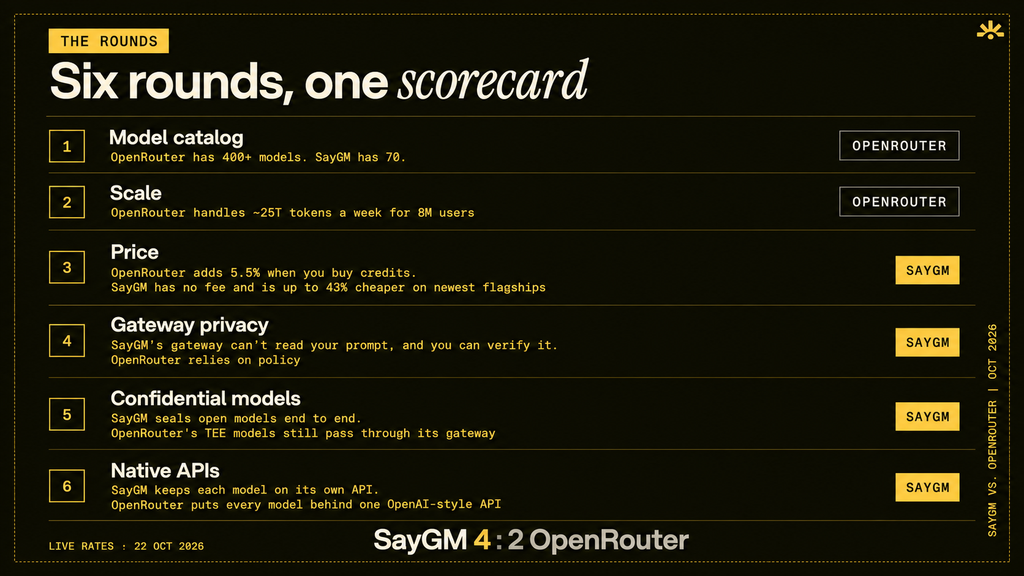
1) Model Selection (OpenRouter Has the Edge): OpenRouter has a much larger list (400–500+ models) compared to SayGM’s which serves ~70 models.
2) Scale (OpenRouter Already Serves a Large Market): OpenRouter has processed roughly 25 trillion tokens a week for about 8 million users while SayGM is still a much smaller, more focused gateway.
3) Pricing (SayGM Targets Lower Access Costs): SayGM shows lower effective cost (up to 43% savings on certain frontier models once fee is included, with no top-up fee of its own) while OpenRouter charges a 5,5% fee on credit top-ups (standard plan).
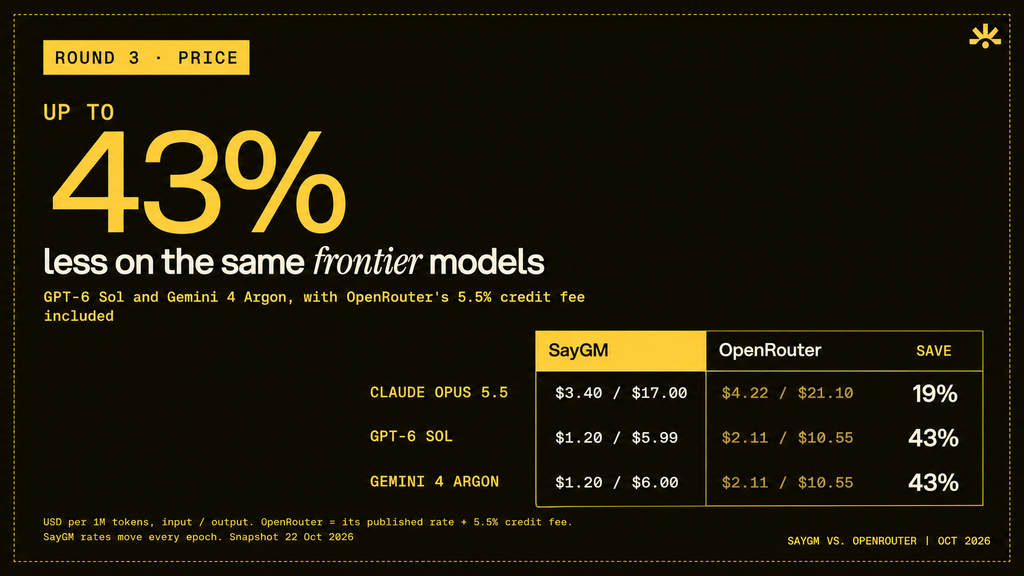
For more on how SayGM’s pricing works in practice, see earlier TAO Daily coverage: HERE and HERE.
4) Privacy (Hardware Attestation vs. Policy): SayGM’s routing layer runs in verifiable hardware (Intel TDX).
The attestation is independently verifiable, so the operator cannot read prompts, compared to OpenRouter, which relies on its self-published privacy policy. For a more detailed explanation, see SayGM’s article on hardware attestation versus privacy policies.
5) Confidential Models (Protecting More Than the Gateway): SayGM can seal open-weight models end-to-end while OpenRouter’s TEE options still route through its own gateway.
6) API Access (Native Features vs. One Unified Interface): SayGM keeps each model on its original provider API while OpenRouter only presents a single OpenAI-compatible surface for every model.
Which Gateway Should You Choose?
The comparison does not mean one service is best for every user. Each has a clear strength.
1) Choose OpenRouter if you want the widest model catalogue, broad provider selection, and a single OpenAI-compatible API.
2) Choose SayGM if you want to avoid credit top-up fees, explore hardware-verifiable gateway privacy, or retain access to native provider APIs.
3) Consider using both if your applications have different requirements. One gateway can serve workloads that need a broad catalogue, while the other can handle use cases where its pricing or privacy features are a better fit.
What This Comparison Means for Bittensor
SayGM’s comparison highlights how Bittensor competes by building infrastructure that improves the experience developers receive when using AI, not only the underlying technology.
For developers, the next step is to compare the models they use, calculate their expected costs, and assess the privacy requirements of their applications. That accelerates the decision of which offering to pick.
See more about how SayGM’s dashboard now supports multi-model chat, image generation, custom cascades and detailed spend tracking below:
Enjoyed this article? Join our newsletter
Get the latest TAO & Bittensor news straight to your inbox.
We respect your privacy. Unsubscribe anytime.
Enjoyed this article?
Join our newsletter
Get the latest TAO & Bittensor news straight to your inbox — every morning before markets open.



No comments yet — be the first.