


What does a former NASA data scientist have in common with a plant biotechnology researcher and an international mathematics competitor? All three are helping solve scientific problems on NOVA (SN68), a drug-discovery subnet.
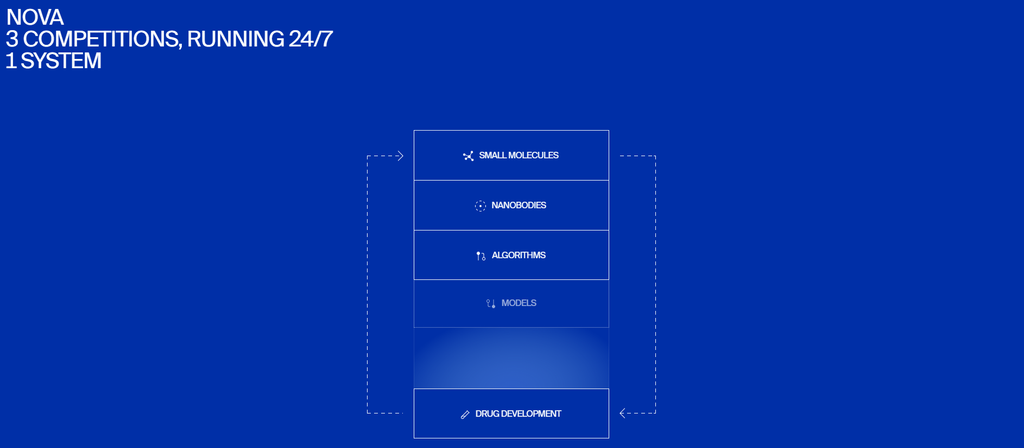
Through open competitions, NOVA attracts participants from different backgrounds to develop search algorithms, identify promising drug molecules, and design nanobodies, rewarding them based on performance, not on qualifications.
One of these participants is Fade, an aerospace engineer who previously worked as a data scientist at NASA. He discovered Bittensor while developing AI models for his own company and initially used mining rewards to offset development costs. After experimenting with dozens of subnets, he eventually settled on NOVA, where he has competed exclusively for over a year. Despite initially having fewer computing resources than some competitors, he spent months refining his algorithms until he could compete profitably.
Ironflower brings a different set of skills. He holds a PhD in ecological epigenetics and developed EpiGBS, an algorithm published in Nature Methods. He currently works in bioinformatics and software development for plant biotechnology companies. After discovering Bittensor in February 2026, he joined NOVA in August and began competing in its Blueprint and Nanobodies competitions. His approach combines biological expertise with algorithm optimization and large language models.
The third miner, Gentle, studied biochemistry and previously competed internationally in mathematics and programming. He discovered Bittensor in 2025 through The Innovation Game and now considers NOVA his primary mining focus. His work involves developing search algorithms and continuously adapting them as the subnet updates its scoring mechanisms and competition requirements.
What makes their participation interesting is that NOVA does not require miners to have conventional drug-discovery credentials. Instead, NOVA defines scientific problems and allows anyone to compete, whether their advantage comes from biology, mathematics, AI, or more efficient use of computing resources. The competitions also evolve, meaning successful miners must continually improve their methods rather than rely on a single winning approach.
Beyond competing for rewards, these miners have also contributed to NOVA’s development. Fade and Ironflower have helped identify bugs, report exploits, and suggest improvements to the competitions. Gentle similarly considers himself a contributor to the project. Their involvement demonstrates how independent competitors can gradually become valuable collaborators without formally joining the company.
For NOVA, this model provides access to a global pool of talent without the limitations of traditional hiring. Its team handles research objectives, infrastructure, incentives, and experimental validation, while miners contribute their own expertise and resources.
Ultimately, scientific breakthroughs may come from people a company would never have thought to recruit. On NOVA, they simply need to demonstrate that their solutions work.
➛ Read More on How NOVA (SN68) Turns Miner Submissions Into Testable Drugs:
Enjoyed this article? Join our newsletter
Get the latest TAO & Bittensor news straight to your inbox.
We respect your privacy. Unsubscribe anytime.
Enjoyed this article?
Join our newsletter
Get the latest TAO & Bittensor news straight to your inbox — every morning before markets open.



No comments yet — be the first.