

UMI (SN78) has changed quite a bit in the past few weeks.
What started as Vocence, a subnet focused primarily on voice, is now being positioned as Universal Motion Intelligence, with a much broader goal of helping machines understand human communication through hands, facial expressions, body movement, voice, timing, and context.
In a recent conversation with Gordon Frayne, UMI’s Koyuki Nakamori and Michael Parker explained why the team is starting with sign language, how Bittensor miners fit into the system, and how that work is already moving toward smart glasses, healthcare infrastructure and eventually robotics.
The easiest way to understand UMI is probably this: sign language is the first product, but understanding human motion is the actual technology.
Why Start With Sign Language?
Sign language looks like a fairly specific market until you look at what a machine has to understand.
Recognizing that someone raised a hand is relatively easy. Understanding what a sequence of finger positions, hand movements, facial expressions, body posture and timing means is much harder. Koyuki described UMI’s larger target as a “motion to meaning” pipeline, where machines move beyond detecting motion and start understanding the intent or information contained inside it.
That makes sign language a useful first challenge. If UMI can teach models to understand something this dependent on fine movement and context, much of the same intelligence can eventually be useful elsewhere.
UMI has officially made the same distinction. Its first application, SignVision™, is being developed for communication between Deaf and hearing people, but the roadmap extends into facial understanding, human intent, activity recognition and embodied AI.
There is also a ready customer pipeline for this product. Parker, who works in healthcare, pointed to the Video Remote Interpreting systems already used by hospitals when staff and patients cannot communicate directly. These usually connect the hospital to a human interpreter remotely, but he said availability can sometimes mean waiting from 30 minutes to several hours, while the service can cost around $150 an hour depending on the arrangement.
UMI does not plan to simply remove the human interpreter. The idea is to add an immediate AI layer into that existing workflow (to extend communication capacity), with the option to escalate to a human interpreter when needed.
UMI solves the problem: “Can someone walk into a hospital, clinic, bank or public office and communicate immediately without first waiting for another person to join the conversation?”
Bittensor Becomes the Model Improvement Engine
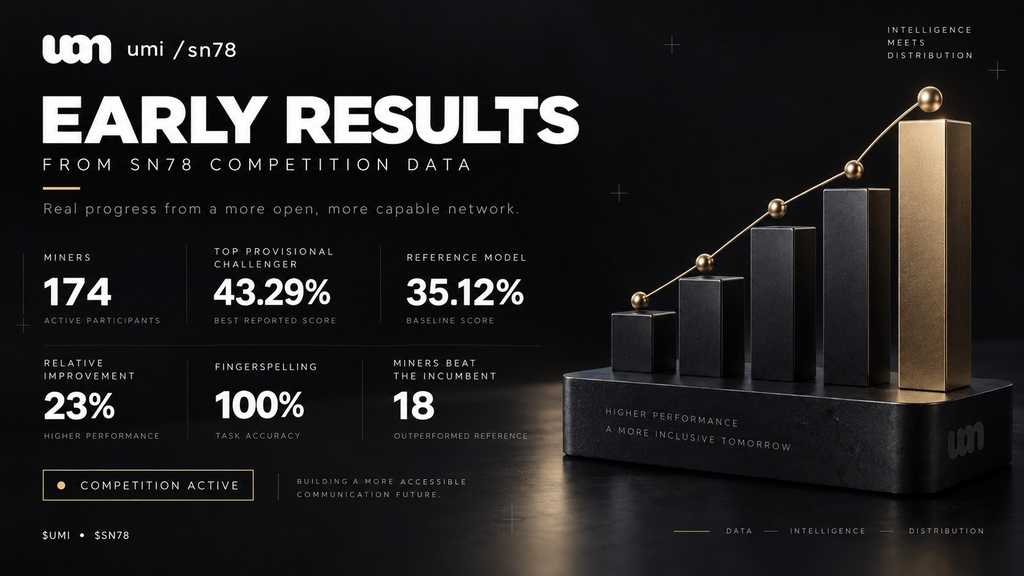
This is where subnet 78 comes in. UMI gives miners unseen sign-language videos and evaluates how well their models understand them. Different miners can approach the problem with different architectures and tools, while the strongest-performing models rise through the competition.
The interesting part is what happens after the competition.
Koyuki said winning models are intended to be automatically synchronized into UMI’s consumer applications. In her description, the system could produce another winning model roughly every 30 minutes, meaning the intelligence sitting behind the product can keep changing as miners improve it.
That creates a pretty straightforward loop: miners compete to improve the model, the best model reaches the product, users generate real demand, and the product gives the subnet a reason to keep improving the intelligence.
The Glasses Are an Interface, Not the Moat
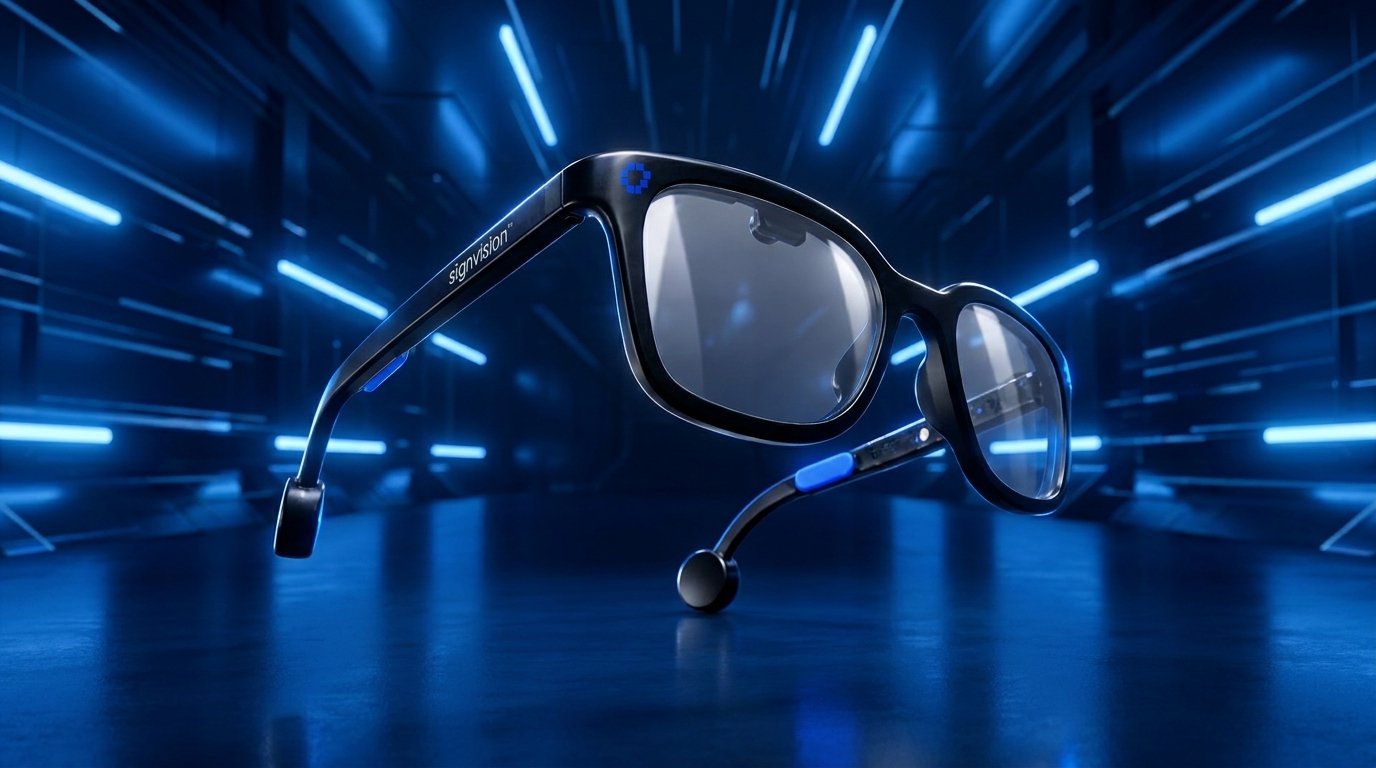
The most visible part of UMI’s recent announcements is SignVision, its wearable AI product.
UMI is not manufacturing smart glasses from scratch. Instead, it is integrating its models through APIs and SDKs with existing wearable hardware. Someone wearing the glasses could see translated sign language and, on supported hardware, hear the translation through built-in audio. The team said it is targeting a rollout in weeks.
But focusing too much on the glasses misses what UMI is trying to build.
The glasses are simply one place where the intelligence can live. The same model could sit behind an iPad in a hospital, a kiosk at an airport, software inside a vehicle or eventually the perception stack of a humanoid robot.
That last part answers one of the obvious questions around UMI: if robotics companies are already building advanced humanoids, why would they need this?
Because building the body and understanding human behaviour are different problems. A robot can have cameras, hands and motors and still need intelligence capable of interpreting what the person standing in front of it is communicating through movement. UMI wants its models and datasets to become that specialized layer.
As Parker put it during the conversation, the glasses are also a proving ground. Integrating into glasses is comparatively simple; proving that the same motion intelligence works there gives UMI something concrete to take later to robotics companies and other hardware providers.
The Other Important Piece Is Data
Models are only half of this.
UMI is also building SignRush, a system where people who know ASL can record themselves signing prompted phrases and earn money for contributing. Other participants then independently watch the submitted signing and provide what they believe it means, giving UMI a way to validate the examples and create its own labeled dataset.
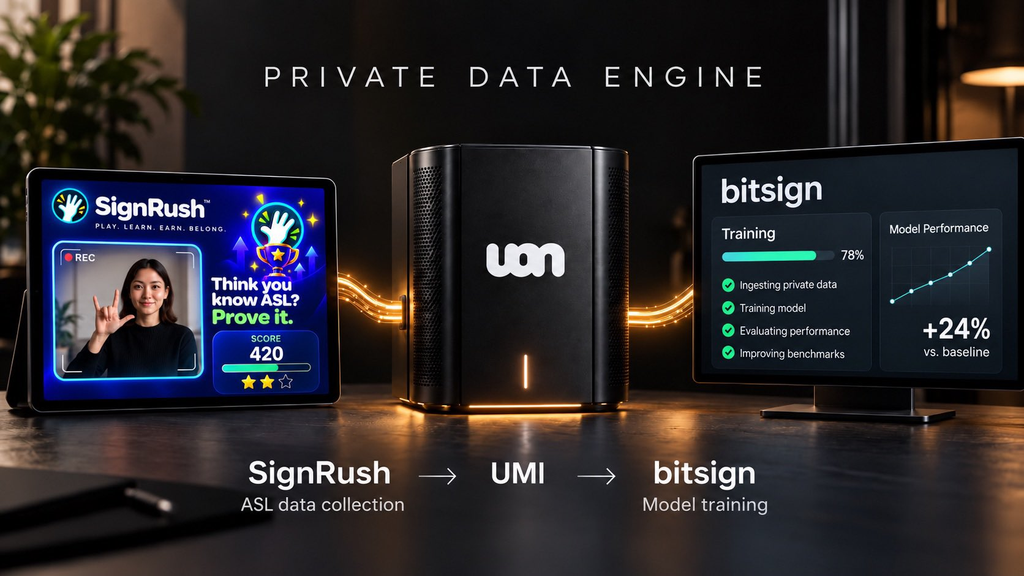
This may end up being one of the important parts of the whole strategy.
Human movement data is much harder to scrape from the internet than text. For UMI, collecting repeated examples of different people expressing the same meaning can create proprietary data covering not only their hands, but facial expressions, body movements, timing and other contextual signals.
So the long-term asset is the combination of datasets and models that understand human movement, with glasses, apps, kiosks and APIs providing different ways to sell access to that intelligence.
Now UMI Has to Get It Into the Real World
The team was unusually clear about what comes next: distribution.
UMI is pursuing healthcare providers, smaller practices, financial institutions and other businesses that need accessible communication, while simultaneously pushing the consumer side through wearables.
The team also said it is exploring more hardware and physical-AI partnerships where its models can operate behind another company’s product through an API, SDK or white-label integration.
For Bittensor, that makes SN78 an interesting experiment in connecting to outside crypto. Miners’ models are supposed to end up inside products being used by actual people, with external revenue then feeding back into the subnet. The team says a significant portion of future revenue is intended for alpha buybacks, although the exact percentage has not yet been decided.
UMI still has plenty to prove, particularly around translation quality and whether businesses adopt the products at scale. But the direction is becoming much easier to understand.
Watch the full YouTube conversation below:
Enjoyed this article? Join our newsletter
Get the latest TAO & Bittensor news straight to your inbox.
We respect your privacy. Unsubscribe anytime.
Enjoyed this article?
Join our newsletter
Get the latest TAO & Bittensor news straight to your inbox — every morning before markets open.

No comments yet — be the first.