


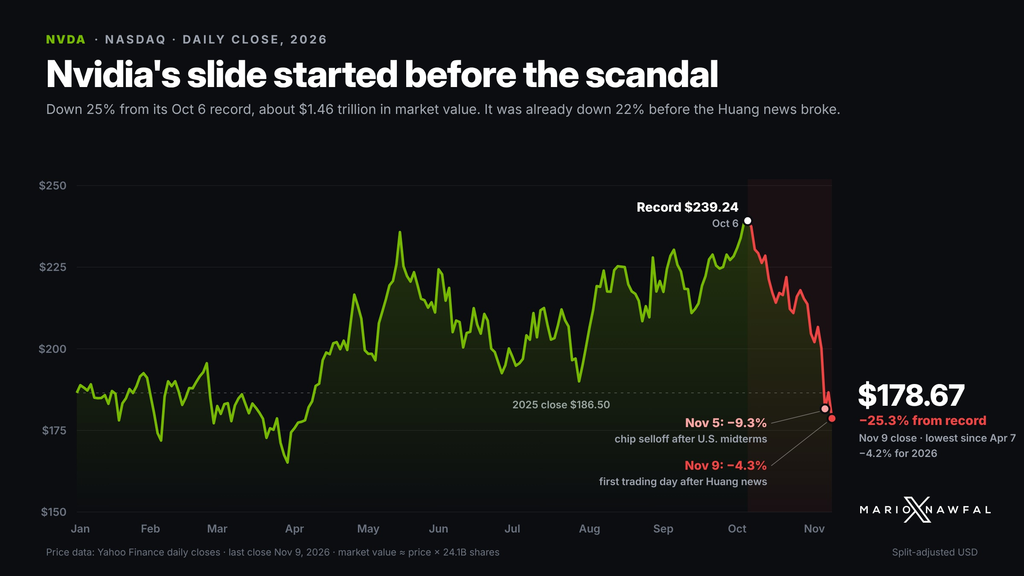
Last week, the most important company in AI lost about $400 billion in two trading days. Its chips didn’t stop working. No rival beat it. It happened because of one man’s private life.
That should scare you. And it shows exactly why decentralised AI is no longer a nice idea. It is a necessity.
Jensen Was Open AI’s Loudest Champion
Let’s be fair to Jensen Huang; very few people did more for open models this year.
In March, he went on the All-In Podcast and talked up decentralised training, acknowledging Covenant-72B, a 72-billion-parameter model trained across the internet on Bittensor’s Subnet 3. TAO rallied about 73% in just 15 days, hitting a local high on March 25.
Then on July 24, after years of silence on social media, he made his first ever post on X where he shared an open letter signed by 25 companies, called “Open Weights and American AI Leadership.” His message was that open models “strengthen safety and cybersecurity, accelerate innovation and diffusion, and enable sovereignty.”
The timing mattered. Washington was weighing curbs on open-weight models after China’s Kimi K3 caught up with the best closed systems, and OpenAI’s Dean Ball had described an open-weight world as “AI communism.” Jensen picked a side, in public, and it was ours.
Nvidia backed the words with work, shipping open models like Nemotron 3 Ultra and giving teams like Poland’s Bielik the tools to build their own.
Then It All Shook
On November 8, Jensen admitted to an affair in a letter to Nvidia staff. The woman, Alice Huang, is a former executive at Singapore’s Megaspeed International whom US authorities reportedly suspect of working for Chinese intelligence. Nvidia’s board opened an independent investigation. Nvidia says it has found no sign that national security or company secrets were compromised, and China has dismissed the claim.
But the market didn’t wait for facts. Nvidia fell 4.3% on Monday, wiping out about $192 billion, on a day the chip index rose 6.9% and Nvidia was its only stock in the red. It fell another 5.5% on Tuesday. Roughly $400 billion gone in two sessions.
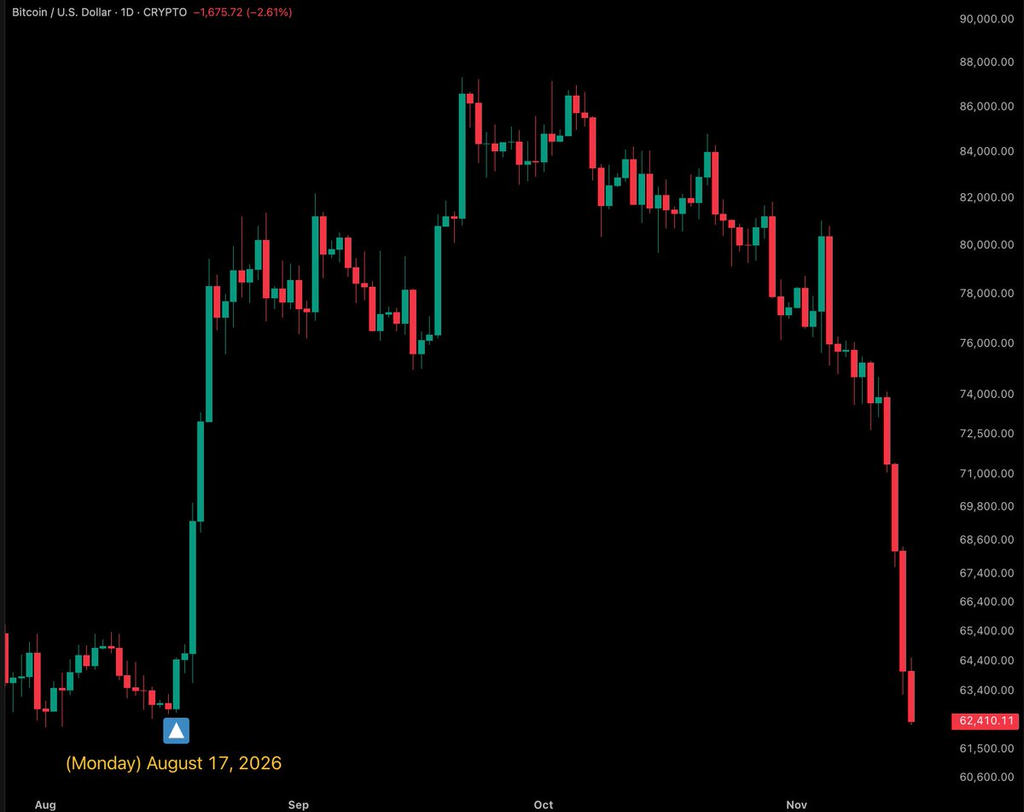
Crypto bled with it. Bitcoin dropped to about $73,761, its lowest since August, and more than $1 billion in leveraged bets were wiped out, with stalled US-Iran talks adding fuel. By November 13 it was below $69,000.
Analyst Dan Ives warned that if Jensen is pushed out, Nvidia could fall another 25 to 30%. His biographer Stephen Witt was blunter. “Nvidia is Jensen Huang.”
Read that again. A $4 trillion company, the backbone of global AI, priced as one man.
The Real Problem
Forget the gossip. Here’s what nobody wants to say out loud.
The future of open AI now hangs on one CEO’s personal choices and one board’s verdict. If that board removes Jensen, who decides whether Nvidia keeps fighting for open weights? If Washington uses this scandal to squeeze Nvidia, does the open-model push survive? Nobody knows. That is the problem.
And Nvidia was on open AI’s side. The closed labs are not. In July, OpenAI’s head of strategy, Dean Ball, suggested Washington should tag Chinese open models “risky to use”, then backed down after heavy criticism. Reports say OpenAI and Anthropic privately pressed the White House to restrict them, though Anthropic says it opposes an outright ban. Closed labs have every reason to want open models gone. Cheap open models eat their margins.
Why Open Models Matter
Open models aren’t a hobby. They’re how the world really runs AI now.
About half of Y Combinator startups run mostly on open-weight models. In Sweden, the Gothenburg region launched a public AI assistant that runs open models on Swedish servers, so people’s data stays in the country. Poland used open tools to build Bielik, its AI model made to understand Polish properly. Hugging Face CEO Clem Delangue warned that restricting open models would “concentrate power in the hands of a few.”
Closed AI means someone else sets the price, changes the rules and can switch you off. Open AI means you own what you run. Even US officials admit a downloaded model can’t be recalled.
But here’s the catch. Open models still come from companies. Companies have CEOs. CEOs have scandals. Boards have votes. Governments have pressure. Open weights fix who can use AI. They don’t fix who controls where it comes from.
Bittensor Was Built for This Moment
This is where Bittensor stops being a crypto trade and becomes the answer.
Bittensor has no CEO to scandalise and no board to vote. Miners compete to produce intelligence, validators score them, and TAO pays whoever does the work best. If any single team walks away, the network keeps running. Nobody can fire it, subpoena it or lean on it to shut down.
It’s already delivering. Covenant-72B, the very model Jensen praised, was trained by more than 70 contributors on ordinary internet hardware. Lium (SN51), a GPU rental subnet, is running at about $34.6 million a year in spending, and subnet revenue across the network is closing in on $70 million.
And TAO got hit just as hard. When the Nvidia news broke, TAO sold off with the rest of the market, and it’s now trading around $185, down about 40% on the year. As long as AI money moves on one company’s headlines, even decentralised AI pays the price for a scandal it had nothing to do with. Bittensor’s job is to grow until that link breaks.
Is Bittensor perfect? No. In April, the owner of the Templar subnet left the network and accused co-founder Const of holding too much control, and TAO fell 25% in hours. That fight was ugly. But it happened in public, and the network kept going. At Nvidia, the fate of open AI stays behind a closed boardroom door.
Bitcoin Fixed Money. Bittensor Fixes AI.
In 2008, the banks showed the world what happens when money depends on a handful of institutions. Bitcoin was the reply, a system nobody controls, capped at 21 million coins.
TAO carries the same 21 million cap and the same halving rhythm. Its daily issuance was cut in half last December.
But the real parallel isn’t supply. It’s purpose. Bitcoin took money out of the hands of bankers. Bittensor takes intelligence out of the hands of CEOs.
This month proved that one man can move AI by hundreds of billions of dollars with a single letter to his staff. So ask yourself one question. Do you want the future of intelligence to depend on a single individual, or on a network nobody can own?
We already know our answer. It’s Bittensor.
Enjoyed this article? Join our newsletter
Get the latest TAO & Bittensor news straight to your inbox.
We respect your privacy. Unsubscribe anytime.
Enjoyed this article?
Join our newsletter
Get the latest TAO & Bittensor news straight to your inbox — every morning before markets open.



No comments yet — be the first.