

A surprising number of humanoid robot demos rely on human teleoperation or motion-capture data behind the scenes, not fully autonomous control.
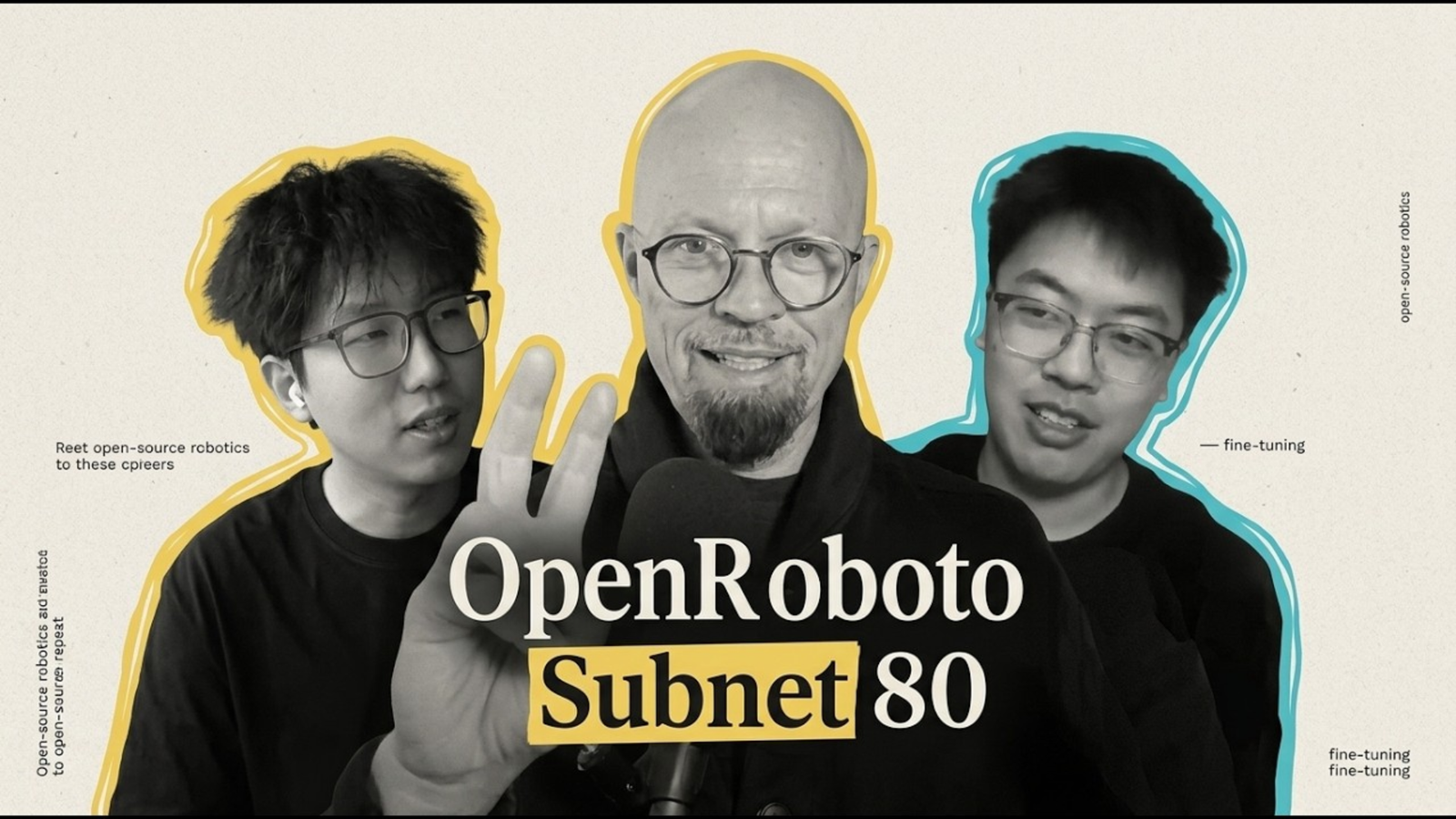
OpenRoboto (SN80) launched three weeks ago to tackle the missing piece: an autonomous brain for humanoid robots, with its team explaining the mechanism on Mark Jeffrey’s Hash Rate Pod Ep. 183.
Fine-tuning Physical Intelligence’s π0.5 open-weight model against the LIBERO-Pro benchmark, miners pushed its base score from 50% to 85% in just twenty-one days.
The improvement was so rapid that the team is holding back its state-of-the-art claim, suspecting the benchmark itself may already be getting gamed.
Where Robotics Meets Web3
The Hash Rate conversation covered the base model choice, the state of humanoid robotics, the robotics data problem, the commercial roadmap, the HackQuest origin story, and the surprising benchmark trajectory.
1. OpenRoboto trains brains, not bodies: Unitree, Figure, and Physical Intelligence spend their capital building humanoid hardware.
OpenRoboto exists to produce the robotics policies that turn that hardware into something capable of operating autonomously in the real world.
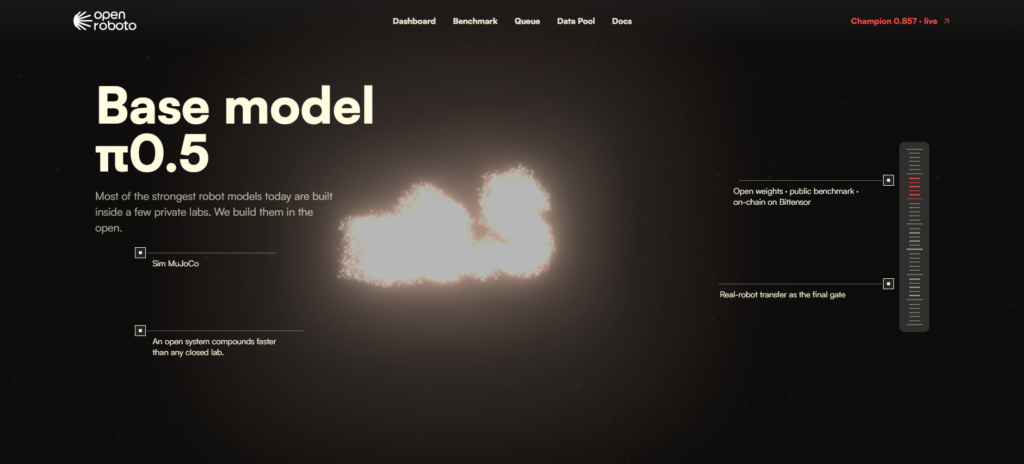
2. The base model is Physical Intelligence’s π0.5: π0.5 remains one of the most representative open-weight vision-language-action models in robotics today.
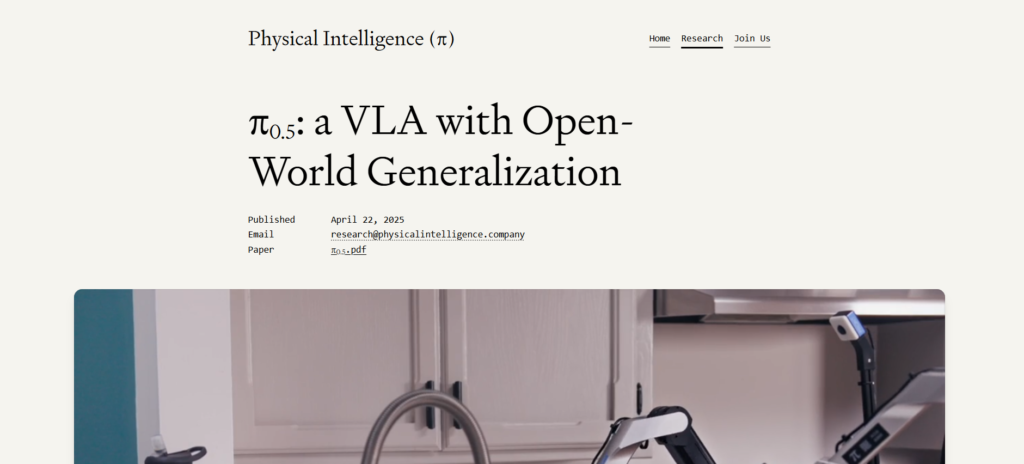
Released over a year ago, it still holds competitive scores across most published benchmarks in the field.
3. Every humanoid robot demo you have watched has been puppeteered: Optimus dancing, Unitree performing kung fu at the Chinese spring festival, none of it is autonomous.
Each demo relies on a human operator wearing a motion capture suit driving the movements from off-camera, with Figure AI as the only company showing genuine autonomous behavior on narrow limited tasks so far.
4. Robotics has a data problem language models never had: Language models trained on the internet, but robotics data has to be collected by hand through teleoperation at roughly $4 to $6 per hour.
Workers in Southeast Asia, India, and China wear VR glasses or teleoperation gloves to generate the training material the models need.
5. The Open Data Pool sits underneath the subnet as its supply layer: Data partners contribute teleoperation, synthetic, and egocentric data into a pool any miner can pull from.
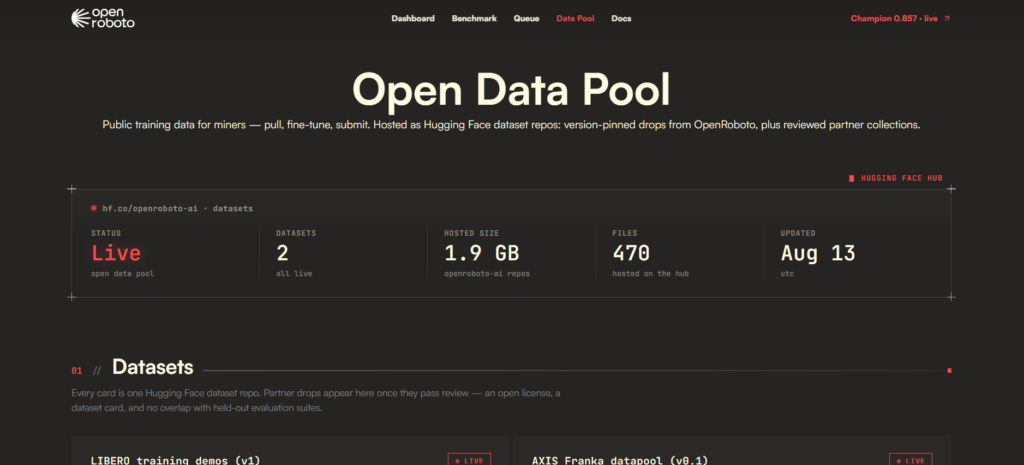
Once that pool grows large enough, the team intends to move from fine-tuning existing models into pre-training a full robotics model from scratch.
6. The commercial roadmap follows a three-step factory plan already in motion: Step one builds a simulation environment mirroring the target factory’s production line.
Step two collects data from that factory’s employees using egocentric capture tools, and step three trains a specific robotics policy for that factory’s exact tasks, with pilot programs already close to step one across facilities in China and Europe.
7. The team is HackQuest, one of crypto’s most established developer education outfits: HackQuest has been running since 2021 and worked with Solana, Arbitrum, and most of the top ecosystems over the past five years.
The founder holds a startup background reaching back to 2017 through a University of Chicago gap year that turned into full-time entrepreneurship.
8. HackQuest ran Const’s China tour across 2025: The tour covered ten-plus events across Beijing, Shanghai, Shenzhen, Hangzhou, and Hong Kong.
Along the way the team discovered a hidden Bittensor mining community already active in China, with attendees who had gotten wealthy from mining showing up in person with gifts for Const.
9. The technical lead came from academic robotics at Northwestern: Originally a computational photography researcher, he moved into robotics in 2024.
Bittensor caught his attention because web3 offers a genuinely different answer to the full-stack robotics company problem, where every startup currently attempts to build hardware, models, and evaluation infrastructure all internally under one roof.
10. The 35-point benchmark gain in three weeks came in faster than anyone expected: No academic robotics timeline would have predicted improvement at that speed.
The team is now building new evaluation infrastructure with dynamically generated tasks so miners cannot game a fixed benchmark, adding real robot testing on top of the simulation layer already in place.
Shenzhen, Not Palo Alto
Half the story here has less to do with the model and more to do with where it is being built. The team operates out of Shenzhen and Beijing, putting it close to Unitree, factory pilots, and a deep robotics talent pool.
That proximity also connects OpenRoboto to engineers moving from computational photography and academic robotics research into Web3.
Physical intelligence is ultimately a physical problem, and being near the factories building the robots may matter more than being near the VCs funding them.
Enjoyed this article? Join our newsletter
Get the latest TAO & Bittensor news straight to your inbox.
We respect your privacy. Unsubscribe anytime.
Enjoyed this article?
Join our newsletter
Get the latest TAO & Bittensor news straight to your inbox — every morning before markets open.



[…] a landmark moment for decentralized AI, OpenRoboto (SN80) has become the first subnet to launch natively (not wrapped) on […]