


What if improving an AI model worked a little more like installing an app?
You have a model that already knows a lot. Instead of taking the whole thing back into training every time you want it to become better at medicine, coding, finance or law, you train that new skill separately and attach it when you need it. Want another skill later? Add another one.
That is the idea Connito, Bittensor Subnet 102, is experimenting with, and its latest results make the concept much easier to understand. Connito trained five separate skills for the same AI model covering math, code, medicine, law and finance. Each was trained independently, then plugged into the original model without changing what was already inside it.
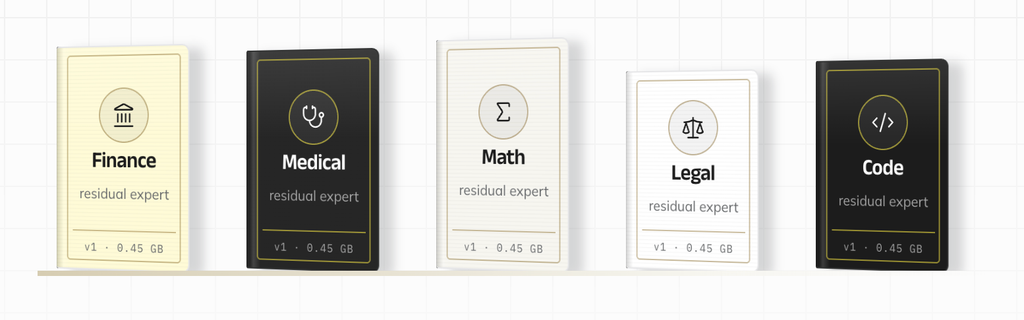
This is different from the usual way models are customized. With traditional fine-tuning, you change some of the model’s existing weights to make it better at a particular job. It works, but those same weights may also be involved in other things the model knows how to do. Change them too much and you can improve one capability while weakening another. You also end up repeatedly training and managing different versions of what started as the same model.
Connito’s experiment asks a much simpler question. Why touch the old knowledge at all?
The test used DeepSeek-V2-Lite, a 15.7 billion parameter Mixture-of-Experts model. Models like this already contain many smaller expert networks inside them, with a router deciding which experts should help process each token. Connito left those existing experts alone and added a new expert at every MoE layer for the skill being taught. It also gave those new experts their own router.
Think of the router as the person deciding when to call the specialist into the room. If you are asking a normal question, the new expert should stay quiet. If the question needs its specialty, it can jump in and help.
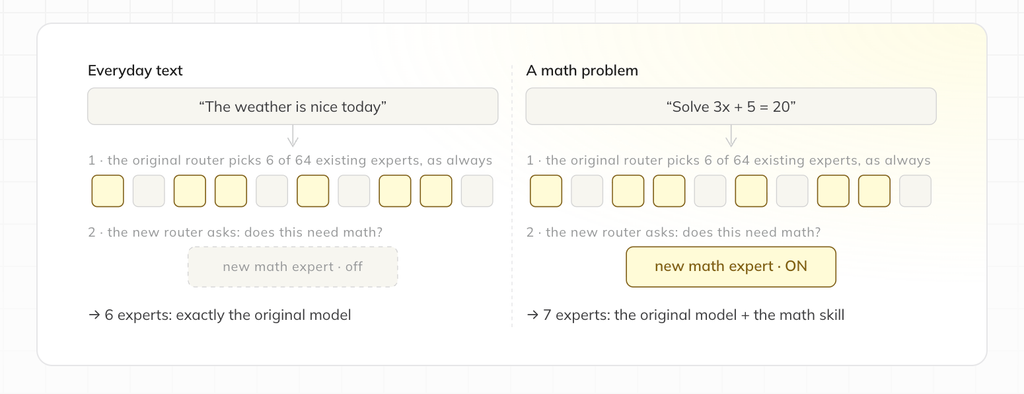
That part is important. Connito trained each router using both specialist data and ordinary web text. On normal text, it was taught to stay off. On data related to its skill, it was taught when to activate. The original model remains frozen, while the new expert adds its contribution only when the router thinks it is useful.
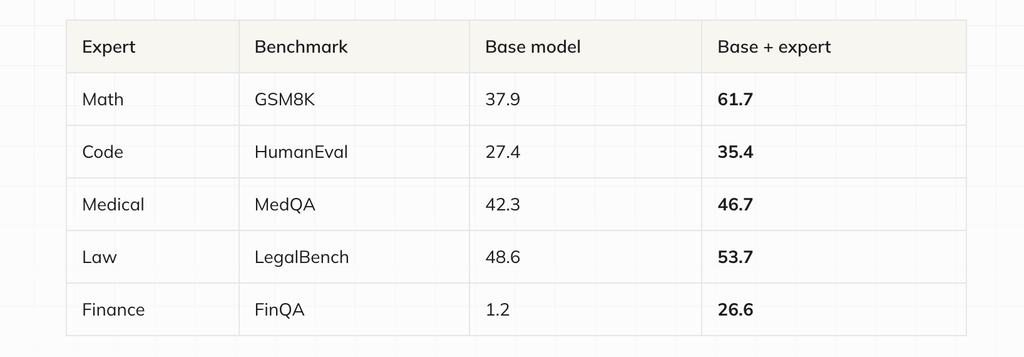
And the skills actually improved the model on their respective tests. The math version moved from 37.9 to 61.7 on GSM8K. Code went from 27.4 to 35.4 on HumanEval. Medicine improved from 42.3 to 46.7 on MedQA, law from 48.6 to 53.7 on LegalBench, and finance made the largest jump, moving from 1.2 to 26.6 on FinQA. Each new skill added about 225 million parameters, roughly 1.4% of the 15.7B base model.
But training one add-on is only half the interesting part.
Connito then took experts that had been trained separately and put them into the same model. Math was combined with code. Math was combined with medicine. Then math, code and law were put together. There was no new joint training session to teach them how to coexist. Connito says combining the experts takes seconds on a CPU because the components are copied into the model instead of being averaged together or retrained.
The combined models remained above the untouched base model across the tested domains. The results are still experiments, and Connito notes that each training run used a single seed, so small differences should not be overread. But the results showed that independently trained AI skills were able to be assembled afterwards while keeping useful gains from each one.
Now let’s talk about how this is useful in real life use cases.
A company might start with a capable open model and add a legal expert. Another user might want code and cybersecurity. Someone else could need finance, tax and economics. Instead of maintaining an entirely new fine-tuned model for every combination, Connito wants these capabilities to become reusable pieces that can be trained once, stored and combined depending on what a user needs.
The subnet already have a marketplace pointing toward categories including legal, finance, tax, code, robotics, security, translation, vision, logistics, marketing and medicine. Many of those are still marked as upcoming.
This experiment also helps explain the bigger goal of Connito itself. It’s building a decentralized training network where different contributors can work on smaller parts of large Mixture-of-Experts models instead of everyone needing the hardware to retrain an entire frontier-scale model.
The subnet’s design involves miners training selected experts, validators testing whether their updates improve the model on held-out data, and useful contributions can be integrated into the global model. Connito calls that evaluation system Proof-of-Loss.
Over time, the ambition is to build something like a growing library of AI capabilities. A skill trained for one job does not necessarily have to disappear into one customer’s private fine-tune. It can become a reusable component that may be selected, improved and combined with other components later.
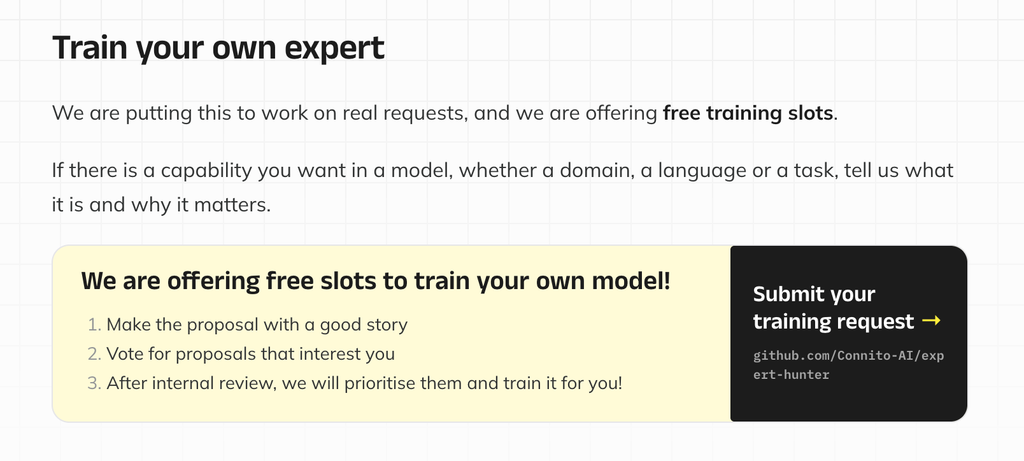
And you can also be a part of this. Connito is currently offering free slots for people to propose skills they want trained. You come up with a capability, domain, language or task that you think a model should learn, explain why it would be useful, and submit the idea. Other people can vote on proposals, after which Connito reviews them and decides which ones to prioritize for training.
So if you have ever thought, “I wish this model was specifically good at this,” Connito basically wants to hear the rest of that sentence.
The fun way to think about all of this is that Connito does not want every new AI skill to require another model. It wants the skill itself to become the thing you can build, share, and plug in.
Enjoyed this article? Join our newsletter
Get the latest TAO & Bittensor news straight to your inbox.
We respect your privacy. Unsubscribe anytime.
Enjoyed this article?
Join our newsletter
Get the latest TAO & Bittensor news straight to your inbox — every morning before markets open.



No comments yet — be the first.