


If you’ve been around Bittensor long enough, you’ve probably come across the name Special K. Behind it is Koyuki Nakamori, founder of Vocence (SN78) & Perturb (SN26), former head of AI at the Opentensor Foundation, and one of the rare builders in the ecosystem to run two subnets simultaneously.
Her path into Bittensor is one of the more unusual ones in the community, so the TAO Daily team sat down with her to hear the stories behind it.
Background: math, then AI, then web3
Koyuki’s training is in applied mathematics, which she studied at UBC and SFU. Japanese by background and Canadian today, she grew up moving between countries as a child, switching schools, languages, and environments along the way.
She speaks Mandarin and Japanese, reads some French, and describes herself as a natural audio learner, someone who picks things up best through their ears and says she can usually learn a new language within a few months.
The math foundation became the through-line for everything that followed. She spent more than a decade in AI and machine learning as a developer, data scientist, analyst, and AI engineer, building infrastructure and AI-driven systems for Web2 companies in San Francisco — backend, frontend, and everything in between.
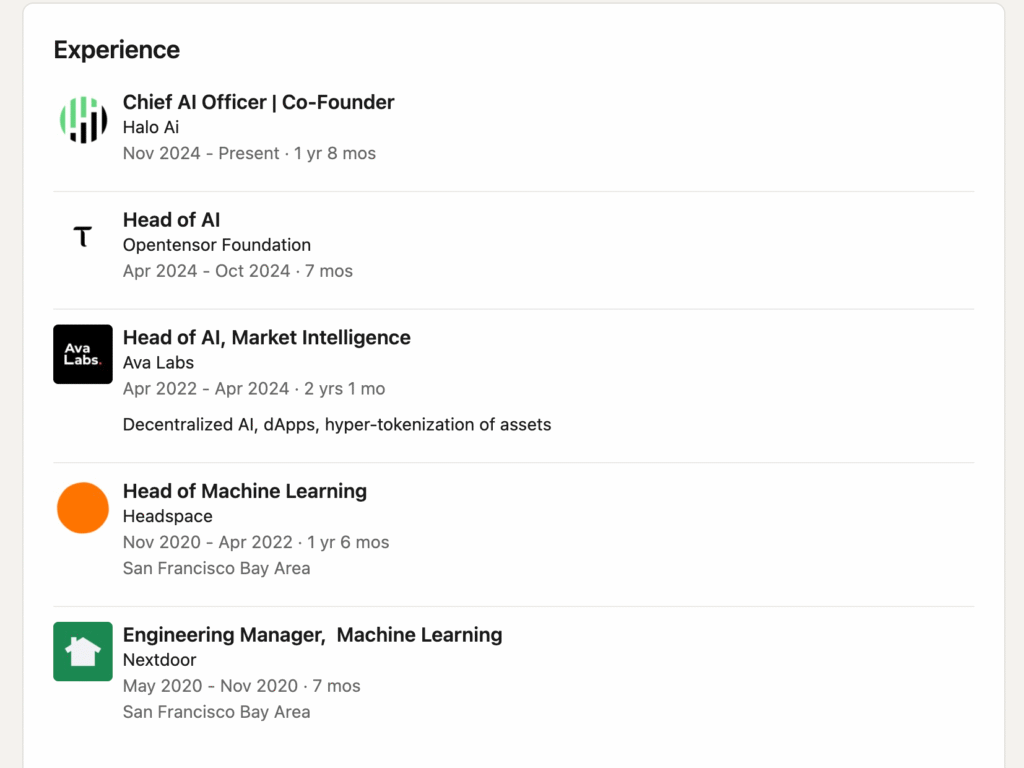
She was the first AI hire at both Nextdoor and Headspace, rising to head of AI at the latter, and her work ran the full stack: feed optimizers, content recommendation and matching engines, and ambient AI designed to read a user’s mood and adapt their smart devices around it.
Her ahah moment into AI came from cryptography, which she got into while writing her thesis, and then to Bitcoin. Reading Bitcoin’s white paper sent her down a rabbit hole that made her question everything she’d been taught about money.
“I came out feeling like a new person,” she says. The coincidence wasn’t lost on her, either: her own surname, Nakamori, sits two letters off from Satoshi Nakamoto’s. (She’ll also correct your pronunciation. It’s Satoshi, not Sa-toh-shi, a westernism she’s quick to flag.)
The Avalanche chapter
Her Web3 career started at Avalanche, where she was the first AI/data hire at the Ava Labs foundation. The team was small, so she wore every hat — data engineering, social, marketing, and the construction of what was effectively a Web3 version of AWS: a blockchain-as-a-service platform where you could spin up custom chains with a few clicks and layer AI capabilities on top.
That broad-scope experience taught her how to ship inside small, fast-moving organizations. It also accidentally introduced her to Bittensor.
How she found Bittensor
The story is almost too poetic. Avalanche used the term “subnets” for its multi-chain architecture, and Koyuki, handling SEO research on the side, was searching the word when something else popped up.
A small, esoteric project called Bittensor. A white paper that mentioned Yuma, a name that felt like it was trying to channel Satoshi (since Yuma, too, is Japanese). Her first reaction was suspicion: “Is this team trying to mimic Bitcoin?”
She read the Bittensor white paper. She didn’t fully understand it, despite having an advanced maths background. So she read it again. And again. And again. By the tenth read, she was hooked. “It reminded me of the journey I took when I discovered Bitcoin,” she told The TAO Daily. “The similarities were obvious.”
Within a week of that final read-through, a recruiter cold-reached out to her. “Have you heard of this project called Bittensor?” She had, she’d just spent days inside its white paper. The recruiter introduced her to the founder, Const. The call landed late in her time zone, but she refused to let that stop her. She broke her sleep routine to take it, telling herself it was fine even if the job never materialized. They hit it off. He asked if she could start right away. She was hired on the spot. It was 2024.
She saw the whole sequence as a manifestation moment; mind over matter. The universe, she says, found them both at the same time.
Inside the Opentensor Foundation
Joining OTF was a baptism by fire. There were maybe 32 subnets. Dynamic TAO (dTAO) didn’t exist yet. The flywheel hadn’t kicked in. A major hack had just happened, and the team was on edge. Const would drop links into chat for meetings and she’d hesitate to click; were these real, or spam?
The pace was relentless. She estimates she was working around 100 hours a week.
One of her first major projects: build a wrapper around all the digital commodities being produced across Bittensor’s subnets; something designed to rival the kind of unified product OpenAI was shipping, but kept non-profit by design.
She was the trailblazer on the project, hiring her team from her network as she went. They built it. They demoed it. And then, because the foundation wanted to stay non-profit, they gave it away.
That experience left an imprint: “Just push yourself. You never know what you can achieve.”
The break, and the return
Eventually, Koyuki stepped away from Bittensor. Around this time, the foundation was gradually moving toward decentralization, reducing the need for a central, controlling OTF.
She spent the next stretch advising and co-founding startups in both Web2 and Web3, staying close to AI but operating outside any single ecosystem.
Then, two months before her return, she sat down with the Bittensor white paper again. And fell in love with it again.
“Now I’m back, and now I’m owning two subnets, and the community is a lot bigger. The flywheel has kicked in. I see a huge opportunity.”
The two gaps she identified and decided to fill were voice and AI security.
Learn more about voice (Vocence) below:
Learn more about AI security (Perturb) below:
Her philosophy
A few threads run through everything Koyuki says:
- Product is marketing, and marketing is product. The work she cares about is shipping things her grandparents could use, not merely sweat-talking investors.
- Mind over matter. She manifested her way into Bittensor by reading the white paper ten times. She’s prepared to do the same for her companies.
- The realness over the theatrics. She’s wary of “circular pleasing” between subnets and wants Bittensor to chase mainstream adoption instead of internal hype.
- Resistance means you’re doing something right. “When you see resistance, don’t stop. Double down. Show them they’re wrong.”
- Hungry, gutsy, and not done. “I don’t look like a college kid, but I’m as hungry as them; if not more.”
She’s been in AI for over a decade and in Bittensor since the early days of dTAO. Two subnets in, she’s still treating the work like she’s just starting.
Enjoyed this article? Join our newsletter
Get the latest TAO & Bittensor news straight to your inbox.
We respect your privacy. Unsubscribe anytime.
Enjoyed this article?
Join our newsletter
Get the latest TAO & Bittensor news straight to your inbox — every morning before markets open.



No comments yet — be the first.