


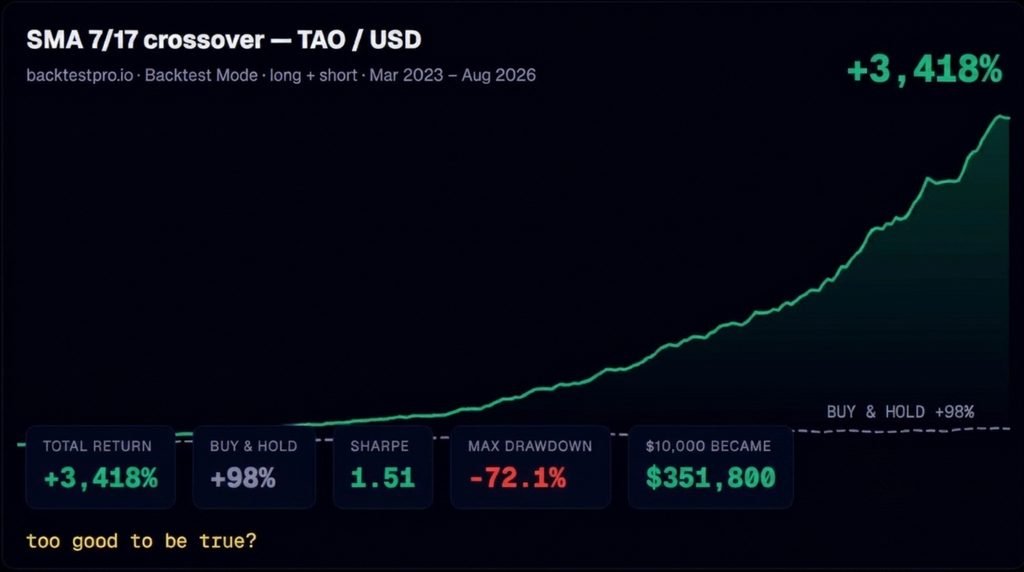
I watched Crypto Cameron’s latest YouTube video, “I Backtested a +3,418% TAO Strategy. Too Good To Be True?”, and found it useful.
In addition to discovering a magic TAO trading strategy, he also showed how easy it is to fool yourself with backtests.
The strategy he found returned roughly 3,400% over three years, turning a hypothetical $10,000 into about $352,000. But instead of celebrating the result, Cameron tried to prove that the result was not simply luck.
Here are the parts I found most interesting.
The strategy was found by searching 780 combinations
Cameron used a crossover scanner to test different SMA combinations on TAO.
The best result was a 7/17 SMA crossover, which is where the +3,400% came from. But this immediately creates a statistical problem:
If you search enough combinations, something is eventually going to look incredible.
That means you shouldn’t only test the winning strategy. You need to test the entire search process that produced it.
He put the strategy through four statistical “gates”
Cameron built a framework designed to separate genuine edge from patterns produced by luck:
- Walk-forward testing → catches strategies that simply memorize the past.
- Permutation testing → tests whether the result could have emerged from random data.
- Monte Carlo testing → tests how fragile the strategy is to different sequences of returns.
- False-discovery testing → accounts for the fact that many different searches were conducted before finding the winner.
I particularly liked the fourth gate because it addresses a problem that is easy to miss.
If you run 100 different experiments, finding one spectacular result isn’t nearly as impressive as finding that result from the first experiment.
The 7/17 strategy survived three tests
The original 7/17 wasn’t consistently selected when he reran the search on different historical windows.
Instead, the process found 7/10 and 5/17 combinations, with the 5/17 appearing repeatedly.
That is important because it suggests the result wasn’t completely dependent on one magical set of parameters. The broader family of TAO SMA strategies showed some persistence.
The permutation test was also encouraging.
After shuffling TAO’s returns across 1,000 random worlds, the strategy landed around the top 4%, with a P-value of 0.0398. It passed Cameron’s <5% threshold.
The Monte Carlo test also passed comfortably, although Cameron admits this is the gate he is least satisfied with and wants to refine.
But then it failed the most important reality check
The final test asked a simple question:
What happens when we account for all the other searches that were run?
Cameron had already tested several other TAO/subnet strategies. After applying the Benjamini-Hochberg correction, the TAO SMA strategy’s adjusted Q-value was above the 0.1 threshold.
It failed.
And because of that, Cameron decided not to trade the strategy, despite its spectacular historical return.
The bigger opportunity isn’t TAO price
Cameron also explains where he thinks the real opportunity lies.
Instead of looking only at TAO’s price, he wants to combine different types of Bittensor data:
- Price
- Wallet flows
- Developer activity
- GitHub commits
- Other ecosystem-level data
Then use AI to search for relationships between these variables and potentially identify factor-based trading strategies.
The ecosystem is generating an increasingly large amount of structured data across subnets, emissions, wallets, activity and markets. If that data can be systematically combined, there may be signals that traditional price-only strategies simply cannot see.
My biggest takeaway
The interesting bit in the analysis is that the +3,400% backtest was tested and then disprove it with statistical backing.
He ultimately found that the strategy had some evidence of an edge, but that the edge appeared strongest in earlier TAO windows and decayed over time. Because it failed the final false-discovery test, he won’t trade it.
This is a useful reminder as more people use AI to generate trading strategies: A backtest showing huge returns is the beginning of the investigation and not the conclusion. You need check more data to make a holistic trading decision.
Watch the full video below:
Enjoyed this article? Join our newsletter
Get the latest TAO & Bittensor news straight to your inbox.
We respect your privacy. Unsubscribe anytime.
Enjoyed this article?
Join our newsletter
Get the latest TAO & Bittensor news straight to your inbox — every morning before markets open.

Be the first to comment