


Open models have made capable AI more accessible to independent researchers and smaller teams, but a capable model is only the starting point.
Coding agents and other tool-using systems need to write and execute code, call tools, run tests, and receive reliable feedback on whether they actually completed a task.
If reinforcement learning requires thousands of attempts, those attempts need somewhere to run safely and consistently, without allowing the model to interfere with the system evaluating it.
That is the problem Cathedral is building around Bittensor, the project now operates as SN94, providing CPU-based execution environments for reinforcement learning, evaluation, and AI agents.
What Is Cathedral?
Cathedral is building execution infrastructure that provides isolated Linux environments where AI-generated code and agent workloads can run, giving teams a place to execute tasks, run evaluations, and generate the feedback needed for reinforcement learning. Cathedral Docs
A model producing code that looks correct does not mean the code works. It needs to be executed and tested, while the evaluation environment needs enough separation to prevent the model from manipulating the conditions under which it is judged.
At scale, that becomes a serious infrastructure problem where teams have to manage machines, sandboxing, environment setup, failures, and large numbers of repeated executions. Cathedral’s approach is to provide that execution layer instead of making every team build it from scratch.
Why Reinforcement Learning Needs an Execution Layer
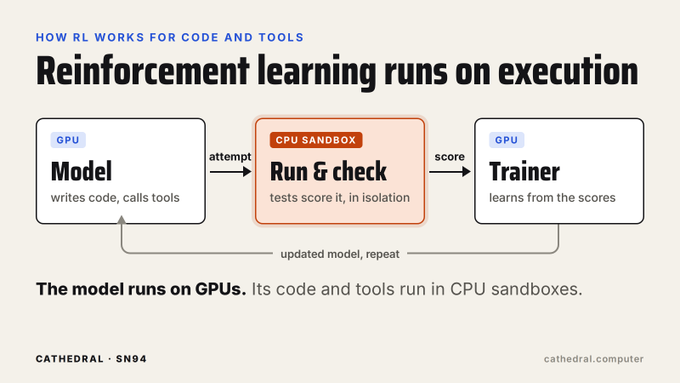
Reinforcement learning depends on repeated interaction. A model attempts a task, the environment records what happened, and that feedback helps determine what the model learns.
For a coding agent, that can mean generating code, executing it, running tests, calling tools, and checking the result. None of this works without an environment capable of safely handling those actions.
The evaluation system also has to remain separate from the model. If an agent can access or alter its grader, it could optimize for the evaluation mechanism instead of solving the task.
That makes isolated execution part of the training infrastructure itself.
Cathedral SN94’s Architecture
Cathedral uses Firecracker micro-VMs to create isolated Linux sandboxes.
- Its Standard box is a dedicated machine capable of hosting up to 13 isolated sandboxes and currently costs $0.99 per box-hour. At full capacity, that works out to roughly $0.076 per sandbox-hour.
- The system also supports snapshots and forks, allowing a team to prepare an environment once and use that state as the starting point for subsequent executions.
- Cathedral has also integrated with existing agent tooling, including Harbor and Prime Intellect’s verifiers library. Cathedral GitHub | Harbor | Prime Intellect Verifiers
The model produces the action, the sandbox executes it, and the evaluation system judges the result without giving the model control over the infrastructure.
Why Cathedral Moved to SN94
Cathedral previously operated on another Bittensor subnet before announcing its move to netuid 94. Its official announcement frames SN94 around reinforcement learning execution and the infrastructure needed to support it.
The longer-term goal is to coordinate independent compute providers around a shared execution service rather than relying entirely on infrastructure operated by a single provider.
That fits a growing need inside Bittensor where subnets that evaluate executable code or agents need somewhere to run those workloads, while reinforcement learning systems need environments where models can repeatedly act and receive feedback.
The Demand Is Already Visible
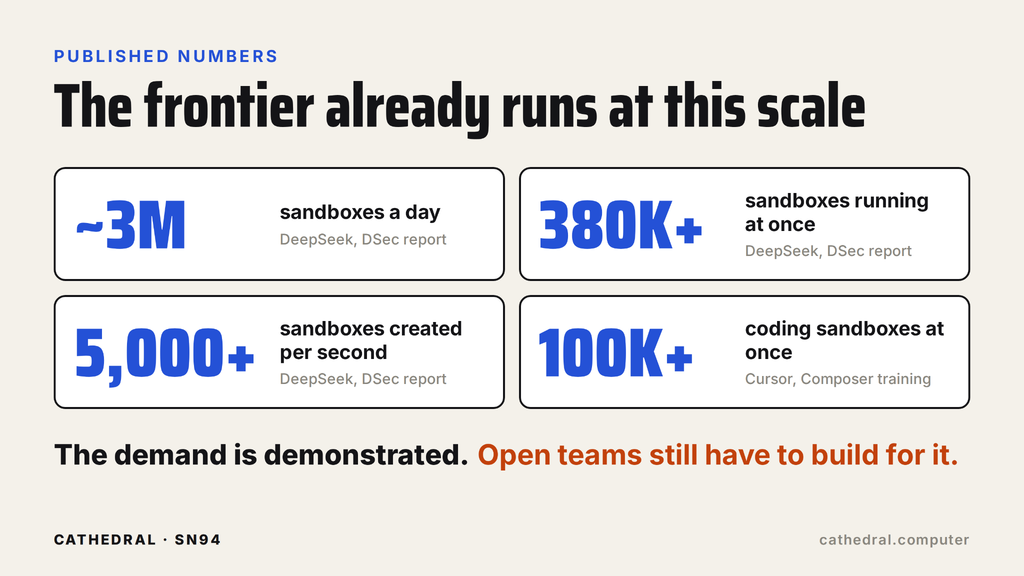
DeepSeek’s infrastructure report describes a sandbox platform supporting its reinforcement learning and evaluation workloads, with roughly 3 million sandboxes created per day, more than 380,000 concurrent sandboxes, and over 5,000 sandbox creations per second.
Note: Those figures come from the respective teams and do not represent Cathedral’s capacity. They show, however, how quickly execution infrastructure can become a major requirement once AI training moves from generating outputs to performing tasks.
What Cathedral Has Actually Demonstrated
1) Cathedral ran a protocol-v2 reinforcement learning grader unchanged inside Firecracker micro-VMs. In the controlled test, 0 of 9 attack submissions returned successfully, 0 packets left the no-network sandbox, and 12 of 12 concurrent 24-case batches received answers.
The test recorded a 26.3-second p50 latency. Across six grading runs, total cost was $0.16, with zero infrastructure errors. Validator integration test | Protocol-v2 grader run | Cathedral announcement
2) Cathedral also ran 13 SWE-bench Verified trials through Harbor with a reference-solution agent. All 13 completed without infrastructure errors, with $0.67 in box time. Cathedral explicitly describes this as an infrastructure test, not a test of the model. SWE-bench Verified smoke test | Cathedral announcement
Why It Matters
As AI systems move from generating responses to performing actions, execution becomes part of the AI stack. An agent that writes code, calls tools, interacts with an environment, and attempts multi-step tasks needs somewhere to perform those actions. The system evaluating those actions also needs controlled conditions in which to judge the result.
Cathedral is currently in limited beta, with the team running its own reinforcement learning experiments, pursuing customer use, and continuing to develop the product. A major UX overhaul is planned, while attested execution remains on the roadmap.
The project is still early, but it has moved beyond the idea stage. Cathedral has a working sandbox product, integrations with existing agent tooling, and controlled tests showing the infrastructure capable of handling reinforcement learning and coding workloads.
Learn about Cathedral’s earlier direction here.
Enjoyed this article? Join our newsletter
Get the latest TAO & Bittensor news straight to your inbox.
We respect your privacy. Unsubscribe anytime.
Enjoyed this article?
Join our newsletter
Get the latest TAO & Bittensor news straight to your inbox — every morning before markets open.


No comments yet — be the first.