

$SN19 holders passed a governance vote on July 1 authorizing the subnet (Blockmachine – SN19) to take over the free public RPC (Remote Procedure Call) infrastructure the Bittensor ecosystem has depended on since the Opentensor Foundation began operating it.
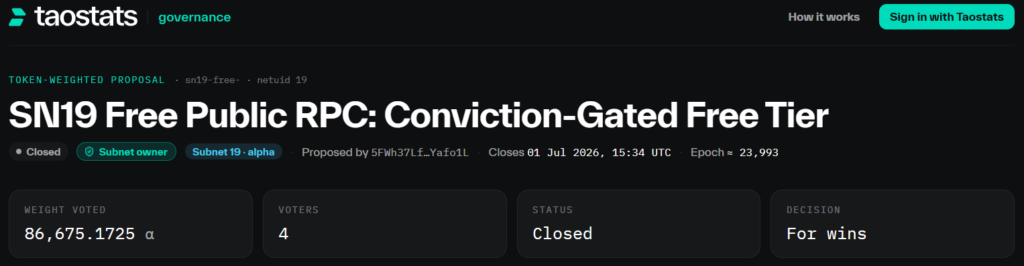
The vote closed with 100% support across all four voters, representing 86,675.17 $SN19 in weighted approval. The approved restructure removes the account and API key requirement, rate-limits by IP, and gates miner eligibility behind an on-chain conviction lock that scales with cumulative free-tier earnings.
The vote also authorized a whitepaper deviation excluding free-tier traffic from PSR (Protocol-Supported Revenue) buybacks, since there is no customer revenue to match against.
What The Vote Authorized
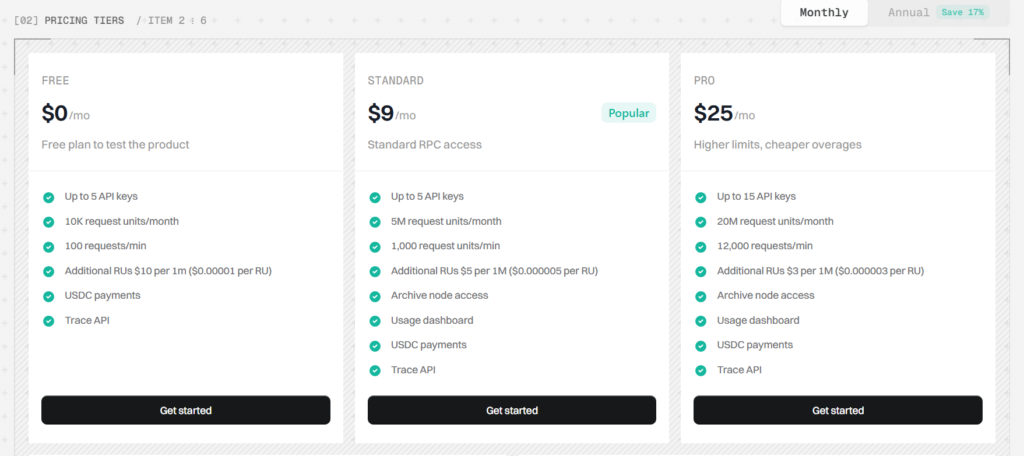
The restructured free tier moves eligibility onto an on-chain lock and drops the friction at the access layer:
1. No account, no API key. Free access without signup barriers.
2. Rate-limited by IP rather than by key.
3. Served from lite nodes only. No archive access.
4. Miner eligibility gated by conviction lock. Only miners with an active lock can serve free-tier traffic.
The whitepaper amendment:
1. Free-tier traffic is excluded from PSR buybacks. No buyback against revenue that does not exist.
2. Paid-tier buybacks are unchanged. Every buyback still corresponds to real customer revenue.
3. Miners still earn on-chain emissions for free-tier work. Same as any other work on the subnet.
Free-tier work is accounted for separately from paid-tier activity, so miners serving real paid demand are protected from dilution.
The Anti-Spam Mechanism
Removing the API key opens the free tier to abuse where an operator could farm emissions from self-generated traffic. The conviction lock is designed to make that uneconomic.
1. Miners must maintain a lock sized to their cumulative free-tier earnings. The lock scales with what they earn.
2. If earnings outrun the lock, the miner becomes ineligible. Until the lock is topped up.
3. Locked $SN19 remains exposed to price. It is the miner’s own stake.
A miner cannot scale free-tier farming without increasing their exposed alpha position, so farming and selling means dumping on their own locked stack.
Why This Was Worth Doing
The case rested on positioning and emission standing rather than a price argument:
1. Ecosystem positioning. Being the free RPC Bittensor runs on is a standing, visible position, potentially the default public RPC option in ecosystem tooling over time.
2. Emission-worthiness. Serving real, public, externally-used infrastructure is a concrete answer to whether the subnet is doing something real.
3. Productive emissions instead of penalized burn. Under chain spec 421, a high burn rate reduces the subnet’s share of network $TAO emission. SN19 burns most of its $SN19 today, and directing part of that toward real public traffic improves how the network weights the subnet.
4. Conviction reduces liquid supply. Serving free-tier traffic locks alpha, removing it from circulation for the duration of the lock.
The team was explicit that the net effect is not deflationary, and the structural lever for SN19’s economics remains real paid demand rather than this restructure.
Where This Goes Next
The whitepaper will be amended to reflect the revised buyback scope now that the vote has closed. A piece of infrastructure the ecosystem has depended on for years moves from being carried as a Foundation cost to being served by one of the network’s own subnets.
For SN19, this trades marketing cycles for a standing ecosystem position, with the emission math under the new chain rules explaining why the timing worked. The aim from here is placement alongside the existing Foundation endpoint and eventual inclusion in ecosystem documentation as a default public RPC option.
Enjoyed this article? Join our newsletter
Get the latest TAO & Bittensor news straight to your inbox.
We respect your privacy. Unsubscribe anytime.
Enjoyed this article?
Join our newsletter
Get the latest TAO & Bittensor news straight to your inbox — every morning before markets open.

No comments yet — be the first.