

Editor’s Note: This article was written in its entirety by Andy.
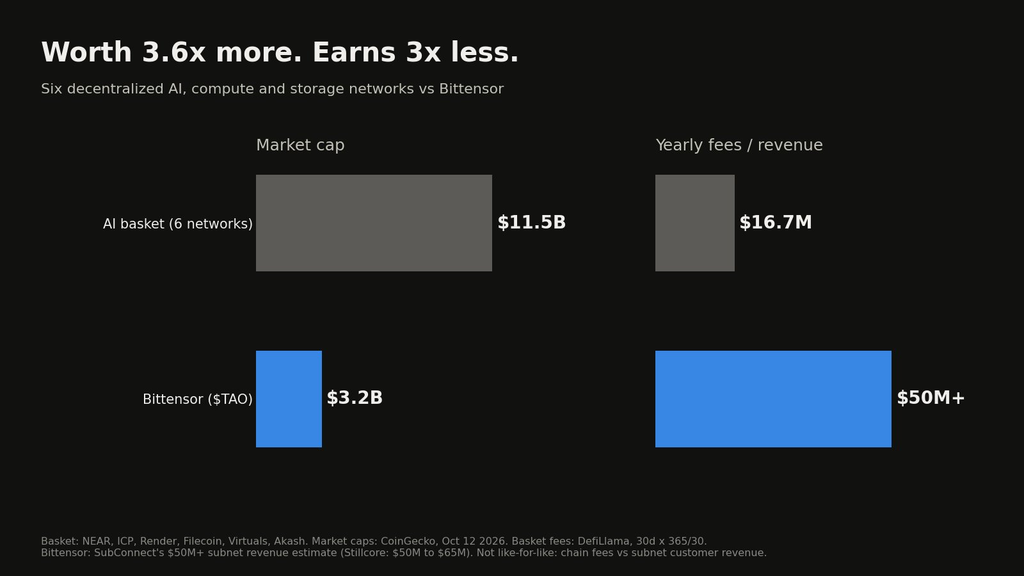
Six AI projects in crypto, compute, and storage networks are worth $11.5 billion combined, 3.6 times the size of TAO. Their tracked fees add up to about $16.7 million a year.
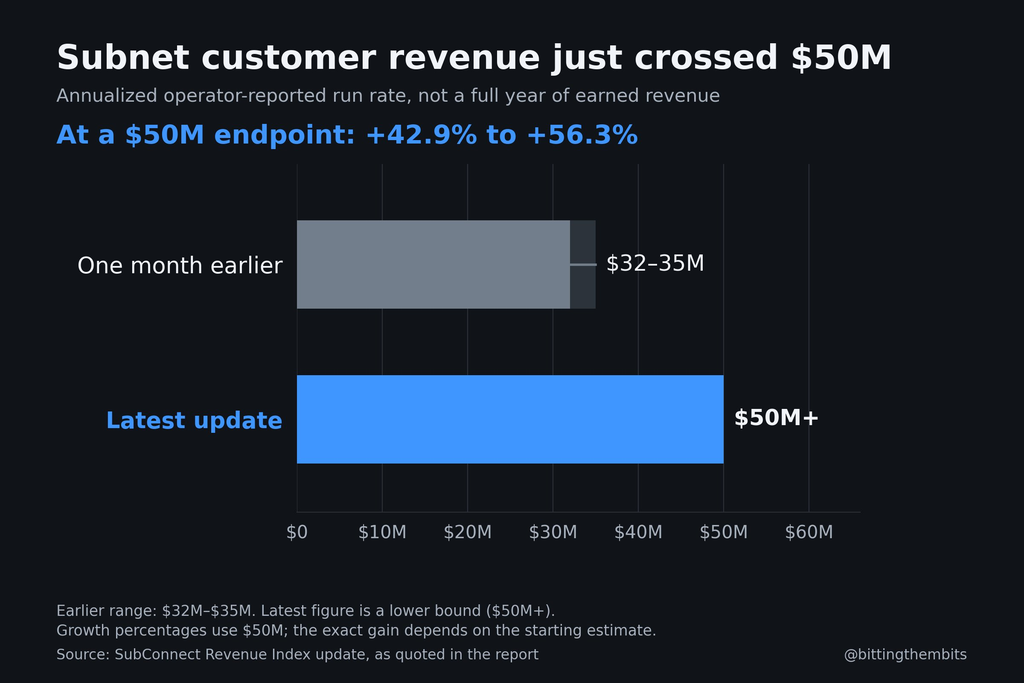
Bittensor’s subnets earn more than $50 million a year from paying customers. One month ago, that number was $32 million to $35 million.
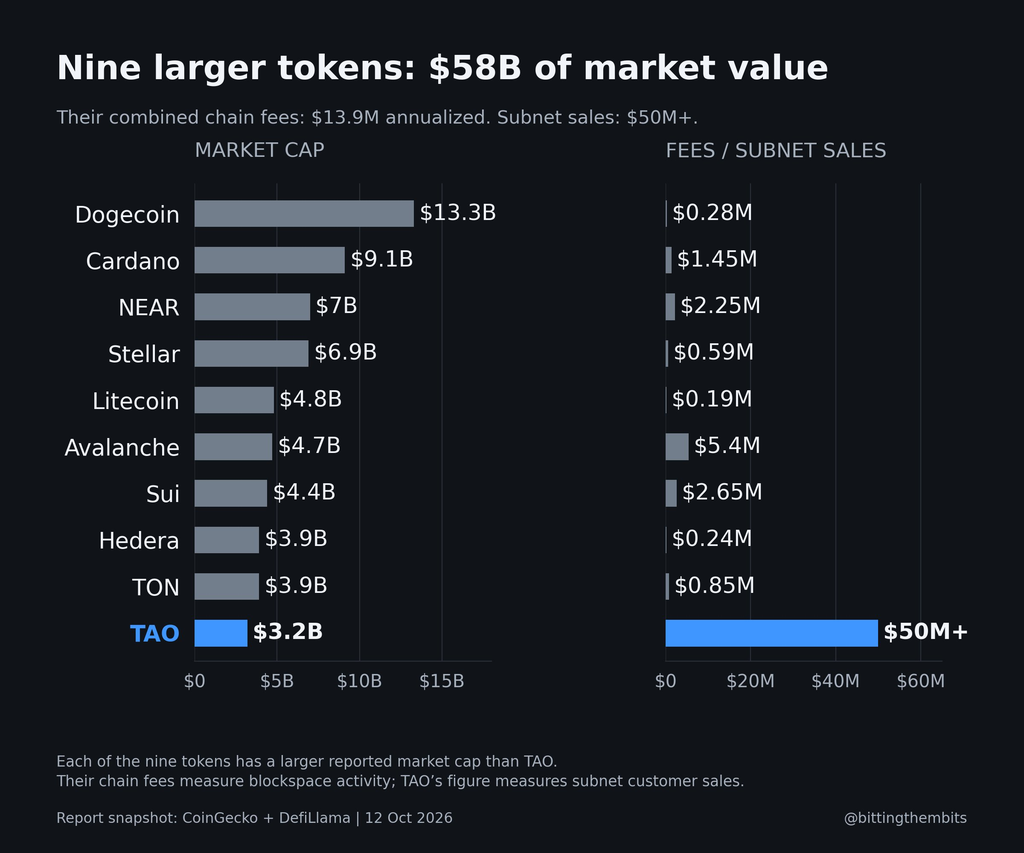
Nine more tokens bigger than TAO (Dogecoin, Cardano, NEAR, Stellar, Litecoin, Avalanche, Sui, Hedera and TON) are worth $58 billion together. They earn about $13.9 million a year in fees.
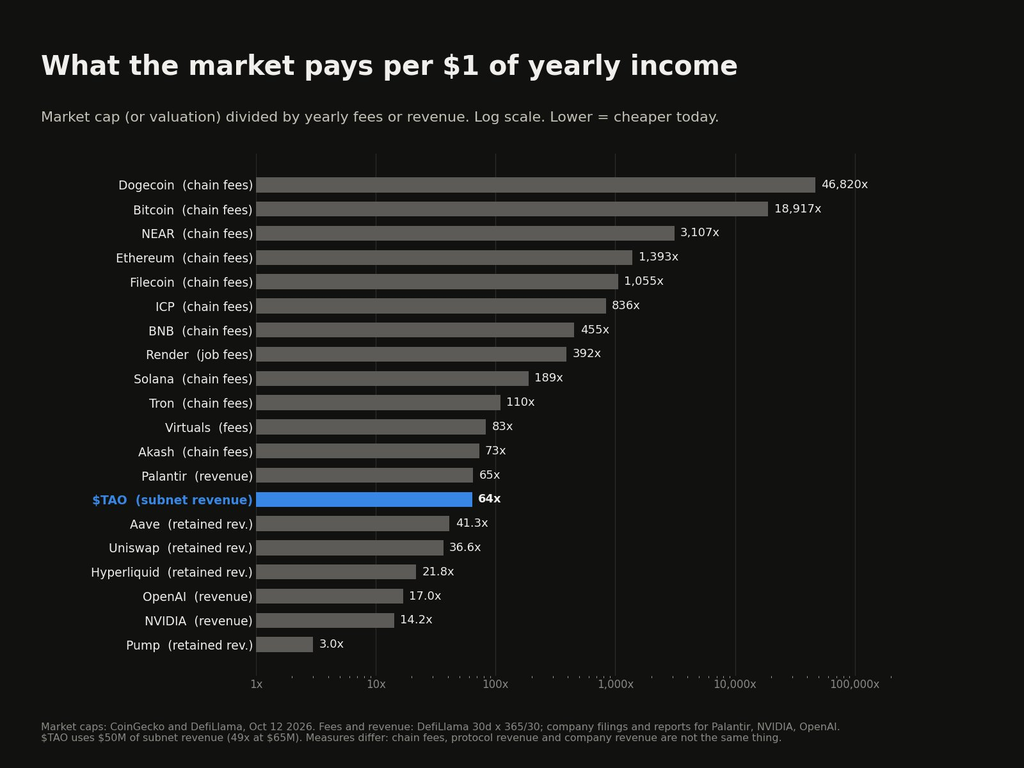
TAO is 0.11% of the entire crypto market. Bittensor’s revenue just grew more than 40% in a month.
This report lines TAO up against every major chain, crypto’s top earners, the decentralized AI sector and the AI giants, all from one data point. It also shows where TAO looks expensive, because a bull case only counts if it survives the bear case.
Data snapshot: CoinGecko and DefiLlama, October 12, 2026, with TAO at $282.50 and a $3.20 billion market capitalization.
The Revenue Grew From $32M to Over $50M in One Month
When SubConnect launched the Bittensor Revenue Index few months ago, subnets were earning $32 million to $35 million a year from outside customers. Today, it’s more than $50 million.
- From $35 million to $50 million is a 43% increase. From $32 million, it’s 56%. The claim of more than 40% month-over-month growth checks out.
- The growth is led by Lium (SN51), Targon (SN4) and Engy (SN53).
- Bitcast (SN93) and Almanac (SN41) continue growing quickly.
- Score (SN44) and Vanta (SN8) have started revenue-funded alpha buybacks.
Stillcore Capital’s separate estimate is $50 million to $65 million a year from outside customers as of September 30, describing it as a significant multiple of what customers paid a year earlier. Stillcore notes that most of this revenue is paid off-chain.
The revenue includes customers paying for GPU compute, inference, enterprise AI, media campaigns and software. Emissions and staking yield are excluded.
SubConnect projected $100 million in annualized revenue by year-end and now says that estimate may be conservative.
Reaching $100 million in three months would require approximately 26% monthly growth. Three more months at 40% growth would produce about $137 million.
Lium illustrates this growth. It recorded $1.40 million of GPU spending in the 30 days ending October 9, an increase of 45%, representing a $19.3 million annualized run rate. Of those rentals, 68.7% were launched through code and AI agents.
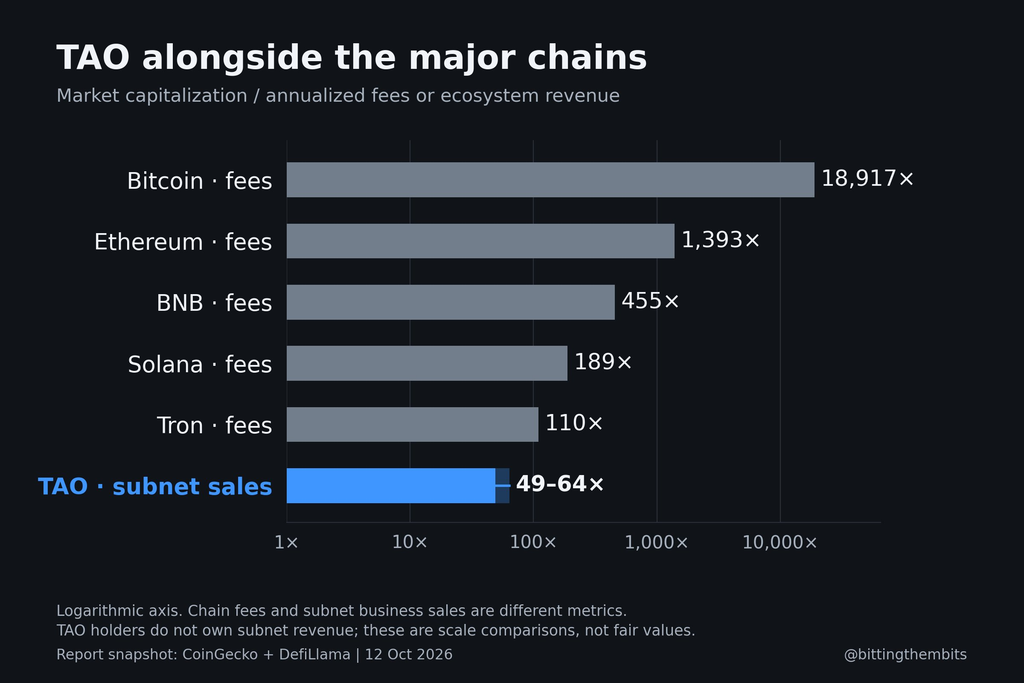
TAO Compared With the Major Blockchains
Bitcoin is valued at approximately 18,900 times its annual fees, while Ethereum is valued at about 1,390 times. TAO trades at 49 to 64 times its subnet revenue.
The following comparison shows market capitalization, annual fees or revenue, valuation multiples, and TAO’s market capitalization as a percentage of each network.
| Network | Market Cap | Annual Fees or Revenue | Multiple | TAO as % of Market Cap |
|---|---|---|---|---|
| Bitcoin | $1.66T | $88M | 18,917x | 0.19% |
| Ethereum | $307B | $220M | 1,393x | 1.04% |
| BNB | $99B | $218M | 455x | 3.2% |
| Solana | $64B | $337M | 189x | 5.0% |
| Tron | $31B | $285M | 110x | 10.2% |
| TAO | $3.2B | $50M–$65M | 49x–64x | — |
Nine Larger Networks With Much Lower Fees
Several cryptocurrencies have larger market capitalizations than TAO but generate considerably less in annual fees.
| Network | Market Cap | Annual Fees |
|---|---|---|
| Dogecoin | $13.3B | $0.28M |
| Cardano | $9.1B | $1.45M |
| NEAR | $7.0B | $2.25M |
| Stellar | $6.9B | $0.59M |
| Litecoin | $4.8B | $0.19M |
| Avalanche | $4.7B | $5.4M |
| Sui | $4.4B | $2.65M |
| Hedera | $3.9B | $0.24M |
| TON | $3.9B | $0.85M |
These nine networks are worth approximately $58 billion combined, around 18 times TAO’s market capitalization.
Their combined fees of about $13.9 million annually are less than one-third of what Bittensor’s subnets generate.
However, this is not a direct like-for-like comparison. Blockchain fees represent what users pay for blockspace, while subnet revenue represents what customers pay businesses operating on Bittensor.
Bitcoin also carries a monetary premium that cannot be explained through transaction fees alone.
Nevertheless, the comparison demonstrates how the cryptocurrency market often values projects based on expectations of future adoption rather than current income.
TAO Compared With Crypto’s Highest Revenue Generators
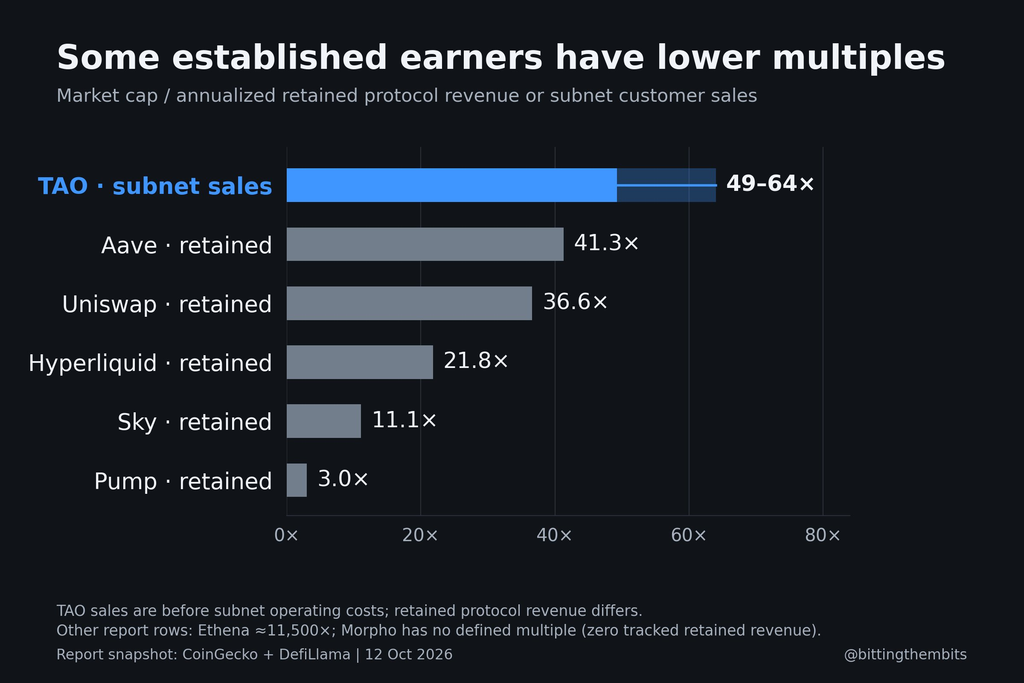
This is where the bullish argument requires more scrutiny. Some of cryptocurrency’s largest revenue generators trade at lower multiples than TAO based on current revenue.
| Protocol | Market Cap | Annual Retained Revenue | Multiple |
|---|---|---|---|
| Hyperliquid | $18.5B | $849M | 21.8x |
| Pump | $2.4B | $786M | 3.0x |
| Sky | $1.8B | $164M | 11.1x |
| Uniswap | $4.6B | $125M | 36.6x |
| Aave | $2.5B | $60M | 41.3x |
| Ethena | $2.9B | ~$0.2M | ~11,500x |
| Morpho | $1.7B | $0 retained | — |
| TAO | $3.2B | $50M–$65M ecosystem revenue | 49x–64x |
Hyperliquid generates approximately $849 million annually, with all of it funding HYPE buybacks.
For additional context, Tether generates approximately $6.3 billion annually, while Circle generates about $2.6 billion. Bittensor’s $50 million represents approximately 0.8% of Tether’s revenue.
Revenue Growth Tells Another Story
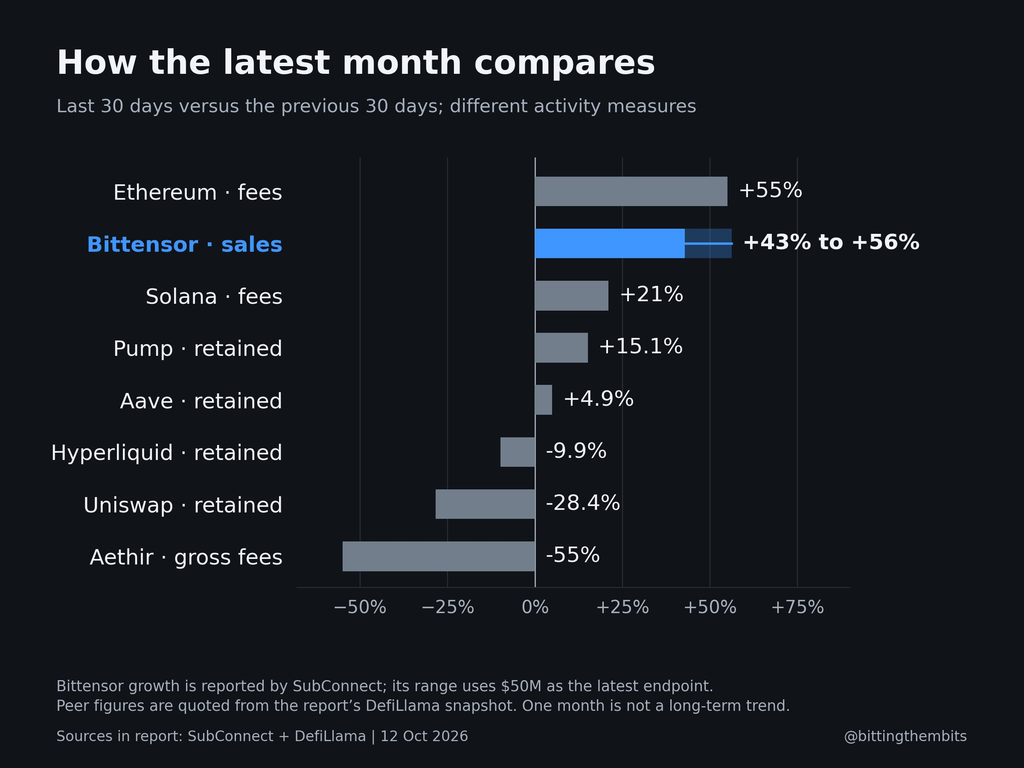
The direction of revenue growth is important.
Comparing revenue over the latest 30 days against the preceding 30-day period:
- Hyperliquid: down 9.9%.
- Uniswap: down 28.4%.
- Aave: up 4.9%.
- Pump: up 15.1%.
- Bittensor subnets: up 43% to 56%, according to SubConnect.
If Bittensor’s annualized subnet revenue reaches approximately $147 million without a change in TAO’s market capitalization, its valuation multiple would fall to Hyperliquid’s current 21.8x.
That would require roughly tripling revenue from its present level.
Based on different monthly growth assumptions, reaching that level would take approximately:
- 40% monthly growth: 3 months.
- 20% monthly growth: 6 months.
- 10% monthly growth: 11 months.
One major distinction remains. Hyperliquid directs its revenue into HYPE buybacks, establishing a direct relationship between revenue and token demand.
TAO’s connection to subnet revenue is more indirect, which remains an important consideration.
TAO Compared With Decentralized AI Projects
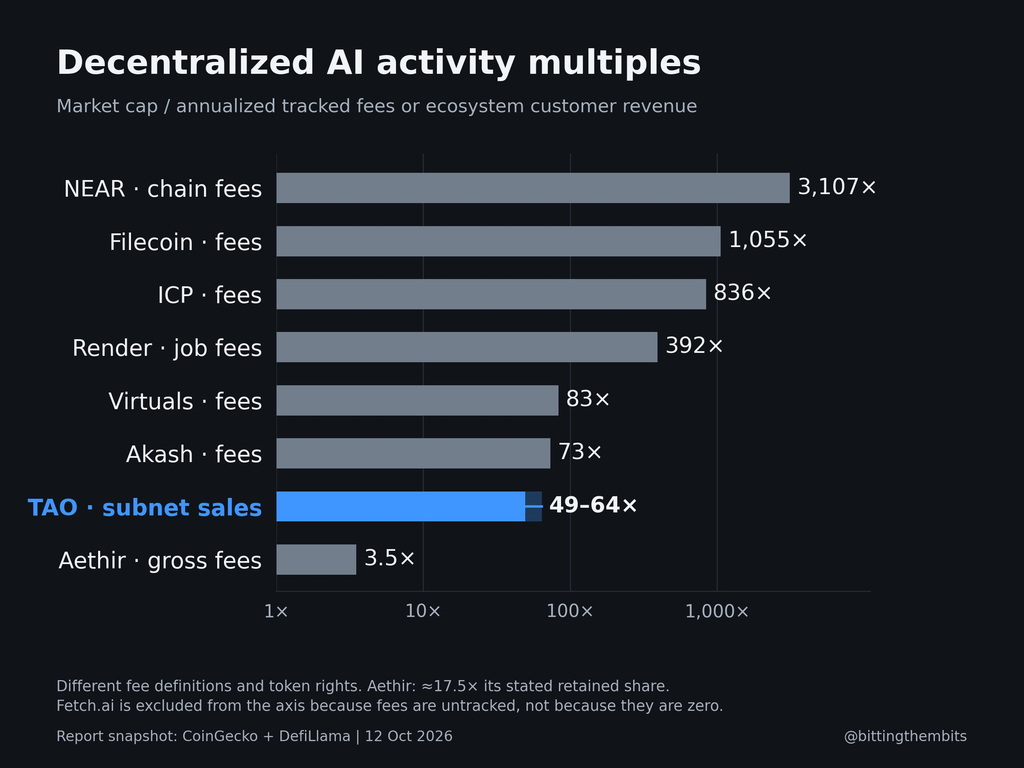
The decentralized AI sector provides another comparison.
| Project | Market Cap | Annual Fees | Multiple |
|---|---|---|---|
| NEAR | $7.0B | $2.25M | 3,107x |
| ICP | $1.8B | $2.15M | 836x |
| Render | $1.1B | $2.8M | 392x |
| Filecoin | $949M | $0.9M | 1,055x |
| Virtuals | $467M | $5.6M | 83x |
| Akash | $219M | $3.0M | 73x |
| Fetch.ai | $515M | Not tracked | — |
| TAO | $3.2B | $50M–$65M | 49x–64x |
The first six projects have a combined market capitalization of approximately $11.5 billion, about 3.6 times TAO’s valuation.
Their combined annual fees total around $16.7 million.
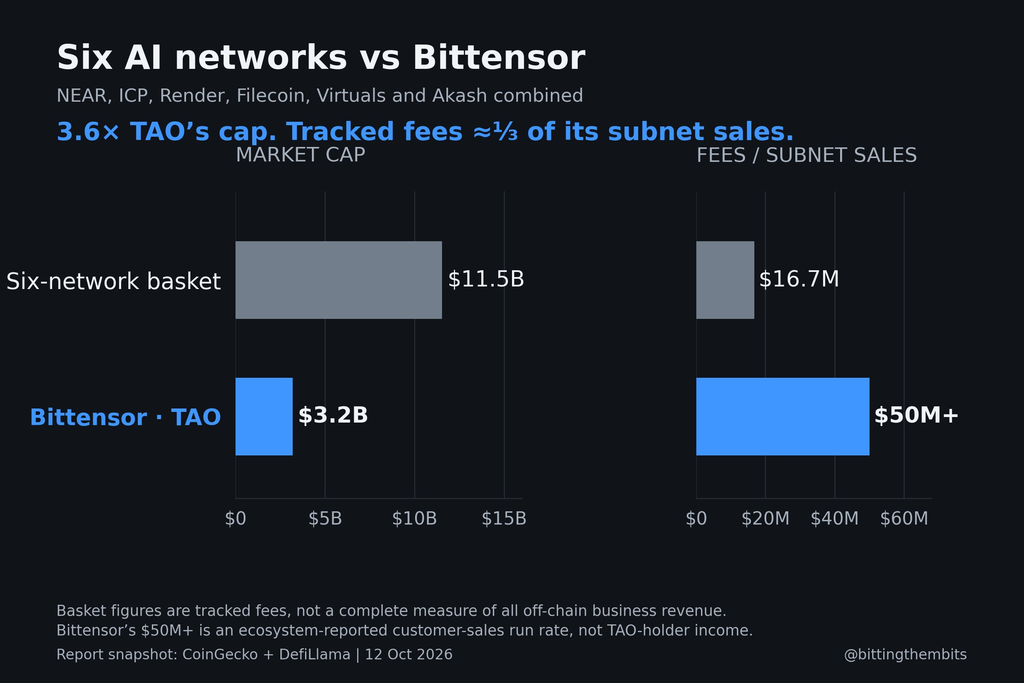
Bittensor’s subnets generate approximately three times that amount.
Lium alone recorded $1.40 million in GPU spending over its latest 30-day period, equivalent to about $17 million annualized. That exceeds the combined annual fees of those six networks.
How Aethir Compares
Aethir provides another relevant comparison.
It has a market capitalization of approximately $124 million and annualized GPU service fees of $35.4 million, translating to a multiple of about 3.5x.
On gross fees, Aethir appears cheaper than TAO.
However, its fees fell 55% compared with the preceding 30 days, and approximately 80% of its fees go to GPU providers.
Based on the remaining 20%, or approximately $7.1 million annually, Aethir trades at around 17.5 times retained revenue.
The broader Bittensor subnet economy is also relatively small by market capitalization.
All 117 subnet tokens tracked by CoinGecko have a combined market capitalization of approximately $1.30 billion, roughly equivalent to Render’s valuation.
TAO Compared With the World’s Largest AI Companies
Major AI companies are also valued based on expectations of future growth, although many have already developed substantial revenue streams.
| Company | Valuation | Annual Revenue Run Rate | Multiple | TAO as % of Valuation |
|---|---|---|---|---|
| NVIDIA | $5.48T | $385B | 14.2x | 0.06% |
| Anthropic | $965B | $47B+ | ~20x | 0.33% |
| OpenAI | $852B | ~$50B | 17x | 0.38% |
| Palantir | $502B | $7.7B | 65x | 0.64% |
| Databricks | $134B | $5.4B | 25x | 2.4% |
| CoreWeave | $42.7B | $10.3B | 4.1x | 7.5% |
Anthropic’s valuation is based on its May financing round, while OpenAI’s valuation reflects its March round. OpenAI’s revenue run rate was reportedly approaching $50 billion by the end of September, according to the Financial Times.
CoreWeave also carried approximately $51.6 billion in debt.
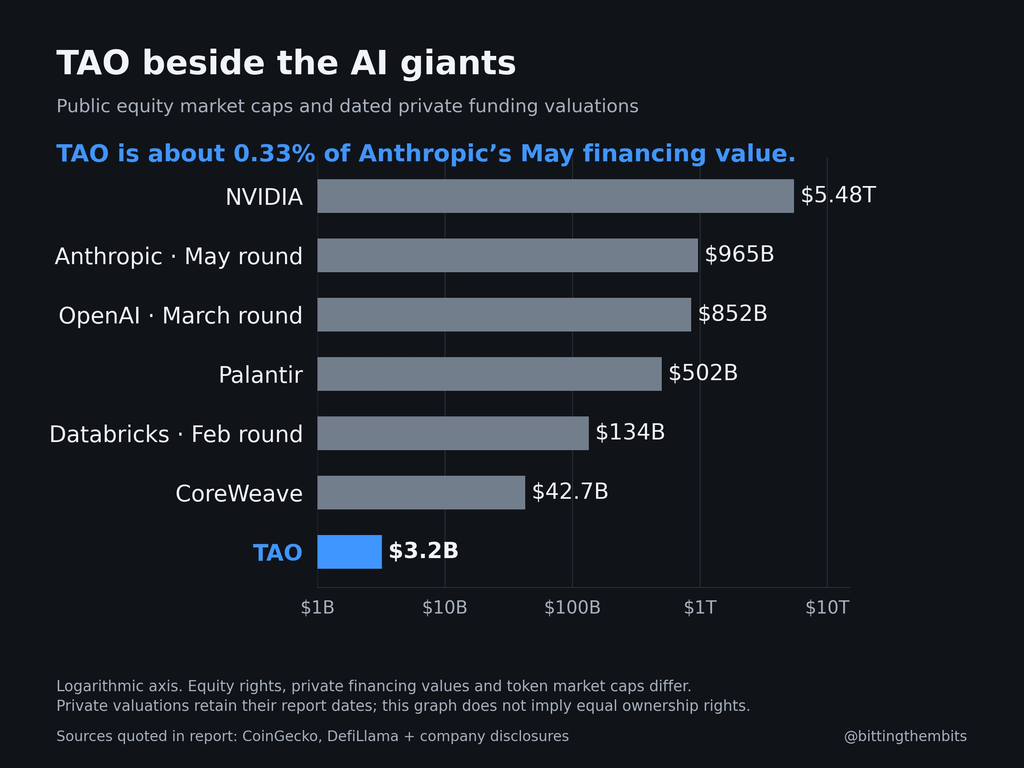
The AI industry has repeatedly attracted large valuations for businesses with comparatively early revenue.
Thinking Machines, for example, was valued at $12 billion in July 2025 before releasing a product. It subsequently sought a valuation around $50 billion while its revenue was still described as early and modest.
Based on current revenue, TAO at 49x to 64x is not cheaper than NVIDIA, OpenAI or Anthropic. Its multiple is closer to Palantir’s.
The bullish argument therefore rests on the potential for rapid growth from a much smaller revenue base.
Recent growth figures include:
- CoreWeave: annual revenue growth of 112%.
- Palantir: annual revenue growth of 93%.
- Databricks: annual revenue growth exceeding 65%.
- Bittensor subnets: monthly revenue growth of 43% to 56%.
These figures cover different measurement periods, but they illustrate the pace of expansion being reported across the AI industry.
Lium Compared With CoreWeave
CoreWeave and Lium offer a more direct comparison because both provide GPU computing infrastructure.
CoreWeave trades at approximately nine times revenue when its debt is included. It also recorded a $626 million net loss in its latest quarter.
Lium has a subnet token valuation of approximately $148 million and trades at about 8.7 times its annualized GPU spending, which grew 45% over 30 days.
CoreWeave is approximately 600 times larger by the stated valuation comparison, and most of Lium’s spending goes to GPU providers.
This means a decentralized GPU cloud is already being valued at roughly the same revenue multiple as CoreWeave, while reporting faster month-over-month growth.
For additional perspective, $1 billion in annual Bittensor revenue would represent just 2% of OpenAI’s reported revenue run rate.
The Subsidy Math That Rarely Gets Discussed
Bittensor’s paying customers already generate revenue equivalent to approximately 13.5% to 17.5% of the dollar value of what the network issues annually.
Bitcoin’s annual fees represent approximately 0.65% of its issuance value.
Bittensor
- Daily issuance: 3,600 TAO.
- Annual issuance: 1.314 million TAO.
- Annual issuance value at $282.50: approximately $371 million.
- Annual subnet revenue: $50 million to $65 million.
- Revenue as a percentage of issuance value: 13.5% to 17.5%.
Bitcoin
- Daily issuance: 450 BTC.
- Annual issuance: 164,250 BTC.
- Annual issuance value at $82,839: approximately $13.6 billion.
- Annual transaction fees: approximately $88 million.
- Fees as a percentage of issuance value: 0.65%.
Relative to the value of what each network issues, Bittensor’s external revenue coverage is approximately 21 to 27 times Bitcoin’s fee coverage.
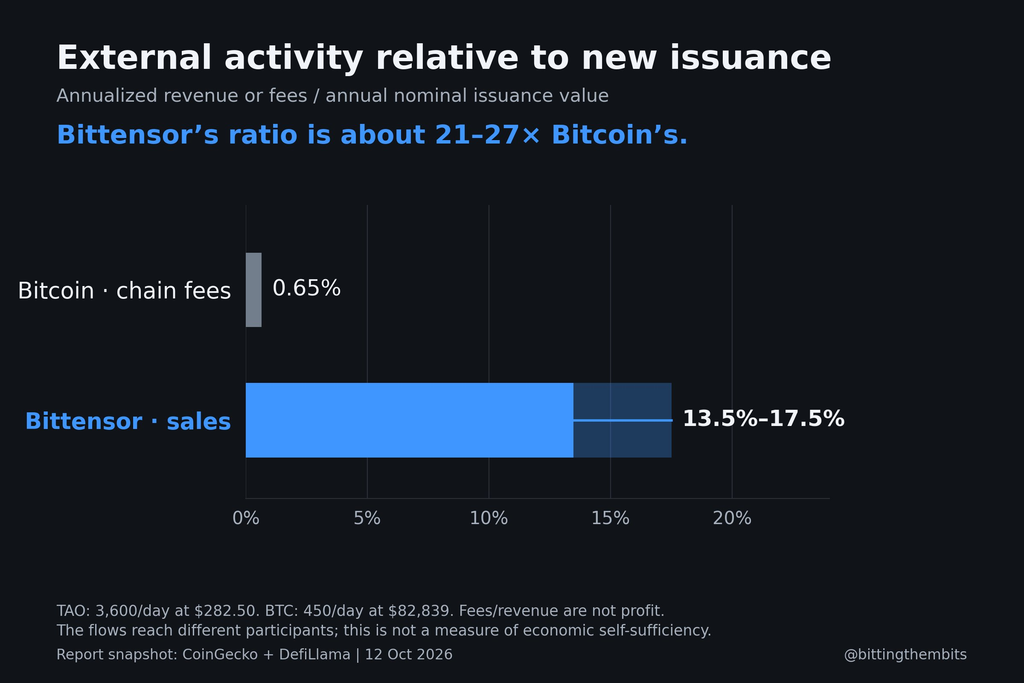
A common criticism of TAO is that its economy depends heavily on emissions.
Based on this comparison, however, Bittensor generates considerably more external revenue relative to issuance than Bitcoin generates in transaction fees.
There are important differences.
Bitcoin’s fees are paid to miners, while Bittensor’s external revenue goes to subnet businesses and their miners. Revenue is not profit, and Bittensor’s annual issuance value is still approximately six to seven times its reported revenue.
The next halving, expected around late 2029 to early 2030, would reduce daily issuance to approximately 1,800 TAO.
Where TAO Could Go Under Different Revenue Scenarios
These scenarios are not price predictions. They illustrate what TAO’s current valuation would imply at different levels of revenue.
Using a $3.2 billion market capitalization:
| Annual Revenue | Valuation Multiple |
|---|---|
| $100M | 32x |
| $250M | 12.8x |
| $500M | 6.4x |
| $1B | 3.2x |
Two-Year Revenue Growth Scenarios
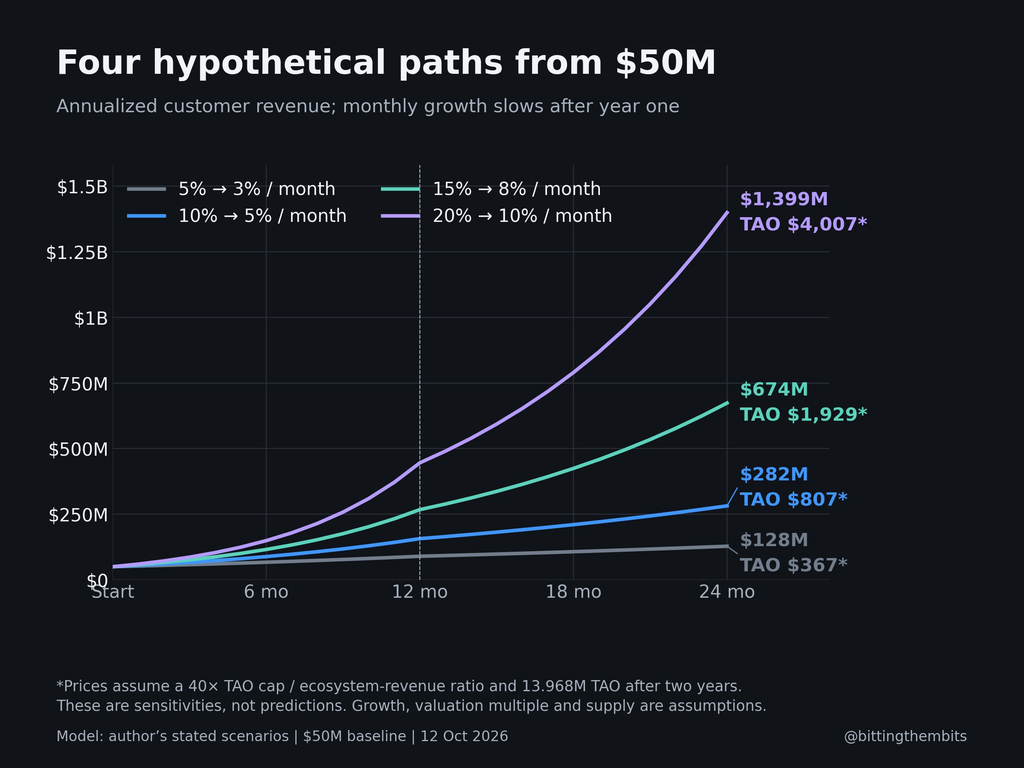
Starting from $50 million in annualized revenue, the following scenarios assume growth slows during the second year.
| Monthly Growth in Year 1 | Monthly Growth in Year 2 | Revenue Run Rate After 2 Years |
|---|---|---|
| 5% | 3% | $128M |
| 10% | 5% | $282M |
| 15% | 8% | $674M |
| 20% | 10% | $1.4B |
At a 40x revenue multiple and approximately 13.97 million TAO in circulation after two more years of issuance, those scenarios imply the following prices:
| Revenue Scenario | Implied TAO Price |
|---|---|
| $128M | $367 |
| $282M | $807 |
| $674M | $1,929 |
| $1.4B | $4,007 |
These projections depend on the assumed growth rates, valuation multiple and future circulating supply.
What If TAO Matched Other Networks’ Market Capitalizations?
Using today’s estimated circulating supply of 11.34 million TAO:
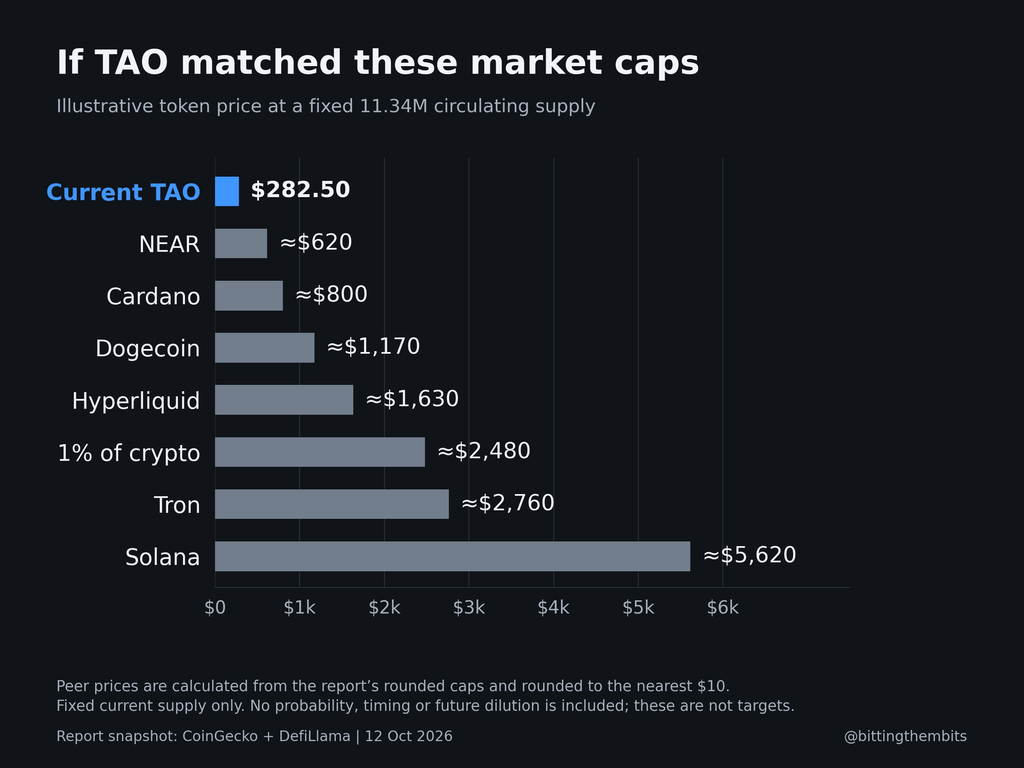
NEAR generates approximately $2.25 million a year in fees, Cardano $1.45 million and Dogecoin $0.28 million.
Matching their market capitalizations would therefore mean catching up to networks that currently generate a fraction of Bittensor’s reported subnet revenue.
Stillcore Capital has also outlined a longer-term scenario in which Bittensor’s ecosystem exceeds $1 trillion in value by 2030.
At a 40x multiple, that would require approximately $25 billion in annual revenue, or roughly fourfold annual growth.
Importantly, that scenario concerns the entire ecosystem’s value across TAO, subnet tokens and businesses, not TAO’s market capitalization alone.
What Most People Are Missing About Bittensor’s Revenue Growth
Several developments could influence how revenue growth translates into economic value across Bittensor.
1. Customer Revenue Is Flowing Through Subnet Tokens
Customer payments can create demand for subnet alpha tokens.
Lium collects USD from GPU renters and pays GPU providers in alpha.
In the August Revenue Index, Engy directed 100% of its revenue into buybacks, while Almanac directed 100% of its fees toward the same purpose.
Bitcast has purchased approximately $276,700 of alpha against $461,900 in lifetime revenue, representing a buyback ratio of 59.9%.
Buying alpha involves TAO moving into subnet liquidity pools, creating a connection between commercial activity and the wider Bittensor token economy.
2. AI Agents Are Already Becoming Customers
Of Lium’s recent GPU rentals, 68.7% were initiated by code and AI agents, up from 63% one month earlier.
This suggests software-driven demand is becoming increasingly important.
Instead of relying entirely on individual users manually renting infrastructure, automated systems can now initiate much of the demand.
3. Institutional Infrastructure Is Developing
Grayscale and Bitwise filed for spot TAO exchange-traded funds in late April 2026.
Grayscale’s proposal would convert its existing GTAO trust into a product listed on NYSE Arca.
Its June 30 report showed that the trust was still trading over the counter and held 46,331 TAO, worth approximately $13 million at the October 12 reference price.
Neither proposed ETF had been confirmed as approved in the report.
4. TAO’s Available Supply Is Relatively Small
Approximately 11.34 million of the maximum 21 million TAO have been issued, representing around 54% of total supply.
BlockEden estimated that approximately 68% of the supply was locked as of May.
This means new demand would be entering a market where a significant proportion of existing tokens is staked rather than freely circulating.
5. Bittensor’s Revenue Is Growing Faster Than Many Comparable Networks
Changes in revenue over the latest 30 days, compared with the preceding 30 days, show:
| Project | Revenue or Fee Growth |
|---|---|
| Ethereum | +55% |
| Bittensor subnets | +43% to +56% |
| Solana | +21% |
| Pump | +15% |
| Hyperliquid | -9.9% |
| Uniswap | -28% |
| Aethir | -55% |
Only Ethereum, whose fees increased 55% from a relatively low base, matched Bittensor’s reported growth range during the period.
6. Revenue Data Is Becoming More Transparent
Some Bittensor subnets are publishing dashboards and revenue reports that allow outside observers to monitor their commercial performance.
Lium publishes monthly statistics and maintains a live Grafana dashboard.
Bitcast operates a live revenue and buyback dashboard.
Meanwhile, taorevenue.com tracks on-chain inflows across individual subnets.
The question of whether Bittensor subnets generate revenue is therefore becoming easier to investigate using publicly available information.
The Bear Case for TAO
Despite the growth figures, several risks deserve attention.
The comparisons are not directly equivalent. TAO holders do not own subnet revenue. Blockchain transaction fees, protocol revenue and subnet business sales represent different economic activities.
Revenue estimates are not independently audited. SubConnect and Stillcore Capital are ecosystem participants. Stillcore also holds TAO and subnet tokens, creating a financial interest in the network’s success. Most of the revenue is reportedly paid off-chain.
Revenue remains concentrated. Lium alone accounts for approximately one-third of the reported $50 million. Lium, Targon and Engy are responsible for much of the recent acceleration.
One month does not establish a long-term trend. Sustaining 40% monthly growth for an entire year would take revenue to approximately $2.8 billion. Such growth rates are difficult to maintain indefinitely.
Emissions remain substantially larger than revenue. The network issues approximately $371 million worth of TAO annually, compared with $50 million to $65 million in estimated subnet revenue.
Direct on-chain value capture remains limited. Taorevenue.com’s 30-day data shows approximately $6.3 million in inflows and burns across all subnets.
Other revenue-generating assets trade at cheaper multiples. Hyperliquid trades at approximately 21.8 times revenue, Pump at 3 times and NVIDIA at 14 times.
Token dilution remains a factor. At 3,600 TAO issued daily, supply grows by approximately 11.6% annually until the next halving.
These concerns are significant.
However, they do not change the reported direction of revenue growth. Subnet revenue increased between 43% and 56% over the month, while TAO’s price rose 22.8%.
That means its revenue multiple declined over the period, rather than increasing.
Bottom Line
TAO does not necessarily have to be cheaper than Hyperliquid or NVIDIA today to represent an early-stage opportunity.
The central argument rests on several observations.
- Bittensor has a $3.2 billion market capitalization, equivalent to approximately 0.11% of the crypto market and 0.33% of Anthropic’s valuation.
- External subnet revenue grew more than 40% in one month, roughly twice as fast as TAO’s price.
- Paying customers generate revenue equivalent to a greater proportion of Bittensor’s issuance value than Bitcoin’s fees represent relative to Bitcoin issuance.
- Bittensor’s subnets generate more annual revenue than six decentralized AI networks with a combined valuation 3.6 times larger.
- TAO remains approximately 63% below its 2024 all-time high, even as commercial revenue has reportedly grown significantly over the past year.
The market values Dogecoin at approximately 47,000 times its annual fees and Ethereum at around 1,400 times.
TAO trades at 49 to 64 times a revenue base that is currently growing quickly.
Tripling subnet revenue would bring TAO’s valuation multiple close to Hyperliquid’s current level without requiring a change in TAO’s market capitalization.
That is the central investment thesis presented by the data.
Disclosure: I hold TAO and subnet tokens. No paid arrangements.
Disclaimer: This article is not financial advice. Always do your own research (DYOR).
Sources
Market capitalizations are based on CoinGecko data from October 12, 2026. Fee and revenue estimates are based on DefiLlama’s latest 30-day figures, annualized using 365/30. Bittensor subnet revenue figures are based on SubConnect and Stillcore Capital estimates.
- SubConnect (@WeAreSubConnect), Bittensor Revenue Index update on X
- Stillcore Capital, TAO 2030
- The TAO Daily, Revenue Index, Volume I
- CoinGecko and its Bittensor subnets category
- DefiLlama fees and chain fees
- Lium monthly review and provider documentation
- Bitcast revenue dashboard
- taorevenue.com
- Anthropic Series H announcement
- OpenAI, March 31 financing
- AI Weekly’s reporting on the Financial Times’ OpenAI revenue coverage
- NVIDIA Q2 Fiscal 2027 results
- Palantir Q2 2026 results
- CoreWeave Q2 2026 results
- DefiLlama market capitalization data for NVIDIA, Palantir and CoreWeave
- Databricks, February 9 announcement
- Implicator coverage of Thinking Machines
- Grayscale Bittensor Trust 10-Q, June 30, 2026
- BlockEden reporting on spot TAO ETF filings
Enjoyed this article? Join our newsletter
Get the latest TAO & Bittensor news straight to your inbox.
We respect your privacy. Unsubscribe anytime.
Enjoyed this article?
Join our newsletter
Get the latest TAO & Bittensor news straight to your inbox — every morning before markets open.
No comments yet — be the first.