

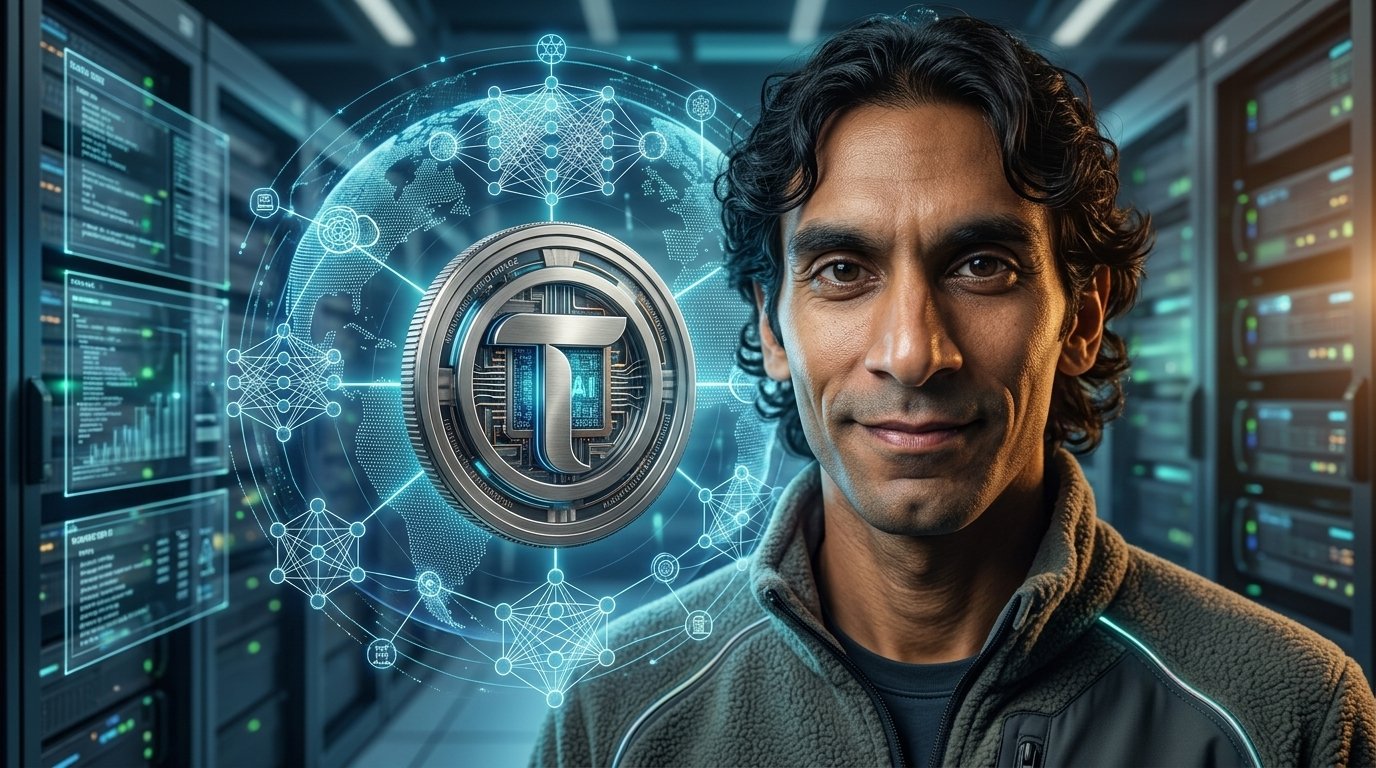
In this episode of Milk Road, host John Charbonneau sits down with Karia Samaroo, founder and CEO of xTAO, founder of WonderFi (acquired by Robinhood), and one of the most publicly convicted advocates for decentralized AI.
The conversation covers WonderFi’s acquisition, why Karia believes centralized AI is a bigger risk than most people admit, how the Bittensor ecosystem actually works, and why he holds only two crypto assets: Bitcoin and TAO.
The WonderFi story and what Robinhood’s move means
Karia founded WonderFi as a regulated, trusted, consumer-friendly Canadian crypto exchange. Robinhood recently acquired it, and he sees the acquisition as more significant because Robinhood isn’t a crypto company.
- Robinhood is launching its own chain, building tokenized stocks, and integrating crypto across the entire company.
- Their international expansion strategy included WonderFi (Canada) and Bitstamp (Europe).
- He says: “It’s a tradfi company acquiring a crypto company. That shows you directionally where finance is headed.”
The centralized vs. decentralized AI debate
Asked about Dario Amodei’s recent warning to Congress that open-source AI is heading down a dangerous path, Karia’s counter was pointed:
“Is it more dangerous that this incredibly powerful tool is accessible to everyone or that it’s only accessible by two companies?”
His broader concern is data. People are already feeding LLMs their finances, health issues, deepest emotional problems because the utility is that high. He compares it to 23andMe, which started as genetic testing and ended up licensing user data to insurance companies. “You ask a friend what they’re putting into ChatGPT or Claude and it’s terrifying.”
The Bitcoin analogy he makes:
“AI intelligence is a more valuable tool than money. Why would we centralize and aggregate all of that wealth of information and power with a few companies that have questionable intentions?”
A clear explanation of how Bittensor works
For newcomers, Karia’s breakdown is one of the more digestible ones:
Three roles:
- Subnet owners define the problem to be solved (e.g., deepfake detection, text-to-video, LLM inference).
- Miners build and train models to solve that problem, competing minute by minute.
- Validators score the miners’ outputs and determine who gets rewarded.
Emission split:
- 41% → miners
- 41% → validators
- 18% → subnet owners
The killer detail: miners are not successful across multiple subnets. Each subnet attracts genuine domain experts, often PhDs in that specific field. A text-to-video expert can’t just show up on an LLM subnet and win. The network effectively recruits specialists and pays them to do what they’re best at.
The “will this be self-sustaining?” question
Karia acknowledged this is the critical question. His answer, and the metric he tells investors to watch:
“If subnets are not able to create meaningful revenue outside of Tao emissions, then everything fails. It doesn’t work.”
Three of the top five compute-focused subnets are doing ~$20M ARR collectively. Not massive yet, but the point isn’t the size, it’s that customers who know nothing about Bittensor are paying for these products because they solve real problems. The ecosystem is also moving toward public-company-style revenue disclosures by subnets, which will make separating the real businesses from the emission-dependent ones much easier.
His metric to watch: external revenue. That’s it.
What xTAO is
There’s often confusion about whether xTAO is a subnet, a treasury company, or something else. Karia’s clarification:
- Publicly traded company that holds a large amount of TAO.
- Runs one of the leading validators on the Bittensor network.
- Focused on being a trusted, simple, accessible entry point for institutional and retail investors who want TAO exposure without navigating the ecosystem’s complexity.
xTAO’s flywheel: staking TAO supports the validator, the validator draws more stakers, more stakers generate more revenue.
What Bittensor success looks like
Two markers, in his view:
- People use Bittensor without knowing it. The best subnets are already headed here; high-quality products where Bittensor and crypto aren’t part of the user-facing pitch.
- Companies like Google and Microsoft launch subnets because it becomes the fastest way to attract world-class talent to solve a specific problem permissionlessly, without the constraints of raising capital and hiring.
What’s currently in the way:
- Awareness: the mainstream still doesn’t understand what happened when the Fable model got briefly banned in the US, but the decentralized AI community understood it immediately as validation of the whole thesis.
- Market conditions: awareness scales when Bitcoin is strong and money is flowing.
- Global AI incidents: the equivalent of the 2008 banking crisis for AI is coming, and when it does, decentralized alternatives will move from fringe to obvious.
Why he holds only Bitcoin and TAO
This is the section worth pausing on. Asked to walk through the conviction:
“I only invest in things that I understand and that I believe in. Bittensor is the only thing I have found since Bitcoin, potentially other than gold, that falls into that category.”
He tells the story of pivoting from law to crypto in 2016 after discovering Bitcoin, then making the classic mistake of chasing altcoins he didn’t really understand, then coming back to the rule that saves him now: deep belief plus deep understanding.
His self-awareness about it is worth quoting:
“For me, there’s been nothing that has brought me more energy and got me more convicted than Bittensor, other than Bitcoin.”
His outlook and what to watch
- Price prediction: he passes that question. He’s a founder and not a trader.
- The signal to actually watch is subnet revenue. Everything else is noise.
- Moment that mattered this year: Jensen Huang mentioning Bittensor on the All-In Podcast. Those kinds of mainstream co-signs from AI-adjacent voices are what accelerate broader awareness.
- Longer term: TAO will eventually decouple from crypto entirely and be seen as an AI infrastructure asset. Until then, macro Bitcoin conditions still drive it.
Bottom line
The competitor to Bittensor isn’t Anthropic or OpenAI; those are the reasons Bittensor exists. As centralized AI grows, the case for decentralized alternatives grows with it. The question isn’t whether decentralized AI matters. The question is whether Bittensor’s specific coordination mechanism becomes the layer where decentralized AI happens.
For someone who founded and exited a nine-figure crypto company and now allocates only to Bitcoin and TAO, that conviction lands with more weight than usual.
Full interview here:
Enjoyed this article? Join our newsletter
Get the latest TAO & Bittensor news straight to your inbox.
We respect your privacy. Unsubscribe anytime.
Enjoyed this article?
Join our newsletter
Get the latest TAO & Bittensor news straight to your inbox — every morning before markets open.

Be the first to comment