


The OpenTensor Foundation has increased Bittensor’s emission gate threshold from rank 32 to 48, allowing more subnets to receive meaningful TAO emissions.
The change, announced on November 23, accompanies the expansion of Bittensor’s subnet limit from 128 to 160, giving more AI projects room to launch and compete for network rewards.
The emission gate determines how strongly a subnet’s demand translates into its share of newly issued TAO.
Introduced through the V440 upgrade in July, the mechanism concentrates emissions among higher-demand subnets while sharply reducing rewards for weaker or inactive projects.
It does not completely cut off lower-ranked subnets, but makes earning substantial rewards much harder without sufficient market demand.
Moving the threshold to rank 48 effectively widens the group of subnets that can compete for larger allocations. Previously, the gate centered around the 32nd-ranked subnet, with rewards falling sharply below that level.
The new threshold moves that boundary down by 16 positions, giving middle-ranked projects a better opportunity to earn emissions without changing the network’s total issuance.
The adjustment also changes how rewards are distributed among existing subnets. With more projects receiving a larger share, some of the highest-ranked subnets will receive less than they would have under the previous setting.
The changes remain demand-driven, meaning a subnet’s position and rewards can change as its market demand changes.
An analysis shared by Bittensor Intern estimates that the top 32 subnets could collectively lose around 6.2% of their previous emission share, while subnets ranked 33 through 48 could see their combined allocations increase by approximately 107%.
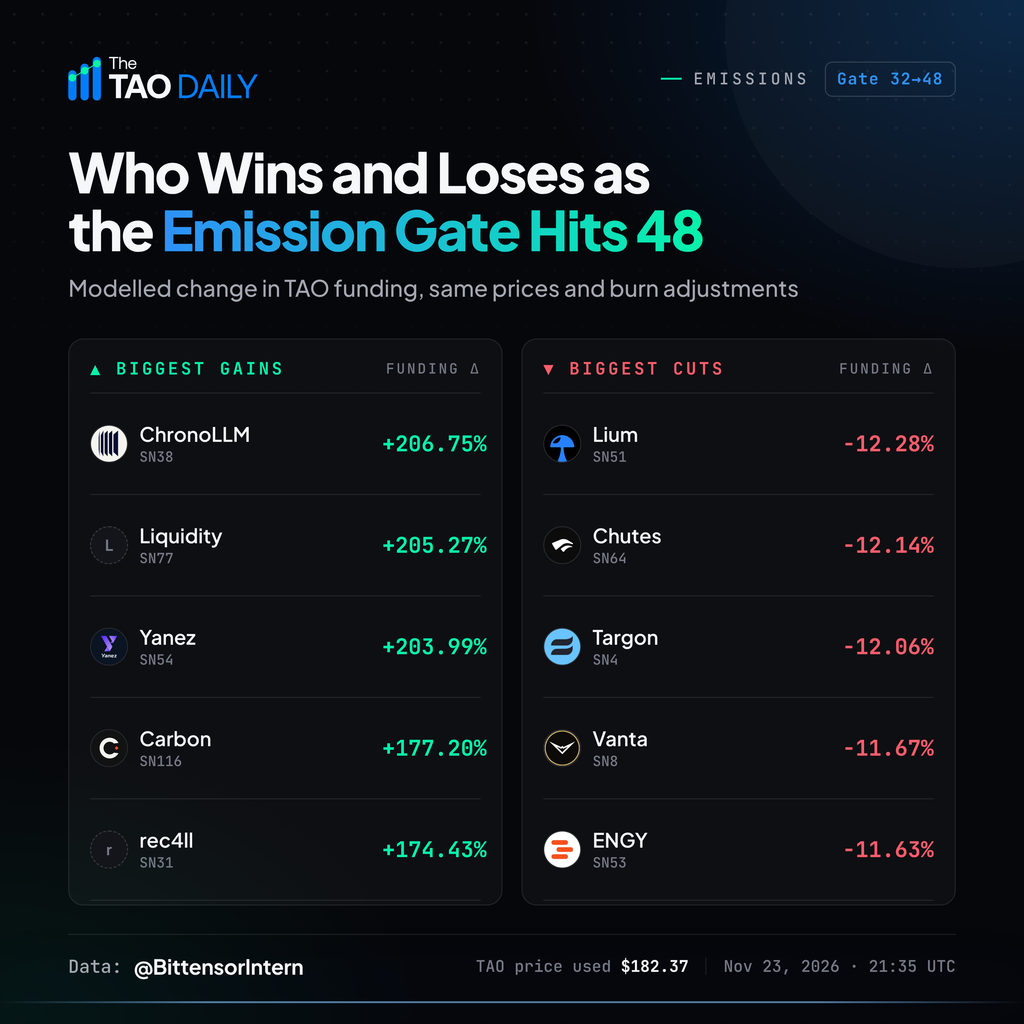
Leading subnets including Lium (SN51) and Engy (SN53) could experience reductions exceeding 11%. These estimates assume subnet prices and burn adjustments remain unchanged, so actual results may differ.
For subnet builders, the update improves the opportunity to secure network funding. Projects that previously struggled to earn significant emissions now have a wider path to compete, provided they attract enough demand for their alpha tokens.
For stakers, the redistribution could also affect expected rewards across different subnet positions.
The two changes reflect Bittensor’s broader approach to growth. Expanding the subnet cap creates room for more AI projects, while widening the emission gate gives a larger group access to meaningful funding.
Enjoyed this article? Join our newsletter
Get the latest TAO & Bittensor news straight to your inbox.
We respect your privacy. Unsubscribe anytime.
Enjoyed this article?
Join our newsletter
Get the latest TAO & Bittensor news straight to your inbox — every morning before markets open.


No comments yet — be the first.