


When Mark Jeffrey asked his Hermes agent to help set up a Bittensor miner, the agent recommended renting GPUs from Vast or RunPod and using Backblaze for storage.
It never mentioned Bittensor alternatives such as Lium (SN51), Targon (SN4) or Hippius (SN75), even though those options are ~50 to 90% cheaper for inference and in the case of storage, as low as one-tenth to one-hundredth the price of traditional providers at the same quality and speed.
The problem was not that these products had nothing to offer. The agent simply did not know enough about them to recommend them.
That experience captures a growing challenge for businesses and Bittensor subnets. As people increasingly turn to AI assistants for product recommendations, being good at what you do is not enough if the models never mention your product.
In a Hash Rate podcast conversation with Mark Jeffrey, Gordon Frayne introduced Optia (SN47), a Bittensor subnet built to measure and improve how businesses appear in AI-generated recommendations.
The Visibility Problem
Mark’s example is becoming increasingly relevant as AI assistants take on more product research. He expects the next stage to involve agents making purchases themselves, which means the products they recommend could directly influence where money goes.
Optia addresses this through AI visibility, often discussed under terms such as AI Engine Optimization (AEO) and Generative Engine Optimization (GEO).
The goal is to understand which brands appear when people ask models such as ChatGPT, Claude, Perplexity and DeepSeek for recommendations.
Mark demonstrated the problem by running Optia’s free scan on Lium. The results showed:
1) 18% visibility, with Lium appearing in 22 of 120 answers.
2) Strong competition from RunPod, Vast.ai and Lambda across several GPU-related questions.
3) Different results across models, with Lium performing better on some queries and platforms than others.
The scan showed that established providers were being recommended more frequently, even though Bittensor alternatives were competing in the same market.
Traditional Search Engine Optimization (SEO) still contributes to visibility because AI models often draw on search results and other online sources.
However, the final response increasingly gives users a shortlist of brands, making it important for businesses to know whether they appear in those recommendations.
How Optia Works
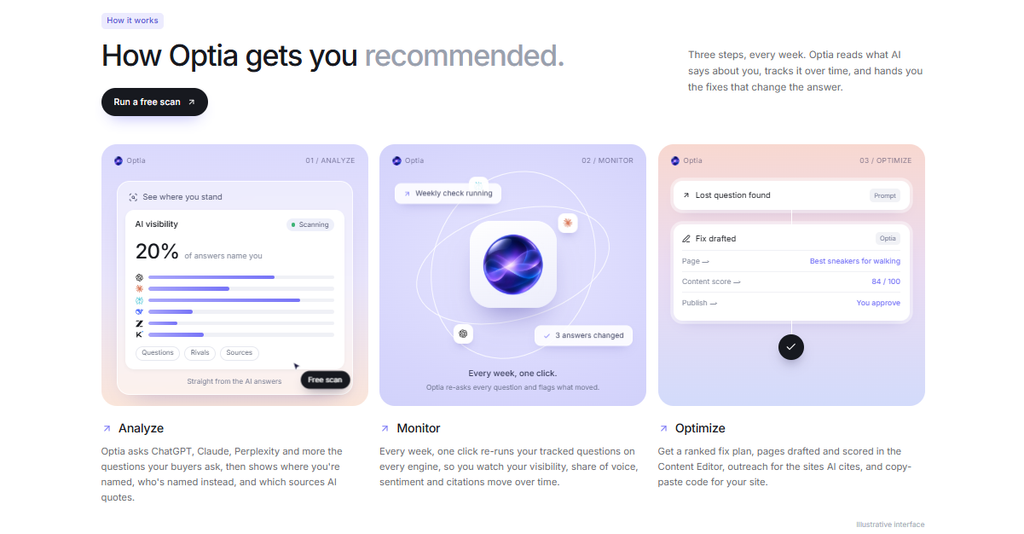
Optia turns that visibility problem into a process businesses can measure and improve.
Its platform follows three stages.
1) Analyze: Optia examines a business website, generates questions potential customers might ask when looking for that type of service, and runs them across several AI models such as ChatGPT, Claude, Perplexity and DeepSeek, recording which businesses appear in the responses.
The report shows the brand’s visibility score, which questions it wins or loses, the competitors being recommended and the sources cited in the answers.
2) Monitor: Paid plans repeat the tracked questions weekly, allowing businesses to see whether their visibility is improving or competitors are gaining ground.
3) Optimize: Optia provides prioritized recommendations based on the results. These include:
a) Content opportunities: Pages that answer specific questions potential customers are asking.
b) Citation opportunities: Relevant websites and sources that mention competitors but may not mention the business.
c) Technical improvements: Website updates such as llms.txt, XML sitemaps and schema markup to make information easier for AI systems to access.
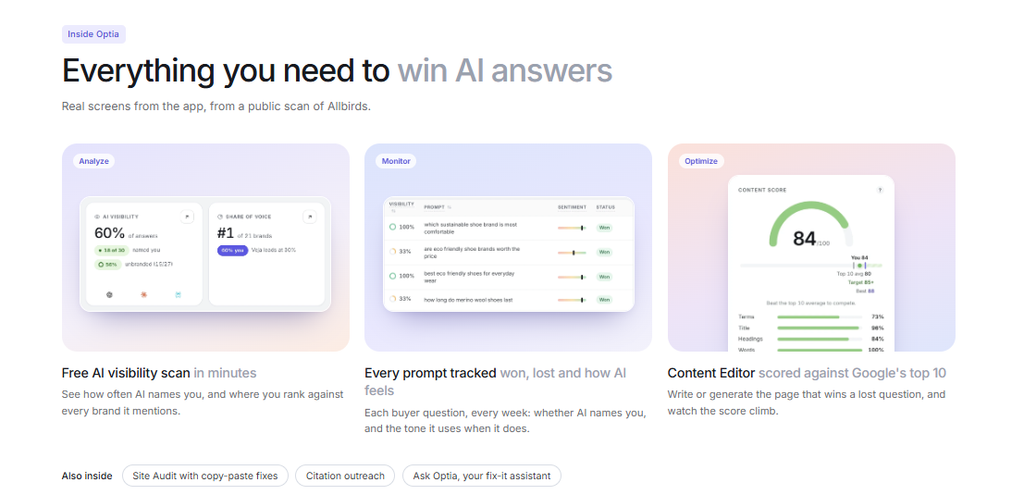
The platform can also help draft answer-focused articles using competitor research and existing search results. Users can review and edit the content before publishing, while its guidance assistant helps explain how to implement recommended changes.
Gordon also discussed an MCP integration designed to let connected agents access Optia’s findings and help implement fixes (it had been built but was not yet live in the dashboard during the interview).
Getting Started with Optia
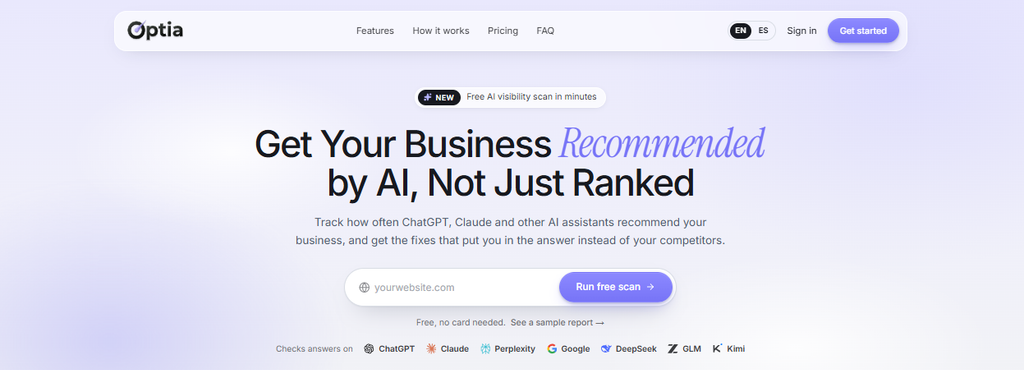
Businesses and subnet teams can start with a free scan at tryoptia.com.
The scan provides an initial view of how often AI models recommend a brand, which competitors appear more frequently and where visibility could be improved.
For a subnet, this is a practical first check. Ask the AI models questions that potential customers would ask about your service, then see whether your product makes the shortlist.
Pricing and Early Traction
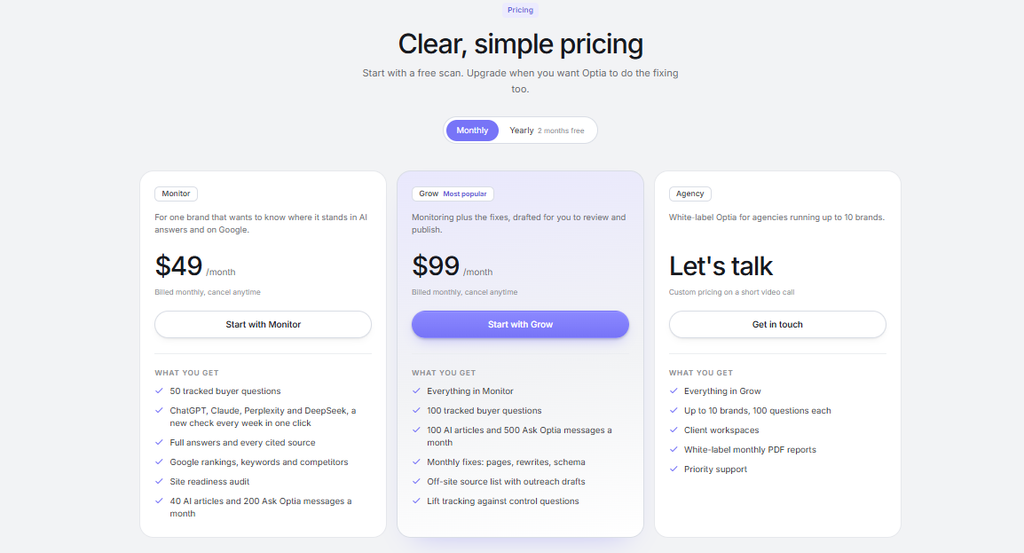
At launch, Optia introduced paid plans at $49 and $99 per month, with the higher tier offering more tracked questions, optimizations and content drafts. Agency options and an API offering also extend its use to teams managing multiple businesses.
Gordon said the project was already onboarding Bittensor subnets and external businesses and had begun generating revenue within days of launch.
From Being Good to Being Discovered
Gordon Frayne brings experience from both Bittensor mining, particularly through Bitcast (SN93), and running an e-commerce agency that built SEO services for Shopify brands.
Optia brings those two areas together by applying familiar visibility work to a growing source of product discovery.
Bittensor has projects building services across compute, inference, storage and more.
The next challenge is making sure AI assistants can find and recommend them. Optia gives the ecosystem a way to measure that visibility, identify what is missing, and start closing the gap.
≫ For more on Gordon’s earlier work in the ecosystem, see our earlier coverage, HERE
Enjoyed this article? Join our newsletter
Get the latest TAO & Bittensor news straight to your inbox.
We respect your privacy. Unsubscribe anytime.
Enjoyed this article?
Join our newsletter
Get the latest TAO & Bittensor news straight to your inbox — every morning before markets open.


No comments yet — be the first.