

Most of what AI does inside a business is boring. Route this ticket. Flag this payment. Approve it or escalate it. Pick the next step.
For the past two years, companies have been paying chatbots to write paragraphs just to get a one-word answer. That is slow, expensive and messy. A new kind of AI model fixes it, and a Bittensor subnet called REAX (SN92) is already one of the best at building it.
What a decision model is
A chatbot writes its answer word by word. A decision model writes nothing. You give it the situation and a fixed set of options, and it hands back a probability for each option in a single pass.
Ask “is this transaction fraud?” and instead of an essay you get something like 92% yes, 8% no. Your software reads that number and acts on it. High confidence and it goes ahead. Low confidence and it sends the case to a human.
That simple change rewrites the economics. Google says its new decision model answers in 150 to 250 milliseconds and charges nothing for output. Microsoft prices its version at roughly four cents per million input tokens. Now compare that with paying a frontier chatbot for every tiny yes-or-no call an AI agent makes all day.
Why everyone suddenly cares
This category is barely two months old. TypeSafe launched Jev, the first public “System One” model, on 15 September 2026. Within three weeks its CEO claimed 29.4% of the Fortune 500 had tried it.
Then the giants piled in. Microsoft released Decision-1 on 9 October. Google launched Gemini Decision 1 on 11 November. Liquid AI, Amazon, Cloudflare and Databricks all shipped their own versions in between. When that many big players move at once, it stops being an experiment. It becomes infrastructure.
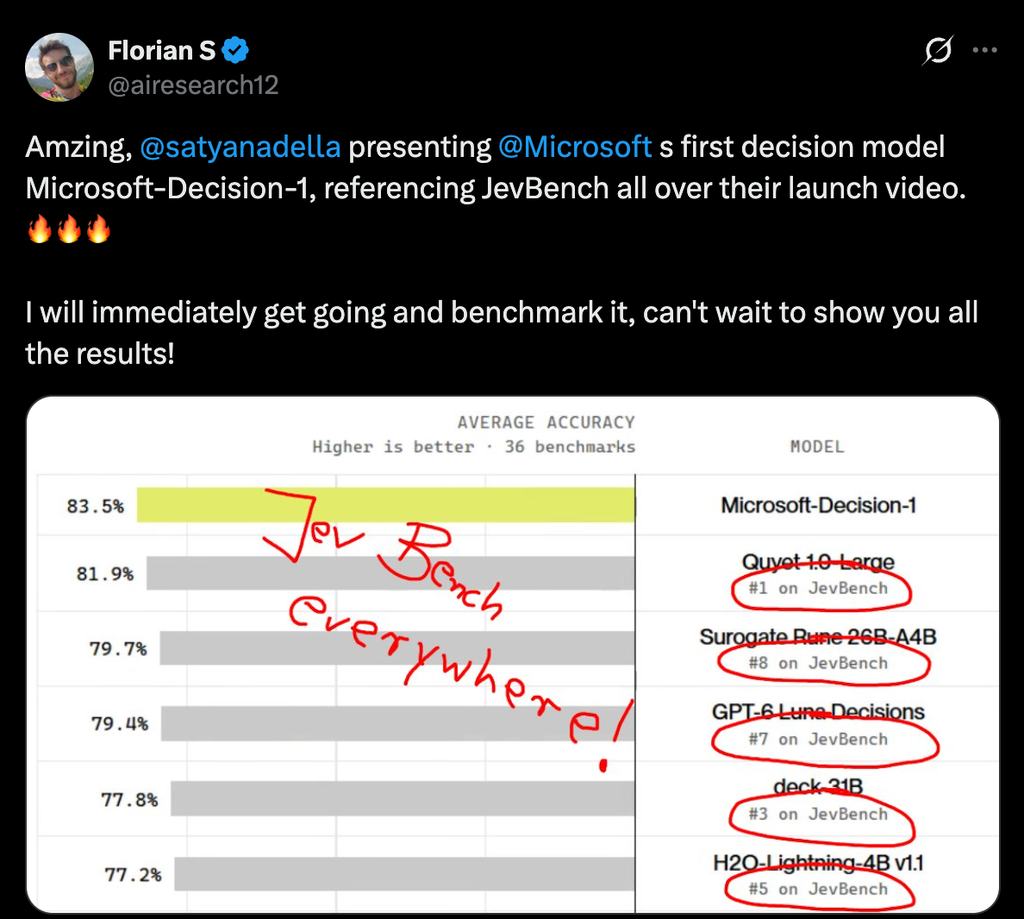
Here is an interesting part for Bittensor folks. Microsoft benchmarked its new model on JevBench, a test suite run as a sister project to REAX. The yardstick the biggest labs are using in this race comes from the same people building on Subnet 92.
What REAX did
REAX is Subnet 92, and it does two jobs.
The first is serving. Miners host decision models on their own GPUs, and validators check every answer by rerunning the same pinned model and comparing results. Swap in a cheaper or different model and you get caught and penalised.
The second is a training competition. Miners fine-tune their own decision models and submit them. The best ones get picked up by the team.
That competition is where REAX 1.3 came from. Miners submitted 98 entries. The team chose two, from the miners at UID 18 and UID 83, and blended each with a strong open model, PelaAI’s KnowLine-31B and vLLM-SR’s d3-ultra. Both halves run side by side on a single GPU, each one votes, and the final answer is the average.
It was released on 3 November with open weights under Apache-2.0. Within days it sat at #1 out of 274 models on the Jev Decision Index hosted on Hugging Face, with a score of 74.0.
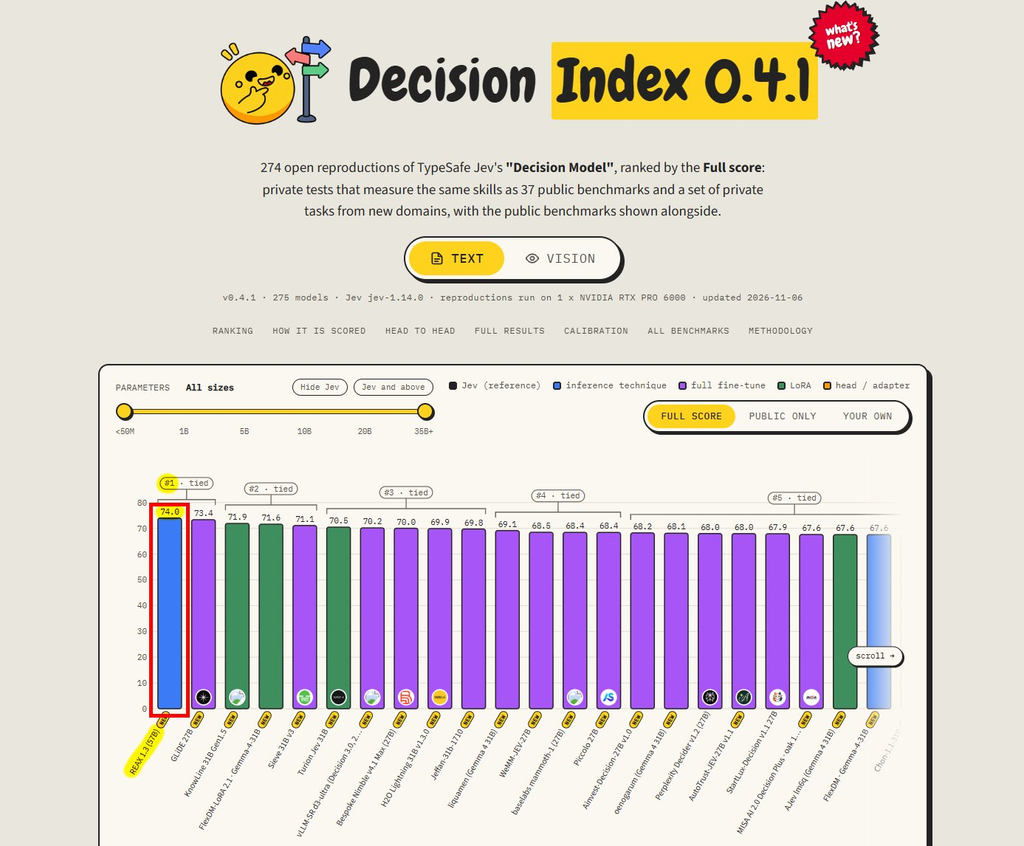
The rankings have since changed, with REAX 1.3 sitting third at 72.64 in the November 12 leaderboard update. But the initial result raises a bigger question. Can decentralized AI networks compete with established AI companies in a category that could become essential to how businesses and AI agents operate?
Why this matters for Bittensor
Bittensor has spent years arguing that open incentives can produce frontier-grade AI. Critics keep asking for proof that is not a pitch deck.
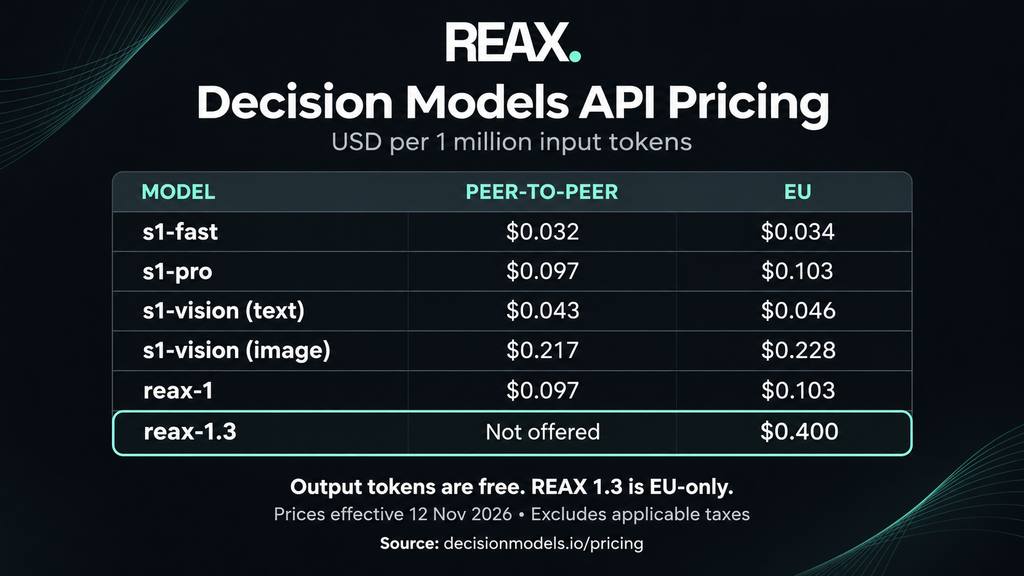
This is proof you can download. Anonymous miners trained the core of a model that topped a public leaderboard of hundreds of entries, in weeks, with no single lab behind it. And the same network serves it, with checked answers, at €0.40 per million input tokens through the Decision Models API.
Decision models also suit Bittensor almost perfectly. The task is narrow, the scoring is objective and every improvement is easy to measure. That makes it hard to game and easy to reward. Expect more subnets to go after categories like this one.
It can see, too
Text is not the limit. REAX founder Florian just reported that his decision models can now look at pictures.
Decision Models, the product side of REAX, runs a model called s1-vision. Send it one photo and one question, and it sends back a typed answer with a probability. Ask “is this parcel visibly damaged?” and you get yes, 92%, in 133 milliseconds. It is live on the API now.

That matters more than it sounds. Delivery checks, insurance claims, quality control and receipt checks all come down to someone looking at an image and making a call. Google built Gemini Decision 1 to handle images from launch. REAX is already playing in the same lane.
The bottom line
Chatbots get the headlines. Decision models will quietly run the plumbing of AI agents, and the plumbing is where the volume is.
REAX has not won this race. Nobody has. But it showed up a month after the category was born, built its best model from miner submissions, and remains a frontrunner. The labs should be uncomfortable about that.
≫ See our earlier coverage on REAX’s top models:
Enjoyed this article? Join our newsletter
Get the latest TAO & Bittensor news straight to your inbox.
We respect your privacy. Unsubscribe anytime.
Enjoyed this article?
Join our newsletter
Get the latest TAO & Bittensor news straight to your inbox — every morning before markets open.



No comments yet — be the first.