

On November 13, Beam, Bittensor’s Subnet 105, announced an integration with Chainlink’s Runtime Environment, better known as CRE.
Beam can now prove to a blockchain that it moved your data, and Chainlink’s network vouches for that record. Smart contracts can read that record and decide what to do next.
If you hold SN105 alpha, or you simply follow where Bittensor subnets are finding real-world use, this one is worth your time.
Below we break down what Beam is, what went live, what is coming next, and what it could mean for the subnet.
First, a quick refresher on Beam
Beam is a data transfer network. You tell it to move files from one place to another, and independent operators on the subnet compete to do the job.
Those operators are split into orchestrators and workers. The network measures how well they perform using Proof-of-Bandwidth, which looks at real throughput, speed and reliability. Miners are rewarded for what they deliver, not for what they claim.
Beam already connects to the storage AI teams use every day, including S3-compatible storage, Cloudflare R2 and Hugging Face. It also has Beam Rooms, private spaces where files can be sent to specific AI agents.
The project has grown quickly this year. It marked six months of mainnet activity in September, launched Beam Studio (a visual tool for building transfer pipelines) in late September, and reported moving 1 TB of data in 2 minutes and 42 seconds.
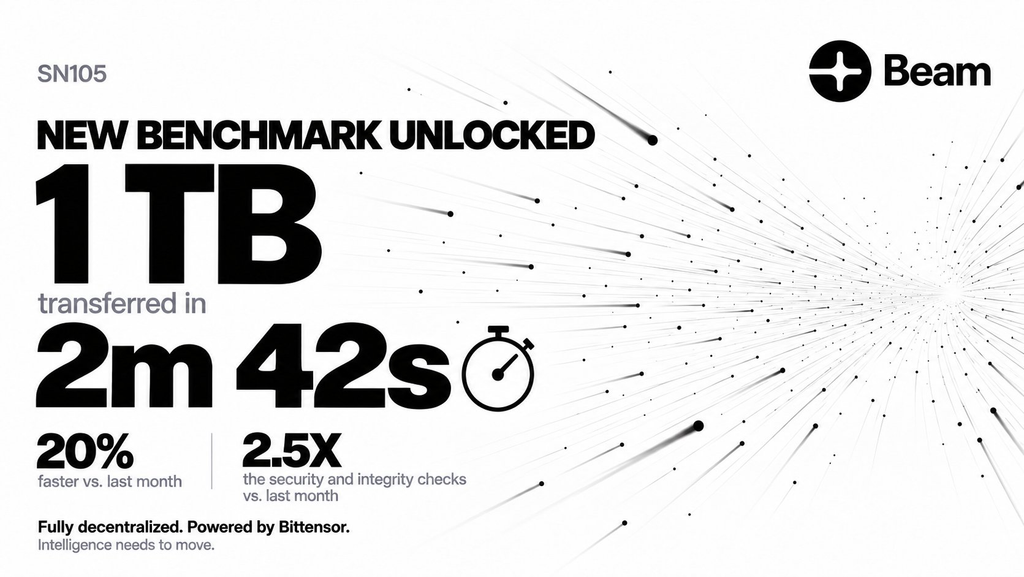
The team reports aggregate bandwidth in the hundreds of gigabits per second, total volume in the petabytes, and more than a thousand miners and operators on the network.
What Chainlink CRE is
Chainlink is the best-known oracle network in crypto. Its job is to bring outside information onto blockchains in a way contracts can trust, and it says it has enabled more than $36 trillion in transaction value.
CRE is Chainlink’s newer orchestration layer. Think of it as a workflow engine that lets one process touch blockchains, APIs and outside systems together, all coordinated by Chainlink’s Decentralized Oracle Networks (DONs).
What CRE did not have was a way to move large files. That is the gap Beam fills.
What is live right now
On Base mainnet, Beam’s transfer reports are now written onchain as receipts attested by Chainlink’s network.
The first receipt covered a 100 GB transfer. The smart contract that stores these receipts is public and verified on BaseScan, so anyone can inspect it.
Here is how a receipt works. When Beam finishes a transfer, several independent Chainlink nodes each read Beam’s report on their own. They then reach agreement on what Beam said, and that agreed result is recorded onchain.
The receipt holds details about the transfer, such as its status, its size, when it finished and digital fingerprints of the data. The data itself never goes onchain. Only the record of the transfer does.
How this builds on what Beam already did
This is not Beam’s first time putting receipts onchain. In late October, Beam launched a Bittensor EVM integration that already recorded transfer and Room delivery receipts smart contracts could read.
The difference is trust. Those earlier receipts came straight from Beam. The new receipts on Base are checked and agreed on by a network of Chainlink nodes, a stronger guarantee for anyone building on top of them.
What comes next
Today the flow runs one way. Beam moves data, and the receipt is verifiable onchain.
The next step flips it around. A smart contract will be able to request a Beam Studio transfer itself, and the receipt will come back onchain when the job is done. The app can then react automatically.
In short, a contract asks for the data, Beam moves it, and the receipt triggers whatever comes next.
What people could build with this
The simplest examples come from AI. A training job could start only once the dataset it needs has a confirmed delivery receipt. Files could go to a private AI agent through a Beam Room, with both inputs and outputs recorded. Access or payment could be released only after delivery is confirmed.
The same idea reaches well beyond AI.
Data sales. A buyer purchases a dataset, Beam delivers it, and the receipt releases payment held in escrow. The buyer still checks the data, but payment no longer waits on someone pressing a button.
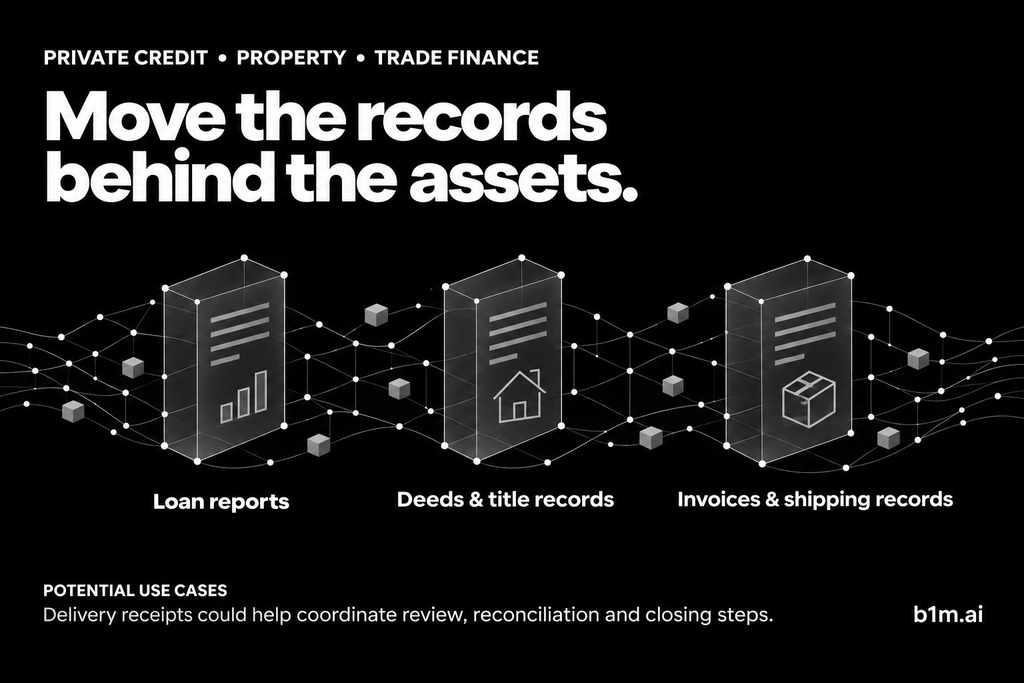
Tokenised assets and private credit. Loan files, collateral reports and valuations need to reach lenders, administrators and auditors. A receipt can kick off reconciliation or document review.
Property deals. Signed deeds, title reports and surveys move between conveyancers, lenders and registries. Receipts can tick off checklist items or help meet escrow conditions, alongside the approvals still required.
Trade finance. Invoices, inspection certificates and shipping records can be delivered with a receipt that triggers review or meets a financing condition.
The common thread is simple. A lot of onchain finance still depends on files that live offchain. Beam turns “the files arrived” into an event a smart contract can act on.
Chainlink itself highlighted the Beam integration alongside other CRE use cases, such as dynamic borrow caps for Aave.
Why this matters if you’re in the ecosystem
It takes a Bittensor subnet outside Bittensor. Most subnets mainly serve users already inside the network. Chainlink is one of the most widely used pieces of infrastructure in crypto, and CRE now gives its developers a documented way to plug Beam into their workflows. That is a door into AI platforms, tokenisation projects and enterprise apps that might never otherwise come across a Bittensor subnet.
It gives Beam a product beyond fast transfers. Moving data quickly is useful. Moving it in a way a contract can verify and respond to is a different kind of product, and one that financial and AI applications actually need.
It strengthens the case for Bittensor as a whole. Every time a subnet ships something outside builders can use, it backs up the argument that Bittensor produces real infrastructure, not just token incentives.
Enjoyed this article? Join our newsletter
Get the latest TAO & Bittensor news straight to your inbox.
We respect your privacy. Unsubscribe anytime.
Enjoyed this article?
Join our newsletter
Get the latest TAO & Bittensor news straight to your inbox — every morning before markets open.


No comments yet — be the first.