


A single viral complaint on X can attract thousands of reactions, but it may not reflect what most customers are experiencing. Some problems receive less attention even when many people are reporting them.
Desearch (SN22), a search-focused subnet on Bittensor, has introduced Open Complaint Radar, a tool that helps businesses identify recurring customer complaints and understand which issues deserve attention.
The tool searches public posts on X (formerly Twitter), organizes complaints into categories, and produces a report showing the most common problems.
It also provides links to the original posts, allowing businesses to examine the complaints themselves.
The goal is to help companies better understand customer experiences by looking beyond viral complaints and paying attention to recurring issues raised by users with smaller followings or lower engagement.
How Open Complaint Radar Works
Open Complaint Radar uses Desearch’s search API to find public X posts mentioning a particular brand alongside words commonly associated with complaints.
These might include reports of failed payments, login problems, service outages, requests for refunds, etc.
Once the posts are collected, the tool removes duplicates, reposts, and posts from the brand’s own accounts. It then groups the remaining complaints into categories such as bugs, billing, outages, account issues, customer support, and feature requests.
Each report shows how frequently these problems appear, how the numbers change from day to day, and which posts attract the most attention.
The results are saved in two formats. One is a readable report that summarizes the findings, while the other contains the collected data and records of the searches performed.
This means teams can review the underlying evidence before deciding whether a particular problem requires action.
What a Test With PlayStation Revealed
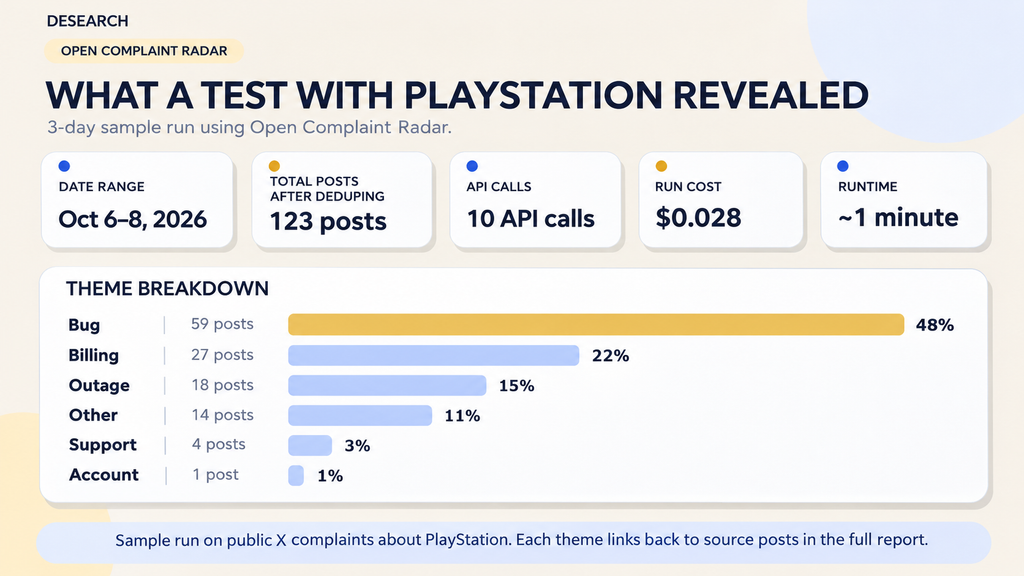
Desearch tested the tool using public complaints about PlayStation over three days, from October 6 to October 8, 2026. After removing duplicates, the tool identified 123 posts and grouped them by the issues customers were discussing.
Bugs accounted for approximately 48% of the collected complaints, followed by billing problems at 22% and service outages at 15%. The remaining posts covered customer support, account issues, and other concerns. The report also included daily complaint volumes and links to individual posts.
The entire test required 10 API calls and cost just $0.028. This demonstrated how a business could generate a useful report on public customer complaints for only a few cents, although costs would vary depending on the amount of data collected.
Why This Matters for Businesses and Bittensor
For customer support teams, Open Complaint Radar offers a way to spot recurring problems before they become more widespread.
A company might discover that dozens of customers are reporting failed payments even though none of their posts has attracted much attention. Product teams could use similar reports to identify software bugs, while marketing and community teams could monitor public feedback about their brands.
The tool also demonstrates a practical application of the infrastructure being developed on Bittensor. Desearch (SN22) builds decentralized search infrastructure and provides APIs that allow developers and AI agents to access current information from the web and social platforms.
Open Complaint Radar shows how those capabilities can be used to create an affordable product that addresses an everyday business problem.
Importantly, the tool does not require a complex AI model to interpret every complaint. It uses straightforward keyword rules to organize posts, making the results easier to understand and review.
How to Try Open Complaint Radar
Open Complaint Radar is free and open source, meaning developers can download the code, inspect how it works, and modify it for their own needs. Users first need an API key from the Desearch Console and can then access the Complaint Radar code on GitHub.
After setting it up, users can enter a brand name, specify the number of days to search, and generate a report. Additional options allow them to adjust search keywords, exclude certain posts, collect replies, and set a spending limit.
The tool runs on Python, so some technical setup is required, but developers can also connect it to other applications or schedule reports to run automatically.
Open Complaint Radar is a relatively simple application, but its value lies in making public information more useful. It gives businesses a wholesome picture of customer problems while keeping the original evidence accessible.
For Bittensor, it is another example of how subnets can support practical products that solve real-world problems at low cost.
➛ More on the tools Desearch is building:
Enjoyed this article? Join our newsletter
Get the latest TAO & Bittensor news straight to your inbox.
We respect your privacy. Unsubscribe anytime.
Enjoyed this article?
Join our newsletter
Get the latest TAO & Bittensor news straight to your inbox — every morning before markets open.



No comments yet — be the first.