


Could Bittensor’s native token, TAO, reach $1 million before 2040? Tao Templar believes it is possible, pointing to the network’s tokenomics, growing commercial activity, and competitive structure.
His argument is that as Bittensor subnets produce increasingly valuable products and services, more economic value could flow back into TAO.
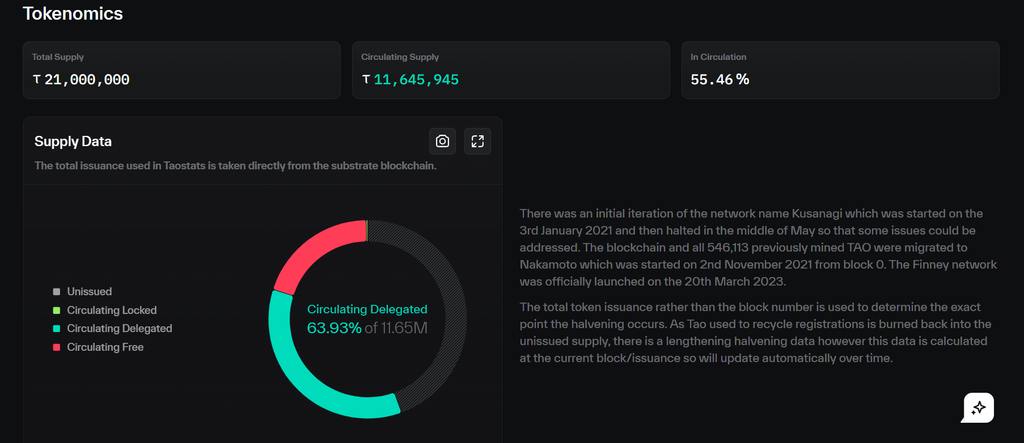
Bittensor has a maximum supply of 21 million TAO, with emissions halving approximately every four years, similar to Bitcoin.
Unlike many cryptocurrency projects, it launched without a premine or venture capital allocation. But scarcity alone does not explain its potential.
What makes Bittensor different is that its miners compete to produce commercially valuable work, from GPU computing and AI inference to model development and content creation.
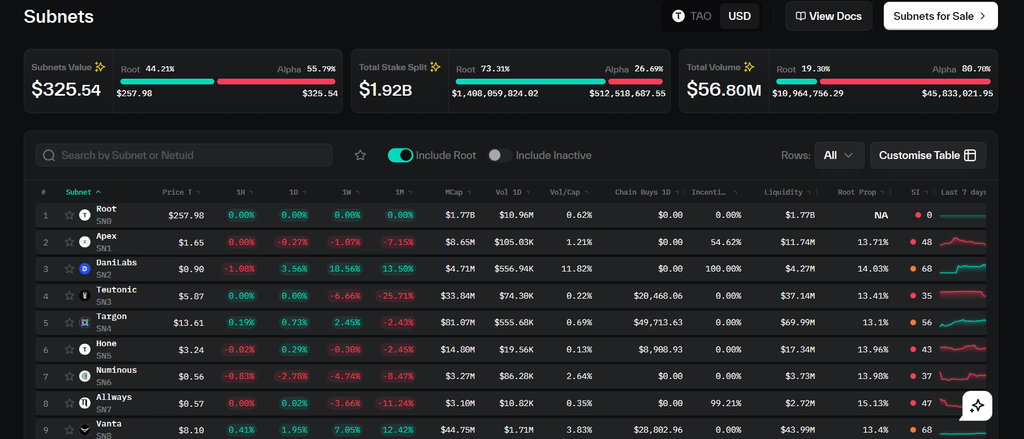
Each subnet operates as a competitive marketplace. Lium (SN51) provides GPU rentals, Chutes (SN64) focuses on AI inference, Targon (SN4) offers computing infrastructure, and Affine (SN120) develops AI models. Others, including Bitmind (SN34) and Bitcast (SN93), focus on deepfake detection and performance-based content creation.
Across these markets, miners compete on quality, cost, reliability, and performance, with rewards going to those delivering the best results.
The connection to TAO becomes clearer through Dynamic TAO, which gives each subnet its own alpha token and market. Subnets compete for capital and a larger share of network emissions, with some using commercial revenue to buy back or burn their alpha tokens.
Lium and Chutes have adopted this approach. In one cited 30-day period, Lium reportedly burned approximately $500,000 worth of alpha tokens, demonstrating how customer revenue can support a subnet’s token economy.
This creates a potential cycle of growth. As subnets attract customers, their revenue can support buybacks, strengthen demand for their tokens, and attract additional capital.
Dynamic TAO allows participants to move capital toward subnets they consider more productive, creating pressure for competing projects to improve. As more businesses generate meaningful revenue, the wider ecosystem could become increasingly valuable.
Bittensor’s potential also extends beyond today’s products. Its incentive mechanisms could support almost any industry where participants compete to deliver measurable results.
As new subnets emerge and existing ones improve, demand for TAO could grow through staking, liquidity provision, subnet participation, and investment exposure.
The underlying argument is that Bittensor could become a large network of commercially productive businesses, all economically connected to TAO.
However, a $1 million TAO price would imply a fully diluted valuation of $21 trillion, an extraordinary figure requiring massive adoption and sustained demand.
Revenue growth and alpha buybacks do not automatically translate into equivalent gains for TAO holders. The prediction ultimately depends on whether Bittensor can scale its commercial activity, attract significant external capital, and capture enough of that value within TAO itself.
➛ Read more about Tao Templar’s work below:
Enjoyed this article? Join our newsletter
Get the latest TAO & Bittensor news straight to your inbox.
We respect your privacy. Unsubscribe anytime.
Enjoyed this article?
Join our newsletter
Get the latest TAO & Bittensor news straight to your inbox — every morning before markets open.



No comments yet — be the first.