


With Bittensor’s eTAO upgrade now live, subnet owners can decide how their subnet’s token emissions are distributed. Some are allocating more rewards to miners, others are increasing their owner share, and some are giving up owner emissions entirely.
But what do these decisions mean for the people earning rewards on those subnets?
Taostats has published an interactive eTAO simulator that lets anyone explore the impact of different emission splits on their staking rewards.
How the Simulator Works
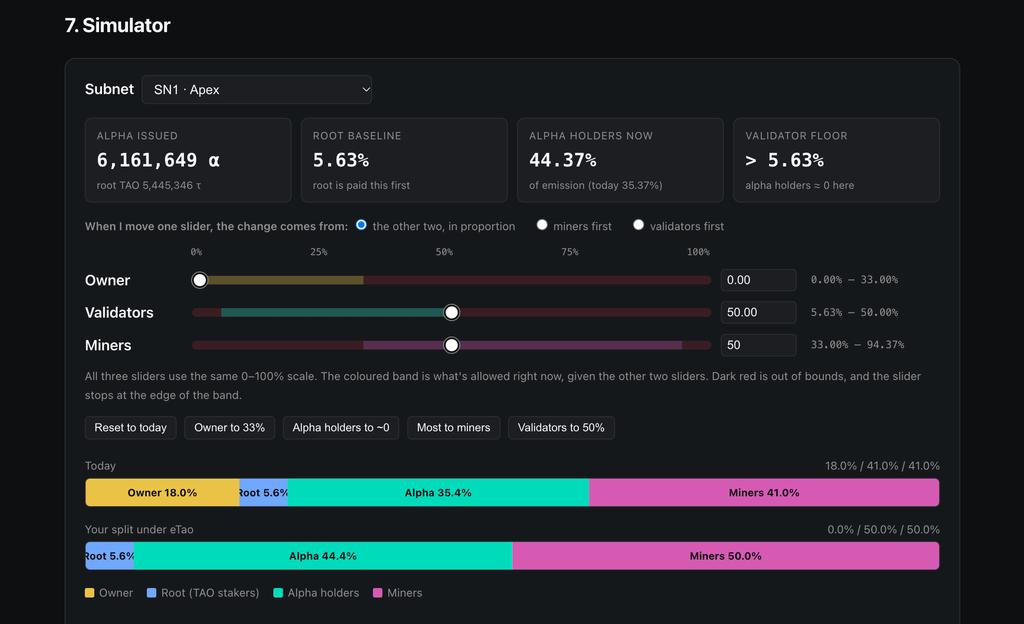
Previously, Bittensor subnets followed a fixed emission split: 18% to owners, 41% to validators and their stakers, and 41% to miners.
Under eTAO, owners can adjust these allocations within protocol limits. The simulator allows users to select a subnet and experiment with different percentages to see how rewards would be distributed.
Users can test scenarios including:
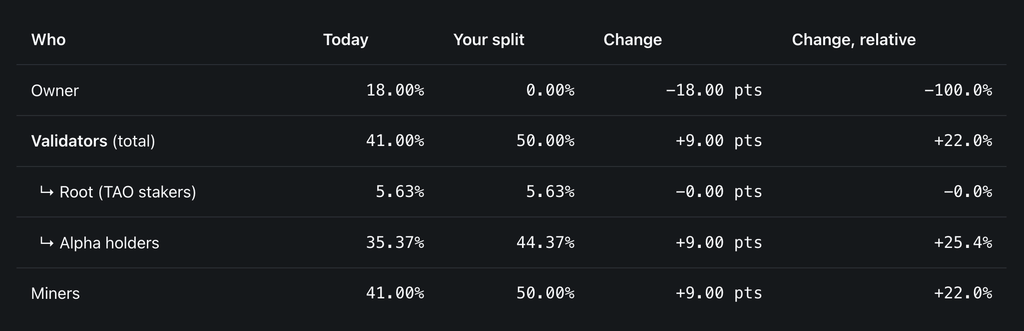
1) Owner to 33%: See what happens when the owner takes the maximum permitted share.
2) Most to miners: Explore how much of the subnet’s emissions could go to miners.
3) Validators to 50%: See the impact of increasing the validator allocation to its maximum.
4) Alpha holders to nearly 0%: Understand how a reduced validator allocation could leave very little for alpha stakers.
The tool also compares the selected distribution with the subnet’s current allocation, using chain data captured when the simulator was built.
Why This Matters for Alpha Stakers
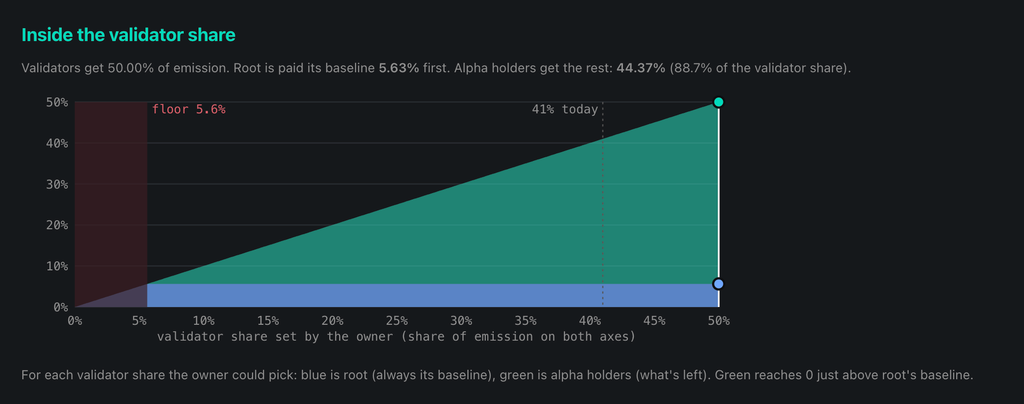
One important feature of eTAO is that root TAO stakers retain their baseline rewards, regardless of the emission split selected by a subnet owner.
Alpha stakers do not have the same protection.
Root’s baseline rewards come out of the validator allocation first, with the remaining portion going to alpha validators and their stakers. Consequently, reducing the validator allocation can substantially reduce alpha staking rewards, potentially bringing them close to zero.
For example, if a subnet’s root baseline is 5.4% and its owner reduces validator emissions from 41% to 20%, the allocation remaining for alpha holders falls from approximately 35.6% to 14.6% of total emissions.
The simulator makes these differences easier to understand without requiring users to calculate them manually.
Try the Simulator
As more subnet owners adjust their emission distributions, the simulator offers miners, validators, and alpha stakers a way to understand how those decisions could affect their rewards.
It also helps subnet owners explore different allocations before making changes on-chain. Under eTAO, owners can generally update their emission split once every 50,400 blocks, approximately seven days.
The simulator is illustrative and does not execute transactions.
Enjoyed this article? Join our newsletter
Get the latest TAO & Bittensor news straight to your inbox.
We respect your privacy. Unsubscribe anytime.
Enjoyed this article?
Join our newsletter
Get the latest TAO & Bittensor news straight to your inbox — every morning before markets open.


No comments yet — be the first.