

Score (SN44) launched a new private-track element for TCG card grading, going live on Monday July 27th. Miners will grade professionally certified trading cards from a single front-and-back image, scored against the ACE Grading standard used by industry-recognized graders.
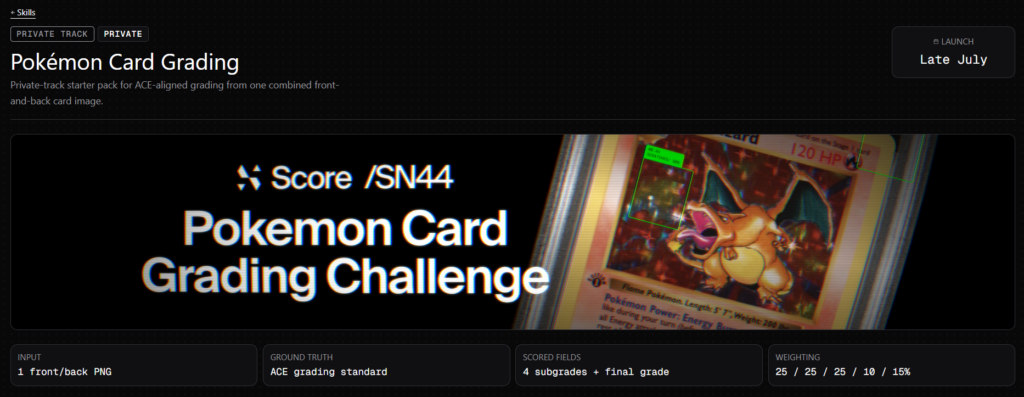
The dataset skews heavily Pokémon but includes other trading card games, meaning miners who build models that generalize beyond one game are the ones who will win. Each card gets five independent scores across surface, corners, edges, centering, and overall grade, with weighted contributions determining the final challenge score.
What the Challenge Tests
Every card gets scored across five categories, each evaluated independently against the ACE reference value.
1. Surface (25%): Scratches, print lines, stains, dents, whitening, and other imperfections on the card’s face.
2. Corners (25%): Corner sharpness and overall wear across all four corners.
3. Edges (25%): Whitening, chipping, dents, and other damage along the edges.
4. Centering (10%): How well the artwork sits within the borders, checked on both front and back.
5. Overall Card Grade (15%): The holistic ACE grade reflecting the card’s combined condition.
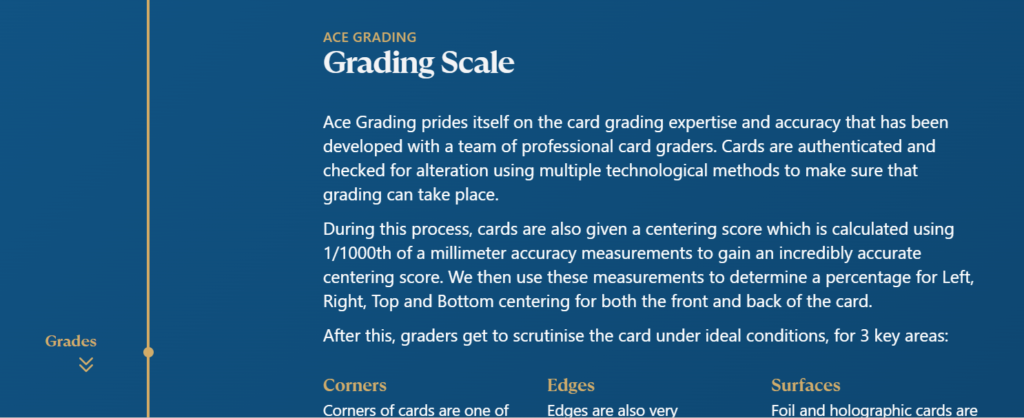
Surface, corners, and edges together account for 75% of the final score, which mirrors how professional grading actually weights condition.
How Miners Participate
Miners receive one combined PNG containing the card’s front and back side by side, and return the five scored values through a standard prediction pipeline.
1. Input: A single PNG URL with both views of the card.
2. Model deployment: Miners submit a Docker image running a prediction server, registered on-chain.
3. Output: Four subgrades plus the final ACE card grade, matched independently against the reference.
4. Ground truth: Every challenge uses a professionally graded card as the standard.
Score’s turbovision tooling on GitHub handles the deployment flow from local build through on-chain registration, so miners iterate through a familiar Docker workflow.
Why the Dataset Choice Matters
The design deliberately mixes Pokémon with other trading card games, and that decision shapes which miners actually win.
1. Pokémon dominates the dataset: The core reference base comes from professionally graded Pokémon cards.
2. Other TCGs are mixed in: A small share of challenges will feature cards from other games.
3. Generalization wins: Miners who overfit to Pokémon lose ground on the mixed dataset every round.
The setup forces miners to build models that read card condition as a general property rather than memorizing Pokémon-specific patterns, which is the difference between a working grader and a demo.
Where This Fits Score’s Broader Play
The launch extends Score’s push to turn its vision infrastructure into a marketplace for specialized visual tasks with real economic demand behind them. Professional card grading is a multi-billion-dollar market with clear reference standards, enough data to make machine learning competitive, and a customer base already paying human graders for the same output.
Miners who nail the ACE-aligned pipeline for Pokémon and adjacent TCGs are effectively building models that could plausibly compete with human graders on speed and consistency at a fraction of the cost. The element goes live Monday July 27th on SN44, with the full specification available in the Score docs.
➛ Explore the Starter Pack Here.
Enjoyed this article? Join our newsletter
Get the latest TAO & Bittensor news straight to your inbox.
We respect your privacy. Unsubscribe anytime.
Enjoyed this article?
Join our newsletter
Get the latest TAO & Bittensor news straight to your inbox — every morning before markets open.



No comments yet — be the first.