

Deepfake detectors have a dirty secret: the ones that ace academic tests fall apart on the fakes people actually meet online. Top open-source models lose 45% to 50% of their accuracy the moment they face content circulating on social media, in fraud, and in disinformation.
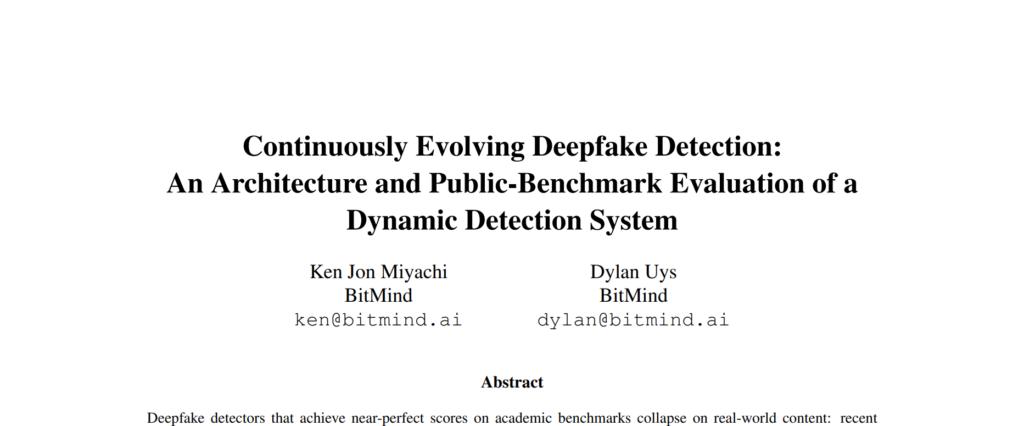
In a 16-pager, BitMind (SN34) argues this collapse is structural, since any detector trained once against a fixed set of fakes decays the instant new generators appear. Their answer, BitMind Forensics (BMF), runs on Bittensor Subnet 34 and treats staying current as a live competition rather than a one-time training run.
Why Yesterday’s Detector Fails Tomorrow
The problem isn’t bad engineering, it’s a moving target. New generators and face-swap tools enter circulation weekly, each leaving different fingerprints, while post-processing scrubs the traces older models learned to spot.
1. The gap is huge. On one in-the-wild test, no commercial detector cleared 90% accuracy and the best open-source model scored near chance.
2. Simple tricks break them. Compression, downscaling, or an off-the-shelf face enhancer can push detectors below a coin flip.
3. Drift drives failure. Detectors trained on pre-2023 data measurably degrade on 2024 and 2025 fakes, so the real question is which process keeps a detector fresh, not which model is smartest today.
A Competition That Feeds the Detector
Instead of shipping one frozen model, BitMind runs an open marketplace where participants compete on both sides, refreshing roughly every four hours.
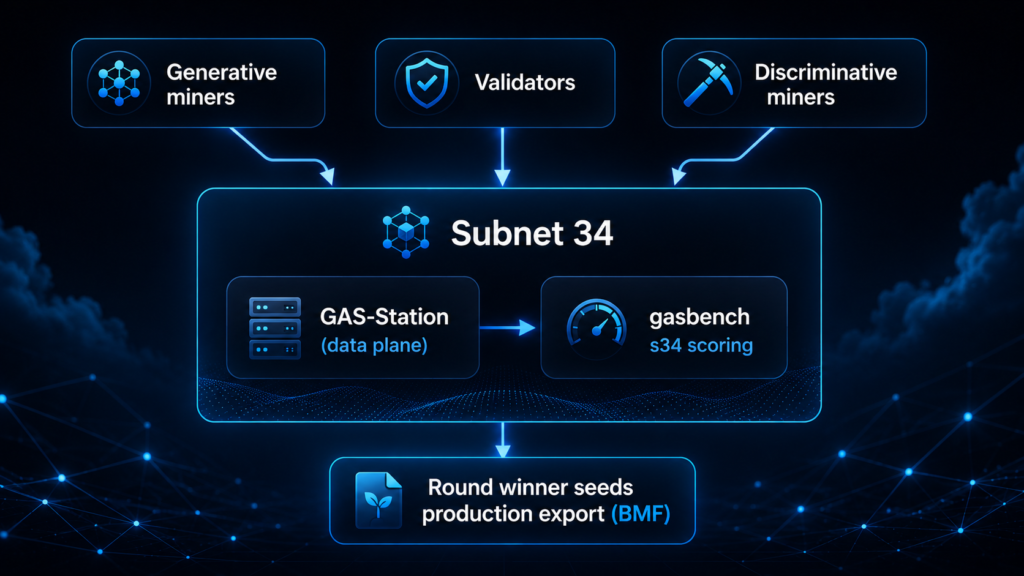
1. Generators get paid to fool it. Rewards scale with how often their fakes slip past the current detector, pushing them toward the newest tools.
2. Detectors adapt or lose income. Rewards go to whoever classifies best each round, so the field is forced to keep improving.
3. The winner becomes the product. Each round’s strongest detector seeds the deployed system, so even a frozen export is days behind the frontier, not years.
No human curator has to chase new generators, since the market does it by rewarding whoever catches what the current detector misses.
What the Numbers Show
BitMind froze one dated version and tested it across 19 public datasets with no per-benchmark tuning, and it lands strongest where older detectors crumble.
1. Holds up in the wild, matching the best commercial detector on images and beating it on video, while open-source rivals sat near chance.
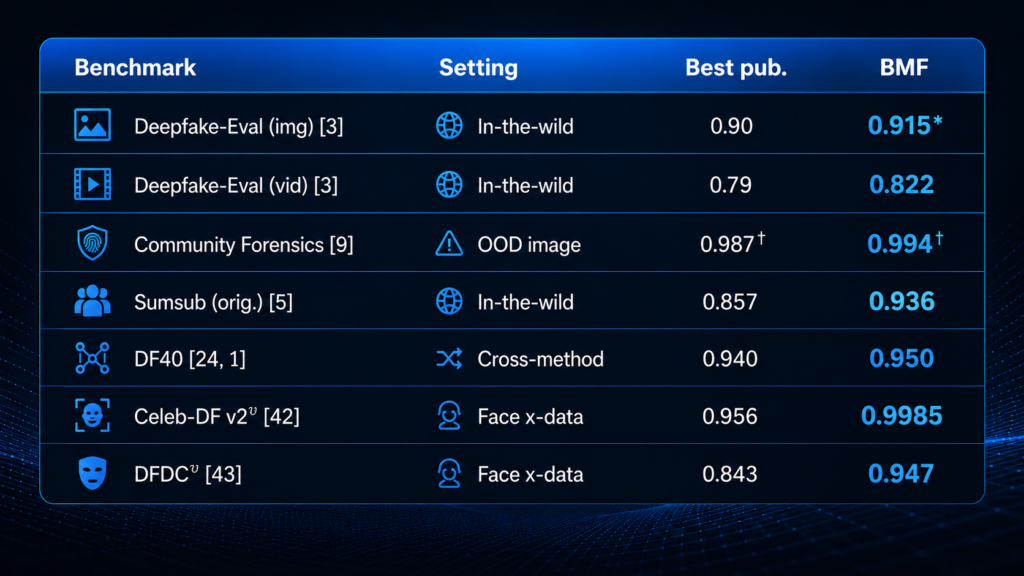
2. Survives manipulation, staying reliable under compression and downscaling, and improving after face enhancement rather than breaking.
3. Generalizes to unseen fakes, beating a specialist trained directly on the classic benchmark it was tested against.
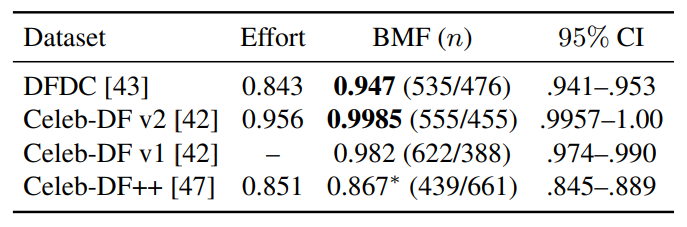
4. Improves over time, with each newer snapshot scoring higher on fakes from brand-new generators, on both image and video.
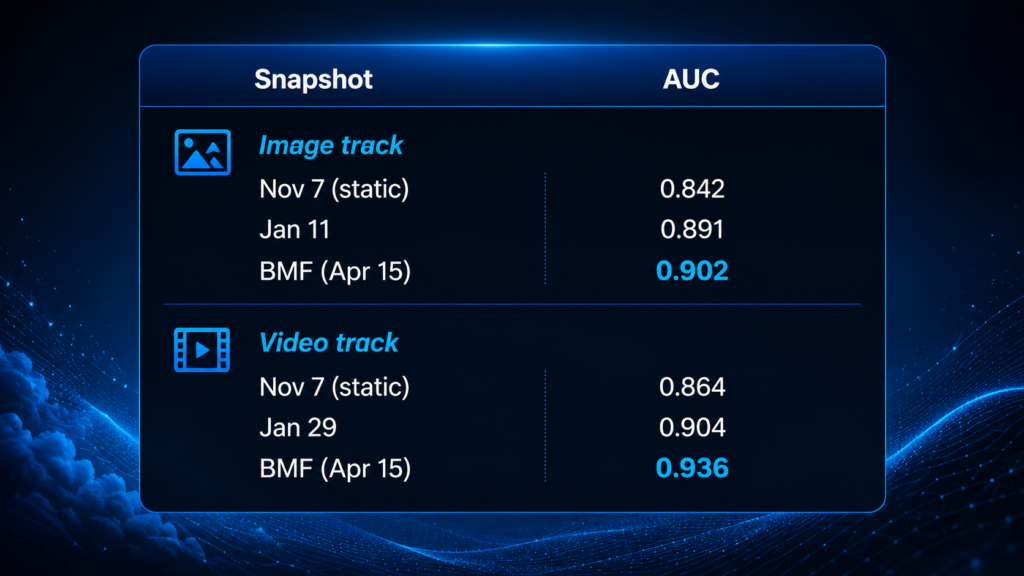
BitMind is honest about the soft spots, noting weak video recall at strict thresholds, shaky calibration on heavily compressed inputs, and one unusual generator that exposed a gap the mechanism hasn’t yet closed.
Detection as a Living System
The lasting point is that deepfake detection is not a model you finish, but a process you keep running. Tying a detector to an open, self-refreshing competition lets it track the frontier without waiting for the next manual retrain.
To back the claim, BitMind made its evaluation harness public and pointed its live API at the exact version tested, so anyone can check the work. Whether or not BMF stays ahead, the idea travels, since any security problem with an evolving threat could use a detector that evolves with it.
➛ Read BitMind (SN34)’s ‘Continuously Evolving Deepfake Detection: An Architecture and Public-Benchmark Evaluation of a Dynamic Detection System’
Enjoyed this article? Join our newsletter
Get the latest TAO & Bittensor news straight to your inbox.
We respect your privacy. Unsubscribe anytime.
Enjoyed this article?
Join our newsletter
Get the latest TAO & Bittensor news straight to your inbox — every morning before markets open.

No comments yet — be the first.