


Salesforce trained Moirai 2.0 on 36 million time series containing approximately 295 billion data points, including proprietary operational data.
As detailed in its November 2025 research paper, the model ranked among the world’s strongest time-series foundation models.
Cascade (SN91), a decentralized AI training subnet on Bittensor, has now surpassed its probabilistic forecasting performance just 19 days into its latest training competition.
On November 18, Cascade reported a Continuous Ranked Probability Score (CRPS) of 0.511, beating Moirai 2.0’s 0.5164.
The subnet also reached an 86.2% performance parity with Mistral’s Timestral on Mean Absolute Scaled Error (MASE), a measure of point-forecast accuracy.
Interestingly, these results come from GIFT-Eval, a benchmark developed by Salesforce AI Research itself, covering 144,000 time series and 177 million data points across seven domains.
Where Cascade Stands Against the World’s Best
On October 15, 2026, Mistral introduced Timestral, a family of forecasting foundation models that established a new state of the art among pretrained, zero-shot models across three major forecasting benchmarks.
Its flagship 209-million-parameter model outperformed competing models from Google, Amazon, Datadog, IBM and Salesforce.
Here is how Cascade compares with selected models featured in Mistral’s technical report.
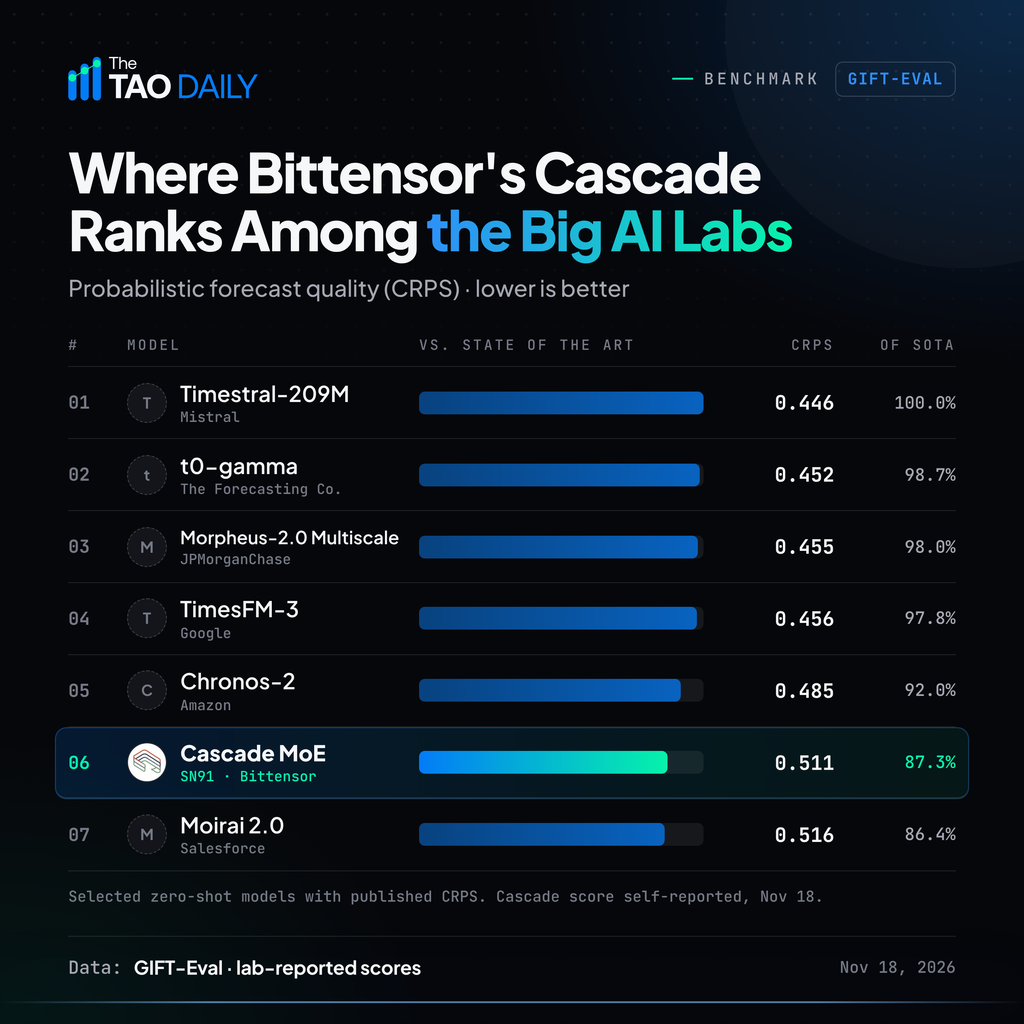
*Lower scores indicate better probabilistic forecasting performance. Cascade’s score is self-reported.
Cascade needs to reduce its CRPS by approximately 12.7% to match Mistral’s flagship model. The gap between Cascade and Amazon’s Chronos-2 stands at just 0.0256 points.
While specialized agentic systems also occupy leading positions on the GIFT-Eval leaderboard, Cascade is already approaching the performance of established foundation models. Its competition is no longer confined to decentralized AI projects.
How Bittensor Is Challenging Established AI Labs
Cascade officially launched its latest training competition on October 30, 2026. At its center is a mixture-of-experts foundation model with 1.23 billion total parameters and approximately 112 million active parameters per token.
Rather than competing to build entirely different models, independent miners develop synthetic data generators that teach the shared model increasingly complex temporal patterns.
The network standardizes training conditions and evaluates submissions against unseen real-world data. Successful contributions can advance the shared model, while miners earn rewards for measurable improvements.
The competition also incorporates evaluations across GIFT-Eval, TIME, BOOM and fev-bench. Bittensor effectively provides the economic infrastructure for an ongoing AI research competition.
The commercial implications extend well beyond cryptocurrency. Time-series forecasting is fundamental to financial markets, electricity demand, supply chain management, healthcare and industrial operations.
Through Ephemeris, Cascade already provides developers and businesses with access to seven forecasting models, including Mistral’s Timestral, through an API.
Note that Cascade’s latest achievement still needs independent reproduction and confirmation on the official GIFT-Eval leaderboard.
Nevertheless, an open competition incentivized by Bittensor has reportedly taken just 19 days to outperform an established AI laboratory on a major forecasting metric. And that laboratory happens to be the one that created the benchmark.
For anyone still questioning whether Bittensor belongs in serious conversations about frontier AI research, the benchmarks are becoming increasingly difficult to ignore.
Enjoyed this article? Join our newsletter
Get the latest TAO & Bittensor news straight to your inbox.
We respect your privacy. Unsubscribe anytime.
Enjoyed this article?
Join our newsletter
Get the latest TAO & Bittensor news straight to your inbox — every morning before markets open.



No comments yet — be the first.