


The Opentensor Foundation shipped a major update to the official Bittensor documentation, and the biggest change is that the docs are now built for agents to consume directly.
AI agents can load the full corpus into a context window, discover on-chain operations, preview what they will do, and execute them without anyone in the loop.
Developers get an easier ride too, with a five-minute Quickstart, cleaner Software Developer Kit (SDK) and Command-Line Interface (CLI) guides, and migration resources for teams already deep in the network.
What Changed for AI Agents
The docs are now what the team calls ‘Machine-Readable Everything:’ Every page, every operation, every error is available in a format an agent can pull directly, without needing to scrape the website like a human user would.
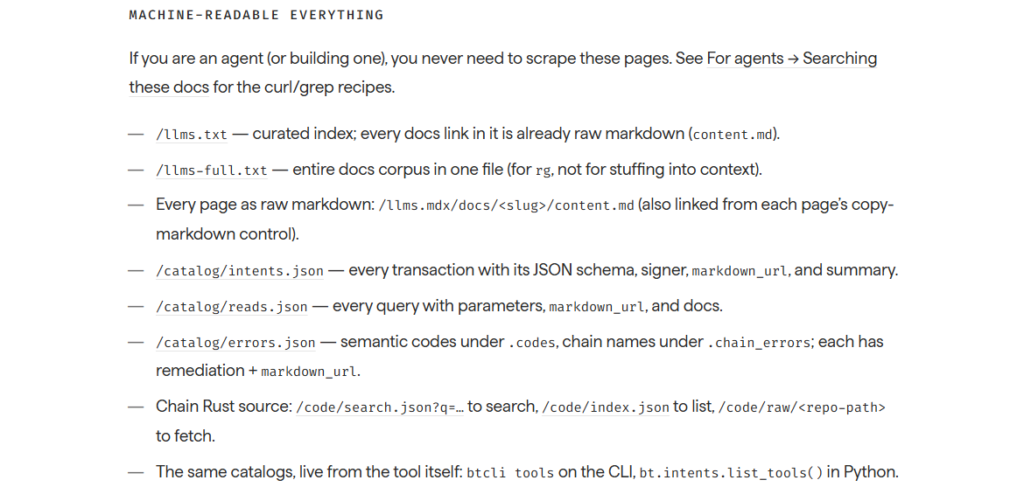
1. Every page has a raw markdown version: Agents can grab the exact content of any docs page in a format they can process.
2. The full corpus is available as a single file: One download brings every docs into one place for search and reference.
3. Every transaction is cataloged: Agents can look up any on-chain action and understand what it needs to run.
4. Every query is documented: Every read operation the network supports comes with clear parameters and links to more context.
5. Every error has a fix attached: Agents encountering issues get semantic error codes with remediation steps included.
The point of all of this is that agents no longer need to guess what Bittensor supports or how to interact with it. The full menu is available in the exact format they can use.
What Changed for Human Builders
Alongside the agent updates, the docs got a serious overhaul for human developers trying to enter the network for the first time or migrate an existing project.
1. Five-minute Quickstart: A fast, opinionated path from zero to a working setup, meant to get new builders shipping instead of researching.
2. Clearer SDK and CLI guides: The two main ways developers interact with Bittensor now have dedicated, cleaned-up documentation.
3. Migration resources: Teams updating existing projects to newer versions of the network get specific guidance for the transition.
The upgrade meets developers where they are: New builders get onboarding that ‘onboards,’ and existing teams get migration paths that do not require reverse-engineering the difference between versions.
Where This Points
The Bittensor thesis has always been about incentivizing intelligence at the network layer, and the documentation upgrade extends that thesis into the interface layer where developers and agents actually meet the network. Making the docs directly consumable by agents is the kind of change that compounds quietly, because every agent-native tool built on Bittensor from here forward benefits from it.
For subnet founders, agent builders, and anyone shipping infrastructure on the network, the smoother onboarding is the more immediate win. For the ecosystem as a whole, the agent-readable structure is the change that will matter most in twelve months.
➛ Explore the New Docs Here.
Enjoyed this article? Join our newsletter
Get the latest TAO & Bittensor news straight to your inbox.
We respect your privacy. Unsubscribe anytime.
Enjoyed this article?
Join our newsletter
Get the latest TAO & Bittensor news straight to your inbox — every morning before markets open.


No comments yet — be the first.