
Prediction has always sat at the core of economic advantage. From financial markets to weather systems and human behavior, the ability to anticipate outcomes has consistently separated signal from noise and profit from loss.
What Bittensor ($TAO) introduces is a structural shift in how this intelligence is produced and refined. Rather than relying on centralized institutions or static models, it enables open, competitive networks where forecasting systems continuously evolve under aligned incentives.
Within this framework, a distinct category of prediction-focused subnets has emerged. Each subnet approaches forecasting from a different angle, yet all contribute to a broader objective of transforming prediction into a decentralized, performance-driven market where accuracy compounds over time.
Numinous (Subnet 6): Training Adaptive Forecasting Systems
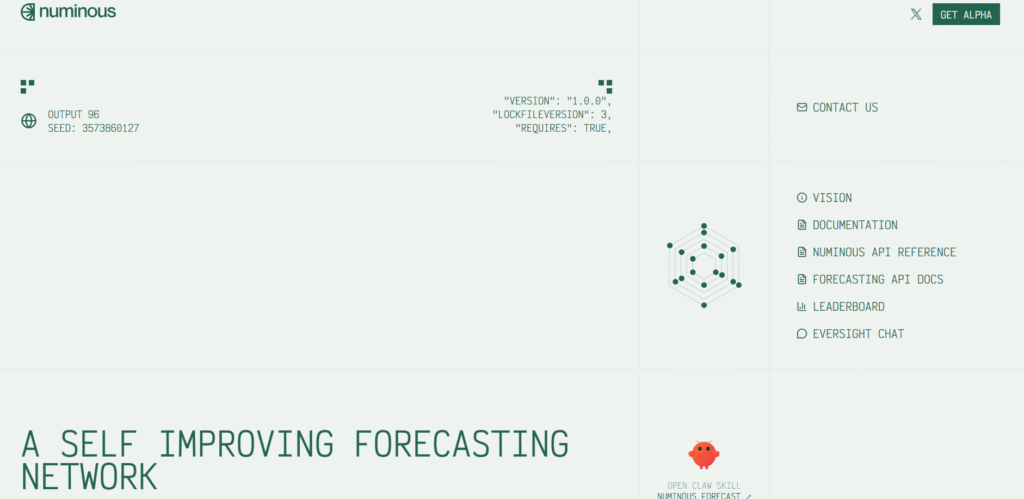
Numinous focuses on evaluating entire forecasting agents rather than isolated predictions, creating a system where intelligence itself is the unit of competition.
The network operates through a structured evaluation cycle designed to foster long-term model evolution:
a. Model-Based Evaluation: Forecasting agents are tested on real-world binary events, with performance measured over time,
b. Continuous Learning Loop: Agents improve dynamically, adapting based on feedback and historical accuracy,
c. Performance-Weighted Rewards: Consistently accurate models receive higher weights and greater token allocation, and
d. Shift in Paradigm: Moves from scoring predictions to scoring the systems generating them.
This structure enables a compounding improvement cycle, where forecasting quality increases as models compete and evolve within the network.
Zeus (Subnet 18): Scaling Environmental Intelligence
Zeus applies decentralized forecasting to environmental and climate data, leveraging large-scale datasets to rethink traditional prediction methods.
To modernize climate modeling, the subnet utilizes a high-throughput data architecture that:
a. Massive Data Integration: Utilizes ERA5 climate datasets spanning decades of global environmental data,
b. Real-Time Accessibility: Validators stream data dynamically, enabling responsive model interaction,
c. AI-Driven Forecasting: Replaces computationally intensive physics-based models with efficient machine learning approaches, and
d. Incentivized Innovation: Encourages development of new architectures for complex environmental prediction.
By reducing computational overhead while maintaining accuracy, Zeus moves environmental forecasting toward a more scalable and adaptive framework.
Almanac (Subnet 41): Market-Driven Sports Forecasting
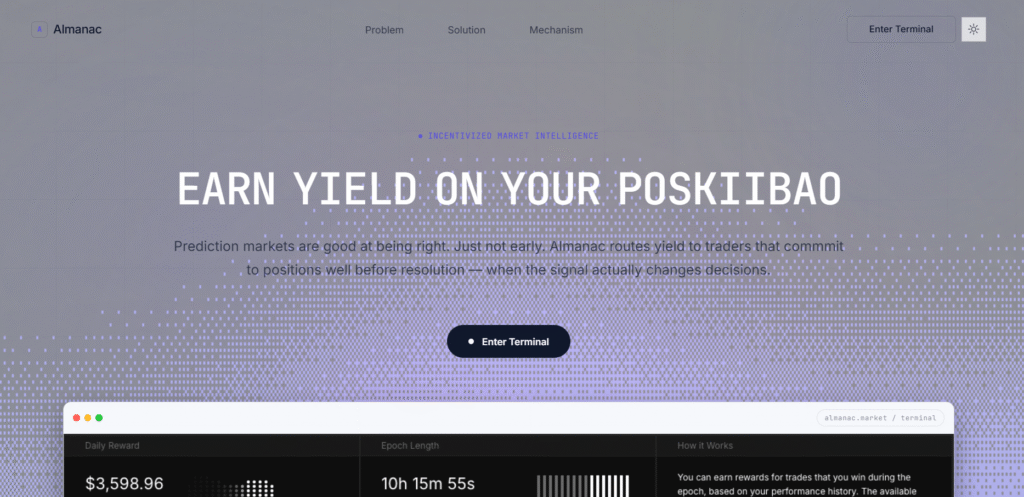
Almanac transforms event prediction into a competitive intelligence market, directly linking forecasting accuracy with financial outcomes.
The subnet bridges the gap between raw data and actionable betting intelligence through several core mechanisms:
a. Collective Intelligence Aggregation: Combines inputs from AI models, traders, and analysts into a unified meta-model,
b. Real-World Market Integration: Deploys predictions into external platforms, aligning outputs with actual betting markets,
c. Performance-Based Competition: Participants earn rewards based on predictive accuracy and profitability, and
d. Broad Market Coverage: Supports major global sports leagues and events.
This approach bridges decentralized intelligence with real-world financial systems, reinforcing prediction quality through direct economic feedback.
Synth (Subnet 50): Probabilistic Market Simulation
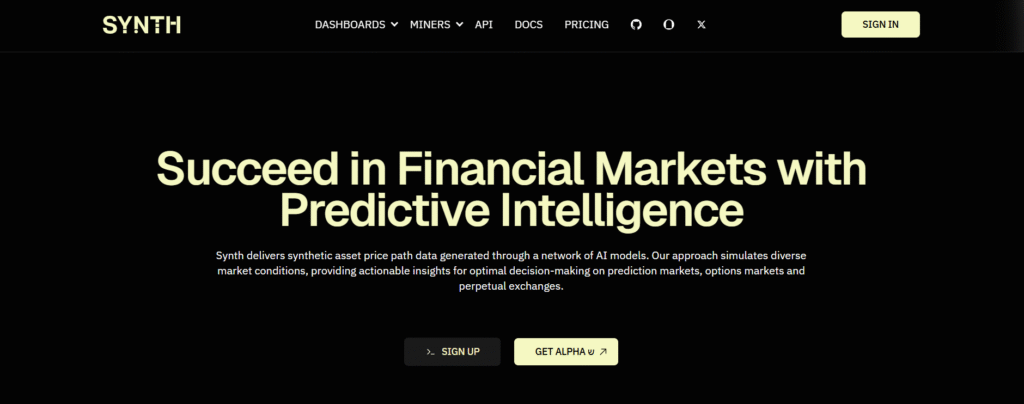
Synth advances forecasting by focusing on probability distributions rather than single-point predictions, enabling deeper market insight.
Unlike traditional ‘point’ forecasting, Synth’s architecture focuses on the nuances of market volatility:
a. Multi-Model Simulation: AI agents generate diverse synthetic price paths for assets,
b. Distribution-Based Forecasting: Captures a range of possible outcomes instead of a fixed prediction,
c. Application Versatility: Supports options pricing, portfolio construction, and risk management, and
d. Continuous Model Competition: Incentivizes refinement of probabilistic accuracy over time.
By modeling uncertainty directly, Synth provides a more comprehensive foundation for financial decision-making in volatile markets.
Sparket (Subnet 57): Decentralized Prediction Infrastructure

Sparket extends prediction into full-stack market infrastructure, decentralizing the creation, pricing, and settlement of bets.
By removing the ‘middleman’ from the betting equation, Sparket introduces a fully autonomous infrastructure:
a. Odds Origination: Miners generate predictive data and pricing signals,
b. Dynamic Market Adjustment: Odds evolve in real time based on incoming data and participation,
c. Outcome Verification: Validators confirm results through trust-weighted, decentralized processes, and
d. Custom Market Creation: Enables prediction markets for virtually any event or metric.
This architecture removes reliance on centralized operators, creating a transparent and extensible ecosystem for real-time prediction markets.
Djinn (Subnet 103): Private and Verifiable Intelligence Exchange
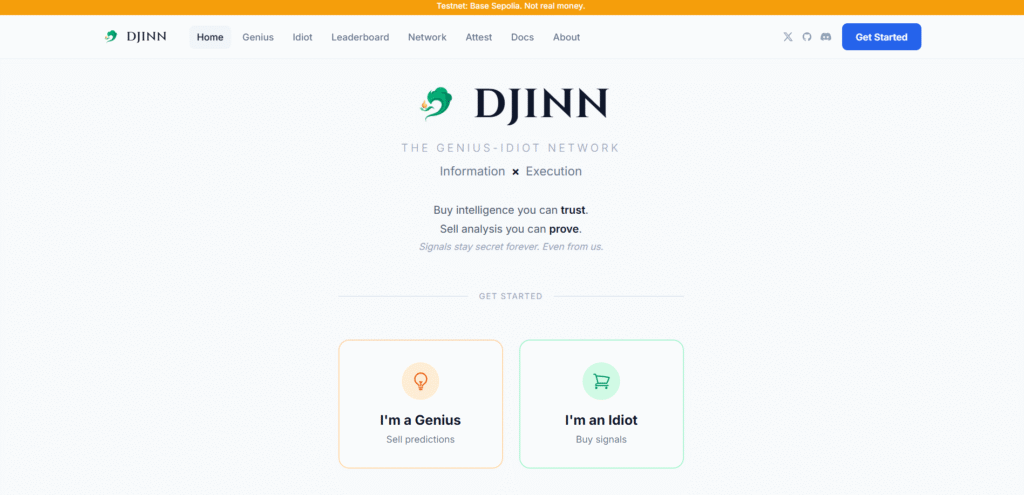
Djinn introduces a privacy-first model where predictive signals are monetized without exposing the underlying data.
Djinn solves the ‘oracle problem’ of privacy by implementing a secure, revenue-focused framework:
a. Encrypted Signal Distribution: Predictions are shared in protected form, preserving intellectual property,
b. Zero-Knowledge Verification: Performance is validated without revealing the signal itself,
c. Decoupled Information Flow: Separates data ownership from execution and consumption, and
d. Revenue-Driven Model: Generates real-world income through transaction-based fees.
This design enables a new category of prediction markets where privacy, ownership, and verifiability coexist within a decentralized framework.
Mantis (Subnet 123): Quantifying Informational Value
Mantis focuses on measuring the actual contribution of predictive signals, rather than simply evaluating outputs.
Mantis moves beyond simple ‘right or wrong’ metrics to quantify the actual utility of data:
a. Information-Theoretic Scoring: Rewards signals based on their measurable impact on prediction accuracy,
b. Encoded Data Submissions: Miners provide embeddings representing predictive insights,
c. Short-Term Market Focus: Targets high-frequency financial forecasting scenarios, and
d. Cooperative Optimization: Aligns participants toward improving collective intelligence.
By prioritizing signal quality over raw prediction, Mantis establishes a rigorous framework for evaluating informational value within decentralized systems.
The Future of the Global Signal
What these subnets collectively demonstrate is that prediction is no longer a standalone application layer. It is becoming an integrated, multi-domain intelligence system built on competition, incentives, and continuous refinement.
Each subnet contributes a distinct approach, from probabilistic modeling and encrypted intelligence markets to real-world betting systems and environmental forecasting. Yet they all reinforce the same structural principle: accuracy improves when it is exposed to open competition and aligned economic incentives.
As this ecosystem matures, the implication becomes difficult to ignore.
Prediction is not just being improved. It is being financialized, decentralized, and scaled into a global market for intelligence.
Enjoyed this article? Join our newsletter
Get the latest Bittensor & TAO ecosystem news straight to your inbox.
We respect your privacy. Unsubscribe anytime.


Be the first to comment