

Weather models learn from the data they train on and the errors they’re asked to minimize. On Zeus, where teams spend thousands of hours refining their models, those choices also determine which forecasts earn rewards.
Orpheus AI, a Dutch weather analytics company, built Zeus (SN18) to find AI models that can accurately forecast temperature, wind, and solar radiation for energy markets.
Miners submit hourly forecasts for near-surface temperature, wind at 100 metres, and surface solar radiation on a global quarter-degree grid.
Validators score the submissions and reward the top performers. A cryptographic commit-and-reveal process verifies that miners are locked in their forecasts before publishing them for independent review. Orpheus AI serves forecasts from top-performing models through the Zeus Pro API.
Zeus uses ERA5 because it gives every miner a physically consistent reference for each location and forecast hour. Weather stations provide direct observations, but coverage is uneven, particularly for wind at 100 metres. The operational datasets Orpheus AI considered offered finer detail but updated less frequently.
SN18’s main scoring metric, root mean square error, penalises large misses and can favour smoother forecasts. A model that places a band of strong winds slightly too far east can be penalised twice, once for missing the winds where they occurred and again for predicting them where they didn’t. Orpheus AI evaluated methods that reward better detail, but a misplaced wind band can still give a trading desk the wrong estimate of how much power a wind farm will generate.
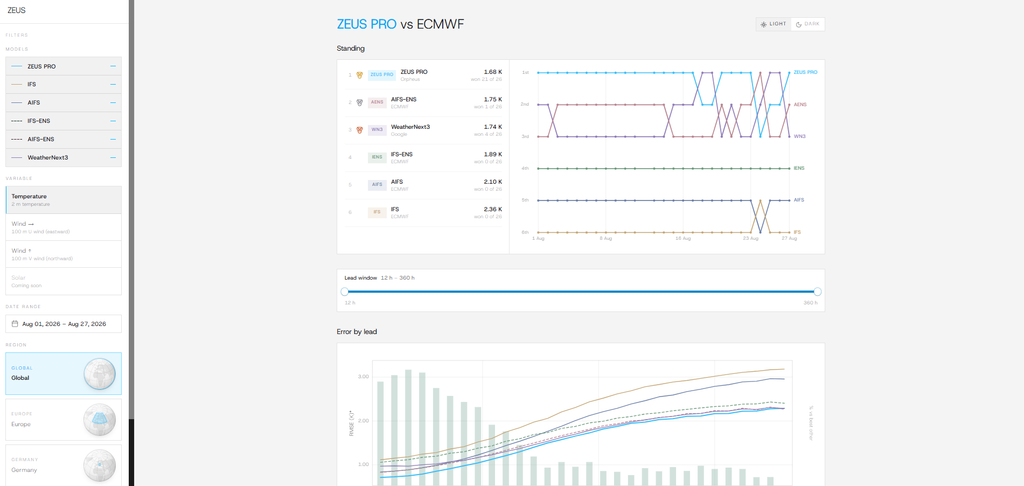
In Orpheus AI’s benchmarks against models from the European Centre for Medium-Range Weather Forecasts (ECMWF), Zeus Pro showed its largest gains at shorter forecast horizons. Beyond roughly a week, forecasts from individual runs lost accuracy, while averaging several runs helped smooth out less predictable fluctuations.
Temperature attracted more competition among miners. After accounting for seasonal effects, it was found that improvements in temperature forecasts became statistically detectable sooner than improvements in wind forecasts.
Orpheus AI reports that Zeus Pro delivers forecasts in about 90 minutes, compared with roughly six hours for the institutional AI weather products it cited.
The earlier delivery gives trading desks more time to revise their estimates of wind generation or temperature-driven demand before making an intraday trade.
➛ Explore Zeus Here.
Enjoyed this article? Join our newsletter
Get the latest TAO & Bittensor news straight to your inbox.
We respect your privacy. Unsubscribe anytime.
Enjoyed this article?
Join our newsletter
Get the latest TAO & Bittensor news straight to your inbox — every morning before markets open.

No comments yet — be the first.