
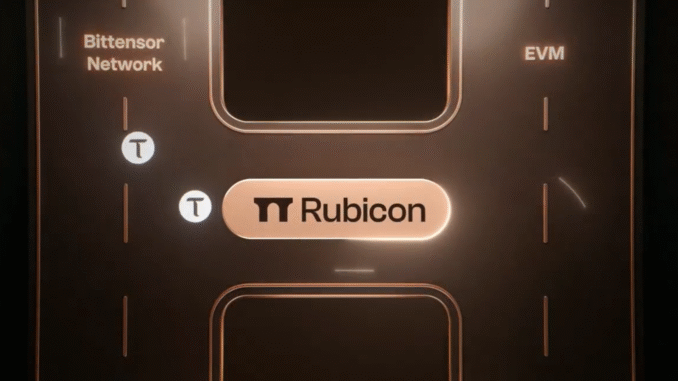
Liquidity has always been a quiet constraint in high conviction ecosystems: On Bittensor for instance, staking $TAO secures the network and aligns incentives across validators and subnet builders.
However, traditional staking also locks capital in place, and for holders who want exposure without sacrificing flexibility, that tradeoff has been structural.
xTAO under Project Rubicon is designed to remove that constraint without disrupting the economic core of $TAO.
What xTAO Actually is
xTAO, liquid staked $TAO, is a derivative token that preserves full economic linkage to underlying $TAO while enabling liquidity across EVM (Ethereum Virtual Machine) environments.
The mechanics are not only simple, they are also deliberate:
a. $TAO deposits are batched through Rubicon’s staking architecture,
b. Deposits are delegated to validators,
c. xTAO is minted as an “ERC-20 receipt token” (a proof that the holder really “own” $TAO), and
d. Validator rewards accrue to the underlying stake.
Each unit of xTAO represents a compounding claim on staked $TAO. As validators perform, yield accrues; the derivative does not dilute exposure or abstract it away, it “just” mirrors it.
There is no incentive misalignment introduced into the system, thus, holders remain economically tied to validator performance and network growth.
Project Rubicon as Connective Infrastructure
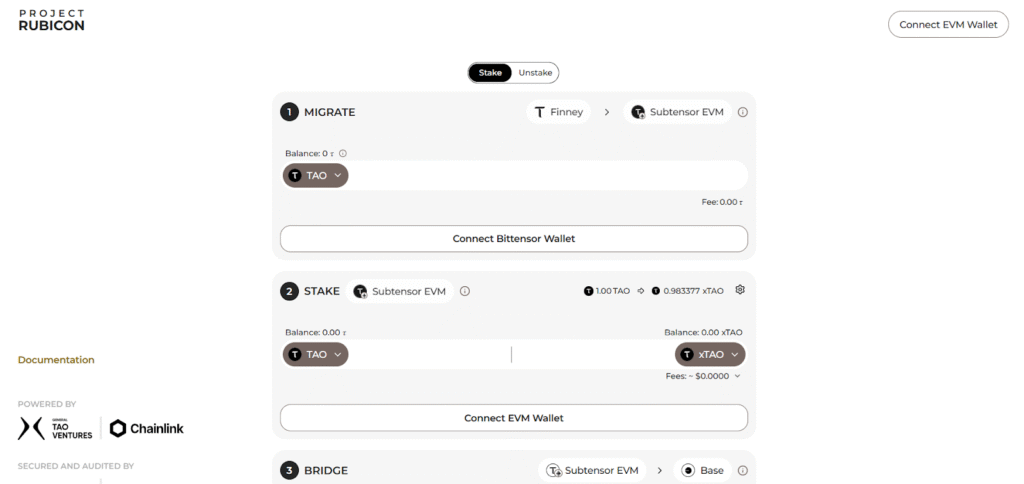
Project Rubicon functions as the bridge between Bittensor’s native staking economy and EVM liquidity hubs. Its primary integration point is Base, an Ethereum Layer-2 ecosystem that has become a focal point for institutional and DeFi capital.
Through Rubicon:
a. xTAO can circulate within EVM markets
b. Subnet “$ALPHA” tokens gain exposure to deeper liquidity (through xALPHA tokens), and
c. $TAO-aligned capital can participate in EVM protocols
Liquidity venues such as Aerodrome Finance now become accessible to subnet assets and staking derivatives that were previously native only.
For subnet owners, this changes the capital landscape as it opens access to larger liquidity pools without requiring a migration away from Bittensor.
Built on Chainlink CCIP (Cross-Chain Interoperability Protocol)
Cross-chain expansion introduces security considerations. To this end, Project Rubicon integrates with Chainlink CCIP, a widely-adopted cross-chain messaging and bridging framework.
By anchoring its interoperability layer to CCIP, Rubicon reduces reliance on fragmented bridge designs and aligns with infrastructure trusted across the broader crypto market. This choice reinforces the institutional positioning of the product rather than framing it as experimental infrastructure.
What xTAO Unlocks
xTAO expands $TAO’s utility in a measured and economically consistent way. It enables:
a. EVM DeFi Participation With Preserved $TAO Economics: Holders can now deploy capital into lending markets, liquidity pools, and other EVM strategies while maintaining exposure to $TAO’s staking yield,
b. Liquidity Without Surrendering Native Alignment: Users do not need to un-stake or exit their position to access capital efficiency, and
c. Protocol Composability: xTAO integrates with wallets, LP (Liquidity Provider) frameworks, derivatives platforms, and broader EVM tooling.
For $ALPHA, Rubicon extends this model further by allowing access to Base-based liquidity environments (through its xALPHA equivalent), expanding capital discovery and participation pathways.
Extending the Economic Surface Area of $TAO
The defining feature of this architecture is continuity: Validator incentives remain intact, yield remains performance based, and exposure remains native in substance, even if portable in form.
xTAO does not attempt to re-engineer Bittensor’s incentive structure, it extends it into new environments.
As liquidity becomes a competitive advantage across ecosystems, the ability to preserve economic alignment while unlocking composability is not incremental (it is structural!)
With Project Rubicon’s xTAO, $TAO’s economic gravity is no longer confined to a single chain: It becomes portable, integrated, and capital-efficient without compromising the foundation it was built on.



Be the first to comment