

In every cycle of Bittensor, newcomers focus on upside: Which subnet is trending? Which one has the highest emissions? Where are subnet ‘$ALPHA’ tokens rotating next?
Very few ask the uncomfortable question: What makes a subnet structurally fragile? What makes them ‘die?’
Because collapse in Bittensor rarely looks like collapse: There are no dramatic blow ups, no sudden zeroes. Instead, there is something far more dangerous, which is gradual irrelevance!
Subnets Do Not Explode, They Hollow Out.
A subnet can look alive while already decaying. Like miners are still submitting, validators are still validating, and emissions are still distributed.
Literally, on paper, activity exists. But then, these ‘activity’ does not translate to relevance (i.e. It is not the same as value creation.)
The real signal is whether the subnet is producing work that matters beyond its own reward loop. When output has no external pull, the system becomes self referential. Rewards circulate internally, and nothing anchors them to demand.
That is how decay begins.
When Emissions Become the Product
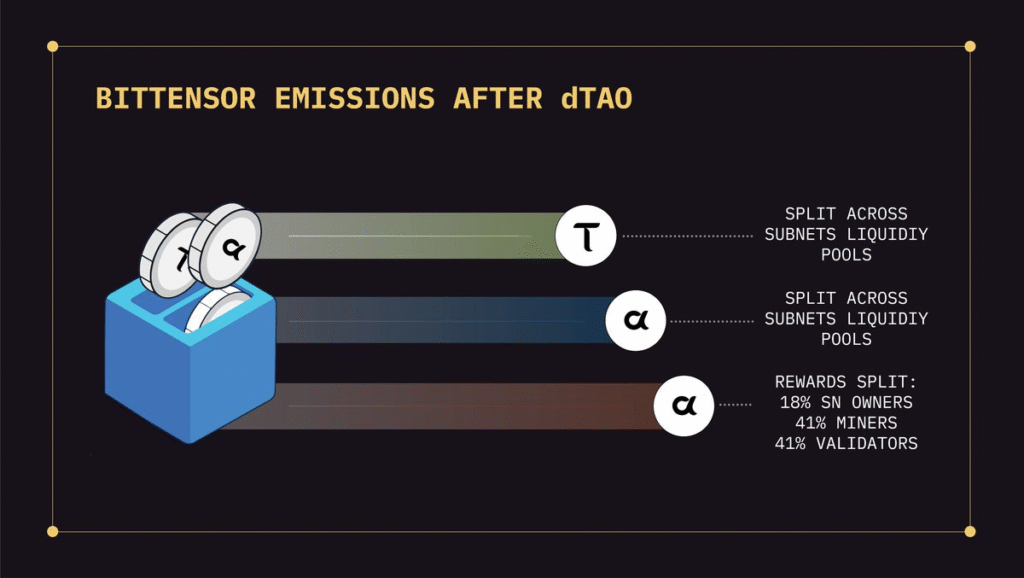
The design of Bittensor assumes that emissions are incentives, not outcomes. They are meant to reward useful intelligence, but when a subnet has no clear product, emissions quietly become the product.
Miners begin to optimize for payouts, validators do it for rank, and owners want to collect their ‘share.’
Meanwhile, the underlying task remains vague or trivial: There is no measurable impact, no integration, and absolutely no reason for capital to flow back in.
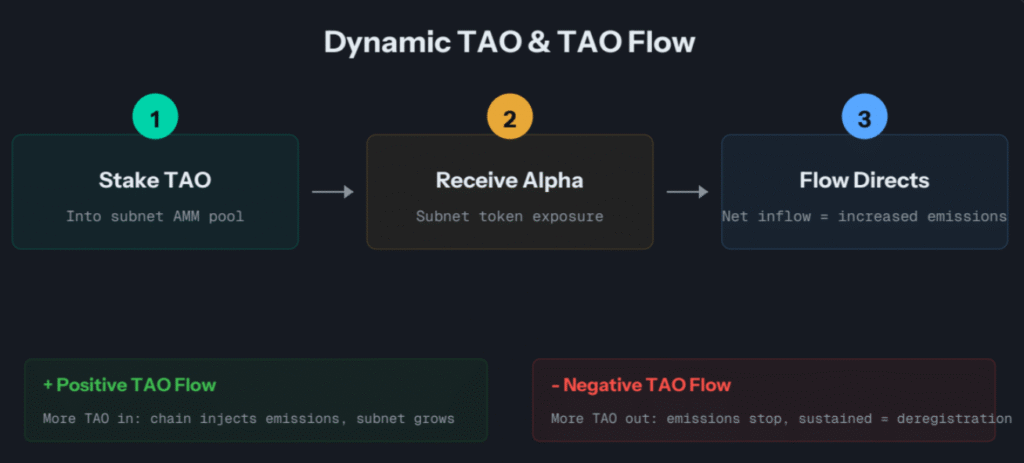
This imbalance shows up slowly in what some call ‘negative TAO flow’. What this simply means is that rewards exit the system, but no new value replenishes it.
It feels stable until it is not.
The ‘Defunct’ Subnet 100 Moment
Subnet 100 made this dynamic impossible to ignore. Launched in mid-2025, it rose quickly, reaching roughly 18 $TAO in daily emissions.
From the outside, it appeared successful. Especially since participation was steady, and rewards were meaningful.
Yet there was no durable product attached to that emission stream, soon enough, development updates faded, the owner went silent, and naturally, community confidence thinned.
On October 19, 2025, Subnet 100 became the first subnet deregistered under Bittensor’s updated enforcement mechanism, and approximately 850 $TAO was returned to holders.
There was no scandal, just enforcement.
The message was that emissions without contribution are temporary.
The Owner Variable
Subnet owners receive 18% of $ALPHA emissions for a reason, and that’s because allocations are not decorative, they are fuel.
It funds:
a. Development velocity,
b. Infrastructure stability,
c. Strategic direction, and
d. Communication with the market.
When that leadership layer disengages, everything downstream weakens. Contributors sense it, liquidity senses it, and price (or value) eventually reflects it.
Markets tolerate volatility, but not abandonment.
Code Now Decides
The protocol has evolved: Since September 2025, the lowest (Exponential Moving Average) EMA-priced subnet outside its immunity window is automatically removed when a new subnet registers. This is done with no negotiation, not even a single-second delay.
Under this system, survival is continuous competition as subnets are no longer protected by inertia. If they stop building, they slide down the rankings, and when they reach the bottom, the protocol handles the rest.
Subnet 100 was the first example, and it wasn’t even the last.
A Different Way to Evaluate Risk
Instead of asking which subnet has the highest emissions, ask different questions.
a. Does the work have independent value?: Can users explain what the subnet produces in one clear sentence? Would anyone care about that output outside the emission schedule?
b. Is capital circulating or escaping?: Look beyond daily rewards, observe whether new participants and external integrations are appearing. Healthy systems attract fresh demand.
c. Is leadership visible?: Are there updates, releases, measurable progress? Or has communication faded into silence?
These indicators move long before price does.
The Bigger Shift
Bittensor is in a ‘stricter phase,’ thus, the era of passive emission farming without accountability is narrowing. Automatic deregistration changes behavior as it forces alignment between incentives and output. Subnets now compete not just for yield, but for legitimacy.
That is a healthy evolution.
Because in the long-run, the strongest subnets will not be the loudest. They will be the ones producing real, defensible work with owners who continue to build when attention moves elsewhere.
If users understand how subnets decay, they stop chasing noise, and start recognizing durability.



Be the first to comment