
Bittensor ($TAO) has grown rapidly over the past year, and what began as a novel experiment in open AI coordination has evolved into a complex ecosystem of specialized subnets competing to produce valuable intelligence.
Across the network, miners generate outputs and models, validators evaluate their quality, and the protocol distributes rewards (in $TAO) to the most valuable contributions, thereby resulting in a decentralized marketplace for intelligence where performance determines incentives.
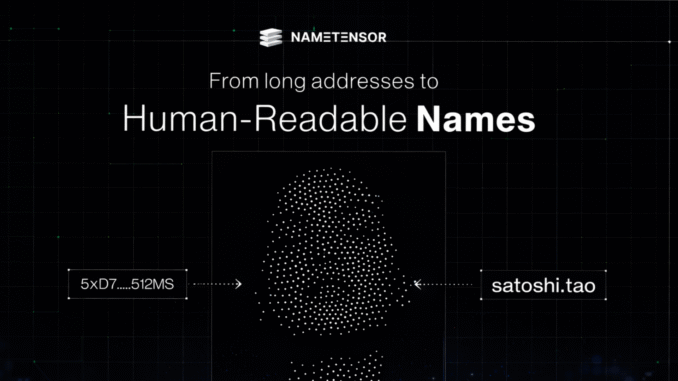
Yet for all the sophistication in how Bittensor coordinates machines, there is still a surprisingly basic piece of infrastructure “missing”: Identity!
Right now, everyone in the ecosystem exists only as a wallet address, there is no standardized way to attach names, reputations, or recognizable identities to participants across the network. As the number of subnets and contributors grows, this lack of identity becomes increasingly noticeable.
That is the problem NameTensor is attempting to solve.
A Network Without Names
In many ways, Bittensor is optimized for machines rather than people. Subnet miners compete, models improve, incentives align, but the humans building, validating, and contributing to these systems remain largely invisible behind cryptographic addresses.
For a network that is steadily expanding over a hundred subnets and thousands of contributors, this creates friction. Wallet addresses are difficult to remember, difficult to recognize, and impossible to build long-term (if any!) reputation around.
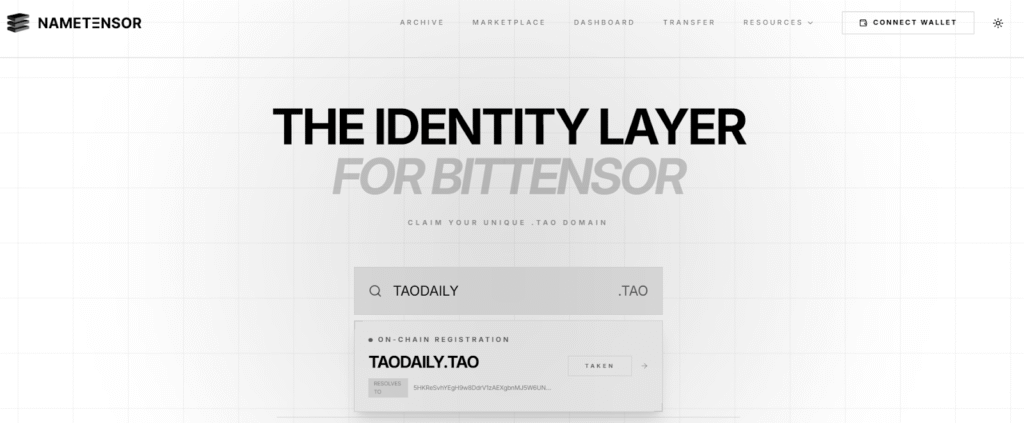
Identity is what turns a collection of participants into a community, and NameTensor introduces a naming system designed specifically to provide that missing layer.
Ownership That Comes Directly From the Chain
Most blockchain naming systems rely on registries, ownership records are stored in smart contracts that can be updated through governance changes or administrative permissions.
NameTensor avoids this design entirely.
Instead of maintaining a registry, ownership is derived directly from the history of the Subtensor chain itself. By replaying the chain’s block history, anyone can reconstruct the full ownership state.
This architecture leads to several important properties:
a. There is no separate registry storing ownership records,
b. There is no centralized backend controlling name resolution, and
c. There are no administrative privileges capable of altering ownership.
The chain itself becomes the single source of truth, and because the system relies entirely on deterministic protocol rules, any participant can independently verify who owns a name without relying on trusted services.
Moving Beyond Temporary Domains
Another notable feature of NameTensor is how it treats domain ownership. Traditional domain systems rely on renewals as names expire if they are not periodically paid for, and ownership can disappear if renewals are missed. NameTensor deliberately removes this expiration model.
Names registered through the system:

a. Are registered once,
b. Never expire, and
c. Remain permanently tied to the registering wallet.
This approach reframes naming as something closer to a reputation system than a temporary lease.
Over time, a .TAO domain can become an identity marker within the ecosystem, and contributors would be able to build recognition around those names as they participate in subnet development, validation, research, or infrastructure.
The Beginning of a Human Layer
NameTensor’s ambitions extend beyond simply making wallet addresses easier to read; it describes its broader goal as establishing the Human Layer of Bittensor.
Today, the network excels at coordinating machine intelligence. Subnets specialize in different AI capabilities while miners compete to produce the best outputs, but humans navigating the ecosystem still lack shared identity infrastructure.
By introducing persistent naming, NameTensor creates a foundation that other tools could build on.
Potential applications include:
a. Wallets resolving human-readable names,
b. Subnets associating contributions with identities,
c. Reputation systems track participation across the network, and
d. Applications organize communities around recognizable participants.
As the ecosystem grows, identity could become a critical coordination primitive. If adoption reaches sufficient scale, NameTensor itself could eventually evolve into a dedicated subnet inside Bittensor.
A Migration Path for Early Identity Systems
Before NameTensor was introduced, some members of the community had already registered names through Tao Name Service (TNS).
These early users helped establish recognizable identities within the ecosystem, and NameTensor acknowledges that history through a migration program.
However, migration does not replicate or import existing records from TNS. Instead, registering a migrated name creates a completely new identity record on NameTensor.
The two systems remain fully independent.
This approach allows NameTensor to maintain its deterministic design while still recognizing early participants.
Snapshot-Based Eligibility
Eligibility for the migration program is determined through a publicly verifiable snapshot. The details of the snapshot are:
a. Date: March 6, 2026
b. Source: FirstTensorLabs TNS GitHub repository
c. Commit: 9b8e5ad9f40c349c5d129beb8f1b14910762b87b
To qualify for migration:
a. The domain must have existed at the time of the snapshot, and
b. The same wallet must still control the domain when registering.
Participants have 60 days from the snapshot date to complete the migration process, after which all new registrations follow standard pricing rules.
Discount Structure for Early Participants
To encourage early adoption, NameTensor introduces a gradually decreasing discount schedule for migrations designed to reward early participants while preventing long-term pricing distortion.
Migration discounts follow this structure:
a. First migration receives a full discount,
b. Second migration receives a 75% discount,
c. Third migration receives a 50% discount,
d. Fourth migration receives a 25% discount,
e. Fifth through tenth migrations receive a 10% discount, and
f. Additional migrations follow standard pricing.
All eligibility checks and discounts are calculated automatically based on wallet history.
Why Identity Matters for Decentralized AI
Decentralized AI networks are more than technical systems, they are ecosystems composed of people building, improving, and coordinating complex infrastructure: Researchers train models. developers design subnets, validators maintain network integrity, and builders create new tools and services.
As Bittensor continues to expand, connecting these participants becomes increasingly important. Identity provides the mechanism for recognition, reputation, and collaboration.
The internet faced a similar challenge in its early years. Before the creation of domain names, users navigated the web through raw IP addresses. While the system technically functioned, but it was difficult for humans to use.
The introduction of domain naming infrastructure transformed the internet into a navigable global network.
Bittensor may now be approaching a similar transition. The network already coordinates intelligence remarkably well, but for the decentralized AI ecosystem to scale globally, it will also need a way to coordinate people.
NameTensor is built around the idea that identity will become that missing piece.



Be the first to comment