
Most talk about decentralized AI focuses on freedom, censorship resistance, and taking power from big tech. But there’s a more practical reason that matters to anyone building or using AI tools: reliability.
Chutes recently shared an insightful post about decentralized AI, and their point is straightforward. When you build your app or business on centralized AI providers like OpenAI or Anthropic, you’re putting all your eggs in one basket. And that basket keeps dropping.
If they go down, you go down with them, and this happened repeatedly in late 2025 with major outages from centralized AI companies. Apps stopped working. Businesses lost money. Users got frustrated.
Decentralized AI infrastructure solves this problem through simple redundancy. Instead of one company’s servers, you have dozens or hundreds of independent providers. When one fails, traffic automatically routes to others. Your app keeps working.
The Problem With Putting Everything in One Place
Here’s how centralized AI typically works. You pick a provider like OpenAI or Anthropic. You build your application using their API. Everything runs through their servers. Your business depends on their infrastructure staying online.
This creates what engineers call a “single point of failure.” When that one point breaks, everything connected to it breaks too.
And it breaks more often than people realize. Q4 2025 saw multiple outages from major AI providers. Each time, thousands of applications built on those providers simply stopped functioning. Developers could only wait and hope for quick fixes.
The problem extends beyond just outages. What happens when your provider raises prices by 50%? When they change their terms of service to exclude your use case? When they decide to prioritize their own products over third-party developers? You’re stuck either accepting it or spending months rebuilding on a different platform.
This dependency on one company’s infrastructure creates business risk that has nothing to do with your actual product quality or business model.
How Decentralization Fixes This
Decentralized AI infrastructure works differently. Instead of routing all requests through one company’s servers, the network consists of many independent providers spread across different locations.
Take Chutes, for instance. It runs on Bittensor, which means instead of one company providing all the computing power, there are over 100 independent providers spread across the world.
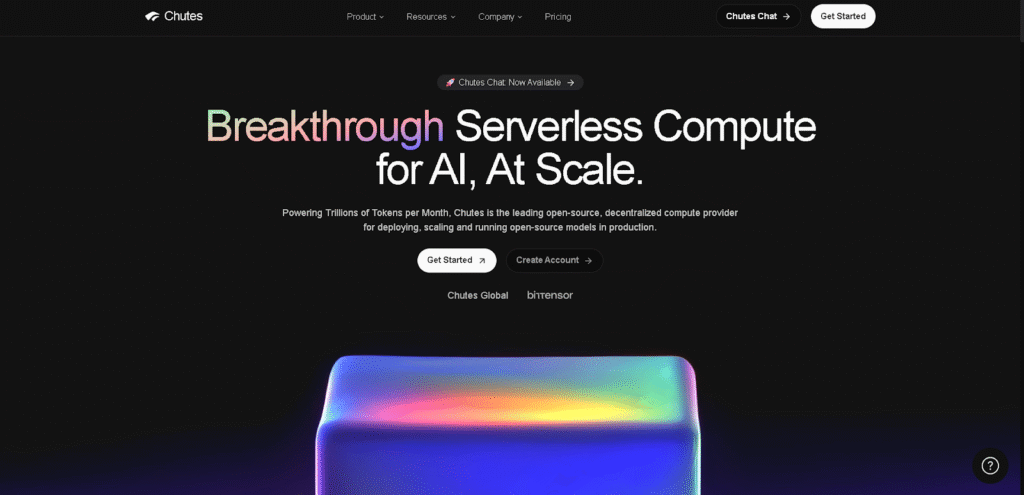
When you use Chutes, your request doesn’t go to one server in one data center owned by one company. It goes to a network that automatically routes to whichever provider is available and performing well at that moment..
If one provider has issues, the network just routes around them. Your request goes to a different provider instead. You don’t even notice. Your app keeps working.
This isn’t theoretical. Chutes points out that while major centralized providers had multiple outages in Q4 2025, their decentralized system had near-zero downtime. Not because they got lucky, but because the system is designed so that individual failures don’t matter.
Think of it like this: If you’re driving and one road is blocked, you take a different route. But if there’s only one road and it’s blocked, you’re stuck. Decentralization gives you multiple roads, so you’re never stuck.
The Real-World Benefits
Reliability is the main benefit, but decentralized infrastructure solves other practical problems too.
No vendor lock-in becomes possible when systems use compatible formats. Switching providers doesn’t mean rebuilding your application. You’re not trapped by proprietary APIs or formats that only one company supports.
Competition between providers keeps pricing honest. When 100 providers compete for traffic, they can’t arbitrarily raise prices. If one charges too much, traffic flows to cheaper alternatives. Market dynamics work in users’ favor instead of against them.
Geographic distribution means providers can be located anywhere in the world. Your users in Asia don’t wait for requests to travel to US servers and back. There’s likely a provider close to them for faster response times.
Censorship resistance exists because no single entity controls the network. One company can’t ban your use case across the entire network. No government can shut down one server and kill the whole system.
But Chutes emphasizes that reliability is the main point. The other benefits are nice, but businesses care most about systems that actually work when needed.
What This Means for Different People
If you’re building applications on AI, decentralized infrastructure reduces the risk that provider problems become your problems. Your app’s reliability stops depending entirely on one company’s uptime.
If you’re a business using AI tools, systems built on distributed infrastructure are more likely to be available when you need them. Less downtime means less lost productivity and revenue.
And if you’re a regular user, you might wonder why you should care about infrastructure. But the reason is simple: the apps and tools you use are only as reliable as the infrastructure they’re built on.
You’ll just notice some apps work more consistently than others. The reliable ones will increasingly be those built on distributed systems.
When ChatGPT goes down, you can’t use it. When services built on top of ChatGPT go down, you can’t use those either. You’re at the mercy of one company’s uptime.
Apps built on decentralized infrastructure like Chutes keep working because they’re not dependent on any single provider. Even if you never interact with the infrastructure directly, you benefit from using apps that don’t randomly stop working.
It’s like preferring stores that have multiple suppliers instead of just one. If a store only has one supplier and that supplier has problems, the store runs out of stock. Stores with multiple suppliers stay stocked even when individual suppliers have issues.
The Practical Reality
Decentralized infrastructure isn’t automatically better at everything. It adds complexity. Coordinating many providers, routing traffic efficiently, maintaining quality standards, and handling payments across a distributed network all require careful engineering.
Centralized systems can be simpler to manage and optimize when things are working well. One company controlling everything means faster decision-making and easier coordination.
But that simplicity comes with fragility. Everything working well is great until it isn’t. And when centralized systems break, they break completely.
The question becomes: Is the added complexity of distribution worth the increased reliability? For critical infrastructure, the answer increasingly seems to be yes.
Chutes is putting this to the test. They’re running an actual business providing AI compute through decentralized infrastructure.
You can use their service just like you’d use OpenAI’s API. Same format, same type of requests. But under the hood, you’re using a distributed network instead of one company’s servers.
The claim is that you get better reliability, competitive pricing, and no single point of failure. And based on their Q4 2025 uptime compared to centralized alternatives, that claim seems to hold up.
This isn’t about ideology or decentralization being morally superior. It’s about practical engineering. Distributed systems are more reliable than centralized ones when designed well. That’s just how redundancy works.
What This Means Going Forward
If decentralized AI infrastructure proves more reliable than centralized alternatives, that changes the conversation about decentralization entirely.
Right now, most people see decentralization as a tradeoff. You sacrifice convenience and reliability to get freedom and censorship resistance. It’s for people who care about principles over practicality.
But if decentralized AI infrastructure proves more reliable than centralized alternatives, there’s no tradeoff. It’s just better infrastructure, period. Businesses would choose it for practical reasons, not political ones.
That’s what Chutes is arguing. They’re not saying “use decentralized AI because centralization is bad.” They’re saying, “Use decentralized AI because it works better.”
Whether this holds true at scale remains to be seen. Running 100+ providers smoothly is complex. Coordinating them, maintaining quality, handling payments, and routing traffic all add complexity that centralized systems don’t have.
But the basic logic is sound: systems with redundancy are more reliable than systems with single points of failure. And Chutes’ Q4 2025 uptime data suggests it’s working in practice, not just theory.
For developers building AI applications, this matters immediately. If you’re tired of outages breaking your app, decentralized infrastructure might be worth testing.
For regular users, it matters when more apps start using reliable decentralized backends. You probably won’t know or care that an app uses Chutes instead of OpenAI. You’ll just notice it works more consistently.
The shift from “decentralization is good for freedom” to “decentralization is good for reliability” could be what actually drives adoption beyond crypto enthusiasts and into mainstream use.
Enjoyed this article? Join our newsletter
Get the latest Bittensor & TAO ecosystem news straight to your inbox.
We respect your privacy. Unsubscribe anytime.



Be the first to comment