
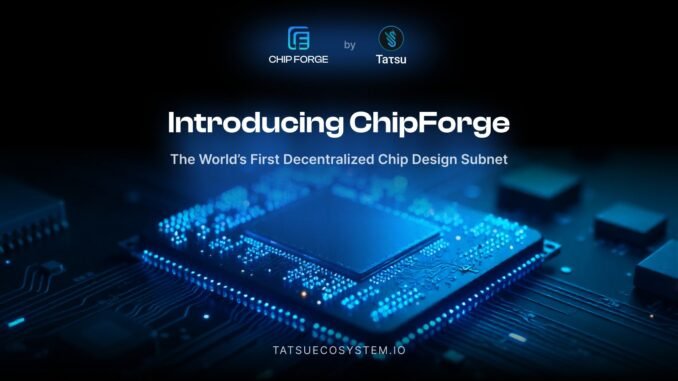
The article from BitNewsBot argues that ChipForge, a decentralized chip-design initiative powered by the TATSU ecosystem, could quietly emerge as a critical launchpad for the next generation of low-power edge-AI silicon.
Traditional semiconductor development is extraordinarily expensive (with costs ranging from $80–200 million for AI SoCs to over $725 million for cutting-edge 2nm processes) and dominated by large corporations with hierarchical, slow-moving R&D teams.
In contrast, ChipForge leverages blockchain-driven competitive challenges to crowdsource innovative designs from global engineers, drastically reducing costs, accelerating timelines, and democratizing access to chip engineering.
This approach aligns perfectly with the growing demand for edge AI—where AI inference runs directly on battery-powered devices (e.g., smartphones, smart cameras, drones, wearables, robotics, and IoT sensors) rather than in power-hungry cloud data centers.
Edge AI requires specialized hardware that prioritizes ultra-low power consumption, small die area, and high performance for real-time processing, while maintaining privacy and low latency by avoiding cloud dependency.
The article posits that ChipForge’s model could disrupt the industry by enabling faster, cheaper innovation in exactly this space, potentially defining a new paradigm for AI-era chip design.
What is ChipForge and How Does It Work?
ChipForge is described as the world’s first decentralized chip-design project, operating as a continuous global hackathon or “on-chain competition” platform. Participants (referred to as “miners”) submit hardware designs to specific challenges, competing for rewards in alpha tokens from the TATSU blockchain ecosystem.
Submissions are evaluated automatically based on objective metrics:
- Power consumption (prioritized for edge devices with limited batteries),
- Area efficiency (to minimize silicon real estate and manufacturing costs),
- Performance (speed and capability for AI tasks),
- Synthesizable RTL (Register Transfer Level code that can be deployed on FPGA hardware for prototyping).
Winning designs are selected based on the best scores, and contributors are paid only for top-performing submissions—eliminating the need for massive upfront R&D budgets.
This contrasts sharply with traditional firms, which employ large in-house teams and bear full costs regardless of outcomes.
A key milestone highlighted is the successful decentralized design of a complete, industrial-grade RISC-V processor with integrated cryptographic accelerators. This was achieved entirely through competitive challenges, without a centralized team—a feat the article claims would take far longer and cost more in conventional settings.
Technical Foundations and Focus on Edge AI
The project builds heavily on RISC-V, an open-source instruction set architecture (ISA) that is gaining traction industry-wide (e.g., NVIDIA integrating it into controllers, Google supporting it natively in Android, and initiatives like Intel’s $1 billion RISC-V fund). RISC-V’s modularity and royalty-free nature make it ideal for customized, low-power designs.ChipForge emphasizes:
- Low-power optimization: Essential for edge devices where extending battery life is critical.
- Hardware-software co-design: Jointly optimizing chips, compilers, runtimes, and AI kernels for end-to-end efficiency.
- Security features: Including post-quantum cryptography to protect against future threats.
- Specialized Neural Processing Units (NPUs): Tailored accelerators for on-device AI inference.
Designs start with FPGA prototyping (using embedded FPGA or eFPGA concepts for flexibility) and aim to transition to actual silicon fabrication via programs like Google’s Open MPW (Multi-Project Wafer) shuttle, which allows low-cost tape-outs.
Advantages Over Traditional Models
The article contrasts ChipForge with centralized giants (e.g., Google, Meta, Tesla investing billions in custom silicon) and notes:
- Cost reduction: Companies pay only for proven winners, avoiding bloated payrolls and failed experiments.
- Speed and innovation: Competition drives rapid iterations; geographic, academic, or corporate barriers are removed.
- Accessibility: Global talent pool, including independent engineers, can participate without needing venture funding or elite credentials.
This could lower entry barriers in a market where advanced chip design is otherwise inaccessible, fostering breakthroughs in energy-efficient hardware for the exploding edge-AI sector.
Roadmap and Future Implications
Future milestones include:
- Full hardware-software co-design pipelines.
- Development of dedicated edge-AI NPUs.
- Transition from FPGA prototypes to fabricated silicon.
- Enhanced quantum-safe security.
The broader implication is profound: With tens of billions of AI-enabled devices projected, affordable, specialized low-power chips will be crucial. ChipForge could become the “go-to” platform for such innovations, scaling community-driven progress faster and cheaper than corporate labs.
By democratizing hardware design, it may reshape the semiconductor landscape, enabling a proliferation of efficient edge-AI solutions in everyday devices and setting a blueprint for open, competitive innovation in the AI hardware era.
Overall, the article presents ChipForge not as a flashy disruptor but as a subtle, structural shift—one that leverages decentralization to address the core bottlenecks of cost, speed, and exclusivity in chip development, positioning it to power the quiet revolution in on-device intelligence.
Enjoyed this article? Join our newsletter
Get the latest Bittensor & TAO ecosystem news straight to your inbox.
We respect your privacy. Unsubscribe anytime.
Be the first to comment