
Full credit to: 𝚖𝚊𝚢𝚢𝚛𝚎𝚡 τ
AI is absolutely everywhere in 2026. Chatbots are writing emails, models are generating images, algorithms predict markets, and are even helping doctors diagnose patients. But what a lot of people don’t realise is that, behind the scenes, almost all of this incredible technology is controlled by a few giant tech companies.
Companies like Google, Meta, and OpenAI own the data, the servers, and the models. They decide who gets access to the tools, what those tools are allowed to say, and exactly how much they cost.
Bittensor was built to change that story completely. People often call it “Decentralized AI” (or DeAI for short). But what does that actually mean? Is it just a crypto buzzword, or is there real substance behind it?
Let’s break it all down.
What Does Decentralized AI Really Mean?
To understand DeAI, you have to look at how regular AI works today.
Centralized AI (The “normal” way): One company builds everything. They train their AI models on massive private servers. They set the rules. And if they decide to change their pricing, censor an answer, or shut down your access, you have no choice but to accept it.
Decentralized AI (The new way): Instead of one company owning the massive servers, the AI is built and run by thousands of individual people and computers all over the world.
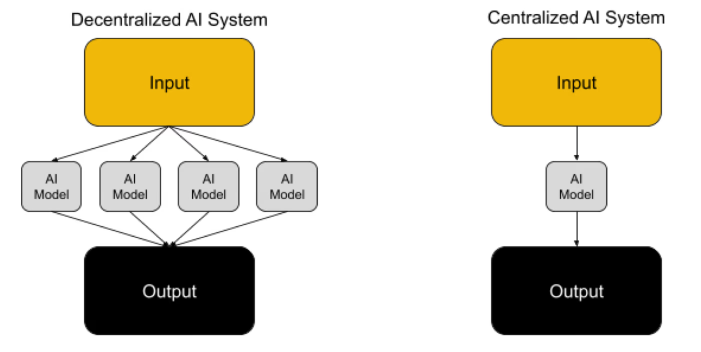
Centralized AI and Decentralized AI
- No single boss: Everyone can join, share their computer power, and help build the AI.
- Fair pay: People get paid in crypto tokens for doing useful work.
- Completely open: Anyone can check to see exactly how it works.
Imagine a massive, global brain where anyone can add a puzzle piece (like a piece of data or computing power) and get paid if that piece is useful. There is no central point of failure, making it incredibly hard to shut down or censor.
How Bittensor Makes Decentralized AI Real
Bittensor is currently the largest working example of this idea in the crypto space. It is a blockchain protocol that creates a completely open marketplace for intelligence.
Here is the core engine making it run:
Proof-of-Intelligence Unlike Bitcoin miners, who just solve random math puzzles to keep the network secure, Bittensor miners do real, useful AI work. They answer questions, train models, and gather data. Then, “Validators” act as judges to check their work. If the work is fast and accurate, the miner gets rewarded with the network’s native token, TAO.
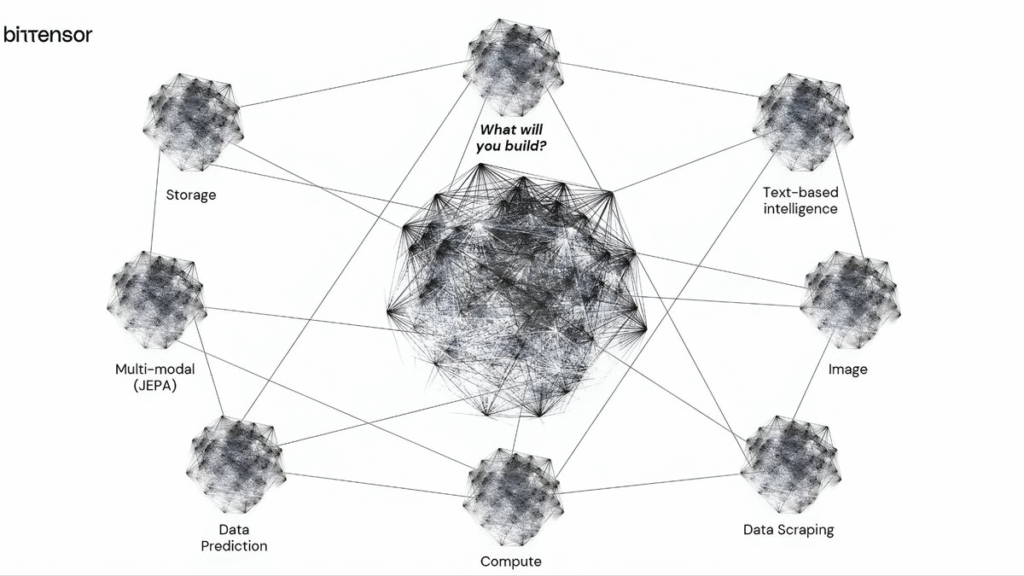
Subnets (Mini AI Companies) The network is broken down into 128 active “subnets.” Each subnet focuses on one specific AI job. You can think of them as tiny, specialized companies competing to be the best. Here are a few examples of what these subnets actually do:
- Chutes (SN64): Chutes is a decentralized alternative to massive cloud servers. It allows developers to upload AI models and run them incredibly cheaply on global GPUs.
- Ridges (SN62): Ridges focuses entirely on building AI software engineers. Miners create specialized agents that can write code, fix bugs, and run tests. It is basically a decentralized coding team that already rivals massive centralized models like Anthropic’s Claude.
- Autoppia (SN36): Autoppia powers autonomous AI agents that can browse the internet, click buttons, and automate everyday business tasks for you without any human help.
- Numinous (SN6): Numinous aggregates different AI agents to predict real-world outcomes, trends, and market data by pulling from all corners of the internet.
The Power of dTAO and Alpha Tokens
In February 2025, Bittensor launched the “dTAO” upgrade. This gave every single subnet its own unique “Alpha Token.” Now, anyone can stake their regular TAO into a subnet to vote on it. If a subnet is highly useful, the market naturally drives its Alpha Token price up, and that subnet automatically gets more daily TAO rewards.
Bittensor vs Other DeAI Projects
Bittensor is not the only project building in the DeAI space, but it approaches the problem very differently from its competitors.
- ASI Alliance (Fetch.ai, SingularityNET, Ocean): While these projects focus heavily on autonomous agents trading or selling data, Bittensor focuses on collaborative machine learning. It builds the core intelligence from the ground up.
- Render and Akash: These are incredible networks for renting decentralized computer power (like GPUs for graphics or cloud hosting). However, Bittensor uses computer power specifically for AI tasks and rewards miners based on the quality of their intelligence, not just their server uptime.
- NEAR and ICP: These are general blockchains that happen to host AI tools. Bittensor, on the other hand, is a pure DeAI marketplace fully dedicated to incentivizing machine learning.
What makes Bittensor stand out is its “Lego” system. Different subnets act like pieces that allow the network to cover the entire pipeline: one subnet gathers the data, another uses that data to train a model, and a third uses that model to answer your questions.
What This Means For The AI Industry
The demand for AI is absolutely exploding, but relying on a few massive corporations brings high costs and huge data privacy risks.
Bittensor proves that an open, highly competitive system can build intelligence faster and fairer than closed systems controlled by a few massive corporations. If AI is going to be as important to our future as electricity or the internet, building it in a decentralized way ensures that it belongs to everyone.
Enjoyed this article? Join our newsletter
Get the latest Bittensor & TAO ecosystem news straight to your inbox.
We respect your privacy. Unsubscribe anytime.



Be the first to comment