
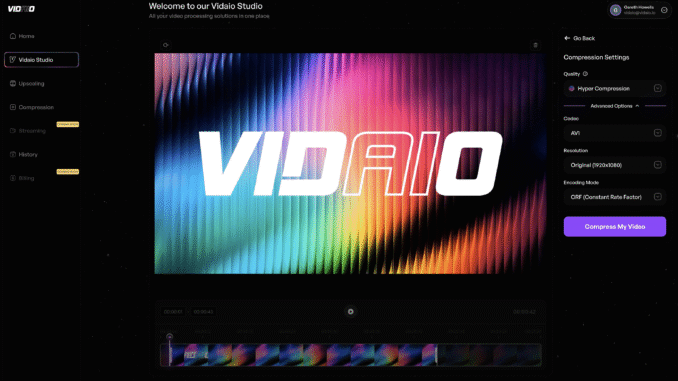
As video continues to dominate internet traffic, the infrastructure behind video enhancement, compression, and delivery remains largely centralized and expensive. Vidaio, grounded on Subnet 85, is attempting to change that by bringing AI-driven video processing onto Bittensor’s decentralized network.
Vidaio is an open-source video processing subnet focused on AI-based compression and upscaling today, post-production automation, and decentralized streaming planned through 2026.
Built on Bittensor, the project uses on-chain incentives to coordinate distributed GPU (Graphics Processing Unit) providers and continuously improve its models.
Why Vidaio is Built on Bittensor
Rather than operating as a centralized service, Vidaio leverages Bittensor’s merit-based architecture, where contributors are rewarded based on performance.
This allows the subnet to scale compute capacity dynamically while avoiding single points of control.
By tapping into Bittensor’s distributed GPU network, Vidaio can:
a. Scale processing capacity with demand,
b. Incentivize ongoing model improvement, and
c. Remain fully open-source and permissionless.
This structure aligns compute supply, model quality, and economic incentives in a single system.
Live Capabilities: Upscaling, Compression, and Studio Tools
Vidaio’s core infrastructure went live earlier this year, forming the backbone for high-volume video workloads.
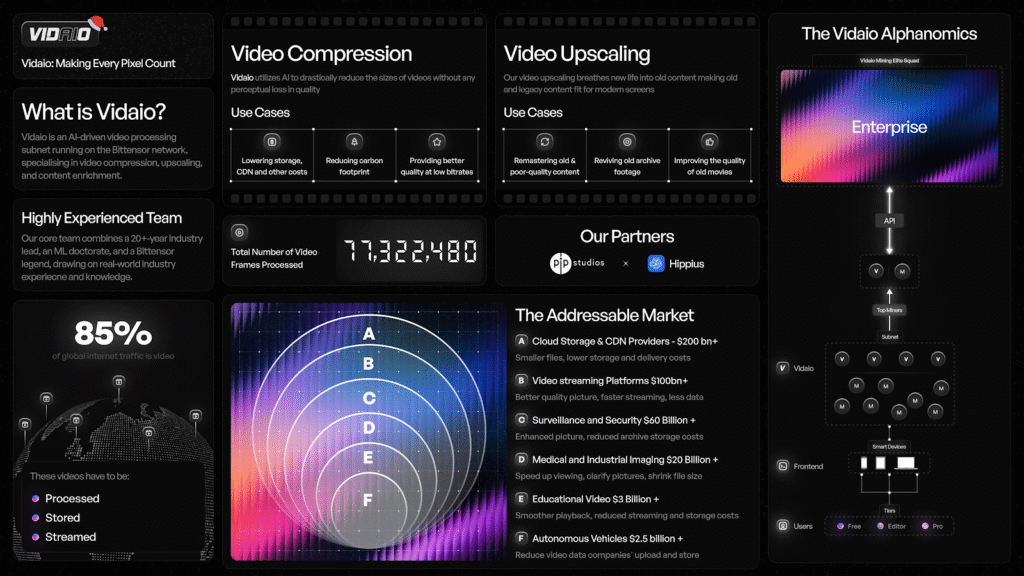
Its first production feature is an AI-driven video upscaling, designed to modernize legacy SD and HD content for today’s displays.
Unlike traditional interpolation, Vidaio’s models analyze textures, motion, and edges to reconstruct higher-resolution frames with improved realism. This enables content reuse without full re-production.
Additional live components include:
a. AI-driven video compression to reduce bitrate while preserving perceptual quality
b. Vidaio Studio, a unified interface supporting multiple codecs, resolutions, and encoding modes
Together, these tools target creators and businesses facing rising storage and delivery costs.
Automation and Intelligent Enhancement on the Roadmap
Looking ahead, Vidaio’s roadmap emphasizes automating tasks traditionally handled in post-production. Planned enhancements include frame rate conversion, color correction, HDR processing, denoising, and stabilization.
The subnet is also developing generative AI models for content-aware video enhancement, enabling scene-level optimization and restoration of degraded footage.
Accessibility and Decentralized Streaming
Vidaio is also set to introduce accessibility services as a core platform layer, including subtitles, closed captions, and audio descriptions, reflecting growing regulatory requirements.
Further out, their roadmap includes decentralized video streaming, with a focus on low-latency delivery and integration with Vidaio’s existing processing stack, all running on Bittensor.
Positioning in the Bittensor Ecosystem
Vidaio illustrates how Bittensor subnets are evolving beyond experimental AI tasks toward production-grade infrastructure.
By coordinating distributed GPUs through incentives rather than centralized contracts, the subnet offers a decentralized alternative for video processing at scale.As demand for high-quality video, automation, and global distribution grows, Vidaio’s approach positions it as a potential building block in a broader decentralized media stack.


Be the first to comment