
Video quality has quietly become one of the biggest bottlenecks for creators and businesses alike. Higher resolutions demand more compute, better codecs, and increasingly complex workflows.
Centralized tools solve some of this, but they come with high costs, rigid limits, and a single point of control.
Vidaio is taking a different path. Built on Bittensor’s Subnet 85, Vidaio introduces a decentralized, open-source approach to video enhancement that makes powerful processing accessible, flexible, and community driven. And with the launch of Vidaio Studio, that vision is now available through a simple, practical interface.
What is Vidaio?
Vidaio is an open-source video processing subnet focused on AI-driven video upscaling and compression (with streaming features coming soon). Its mission is to democratise video enhancement through decentralisation, artificial intelligence, and blockchain technology.
Instead of relying on a single company or data center, Vidaio leverages Bittensor’s merit-based model to tap into a distributed pool of GPUs. Contributors are rewarded on-chain, which creates a feedback loop where better performance leads to better incentives and continual improvement of the models.
Technically, Vidaio uses deep learning models that analyze patterns, textures, and edges in video frames to generate higher-resolution outputs. Unlike traditional upscaling methods that rely on interpolation, Vidaio reconstructs detail in a way that produces sharper and more realistic results.
This decentralized design also removes a single point of control, improving resilience, scalability, and censorship resistance while adapting instantly to growing demand.
What is Vidaio Studio?
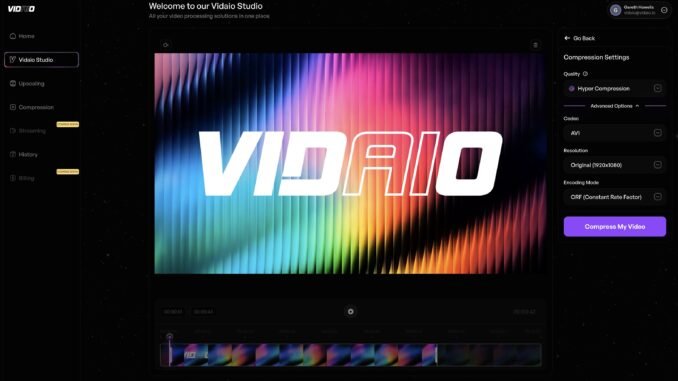
Vidaio Studio is the practical interface that brings this technology to life. It is a one-place destination for video processing solutions, designed for creators, teams, and businesses that want powerful tools without complexity.
The Studio allows users to upload a video, make targeted adjustments, and process it using Vidaio’s AI infrastructure running on Bittensor.
Launched in beta, Vidaio Studio offers a solid foundation, with more functionality on the way.
Key Features on Vidaio Studio
The key features of the Vidaio interface includes:
a. Timeline Clipping: Allows users select a specific section of their uploaded video and process only what they need. Users can also upscale or compress individual segments without touching the rest of the file.
b. Codec Selection: Users get to choose between AV1 and HEVC, depending on their quality and efficiency goals.
c. Resolution Options: Users can dynamically choose to process videos in 4K, Full HD, HD, and SD resolutions.
d. Encoding Modes: Users get to select from either Constant Bitrate (CBR) or Variable Bitrate (VBR) that best fits their workflow; .
e. Bitrate Control: Users also have the ability to fine tune output quality with bitrate options ranging 15 Mbps, 20 Mbps and 25 Mbps.
All of this is currently available in beta and free to use.
How to use Vidaio Studio
Using Vidaio Studio is intentionally straightforward and not complicated. Users do not need to understand AI models, blockchains, or GPU infrastructure to get value from it.
To use Vidaio Studio:
a. Visit the Vidaio Studio dashboard
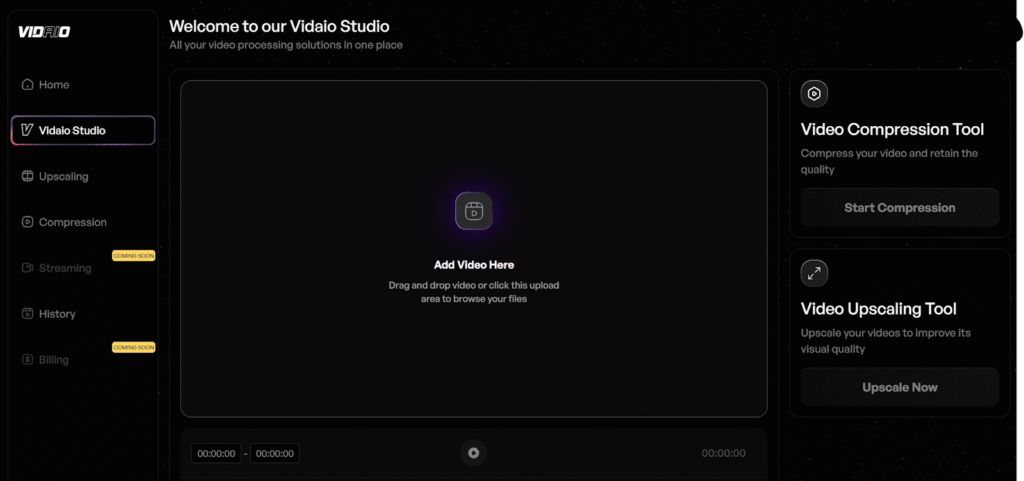
b. Upload your video file by clicking on “Add Video Here”
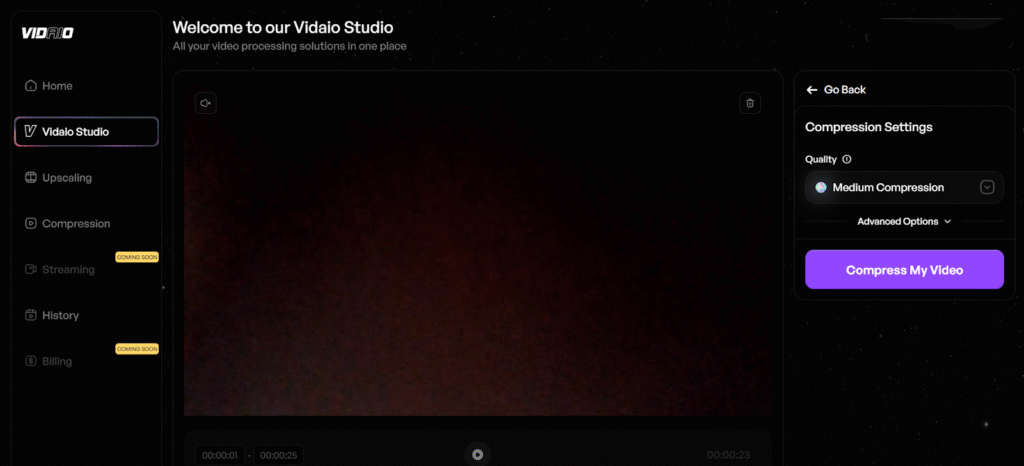
c. Clip the section you want to process (if needed).

d. Choose your codec, resolution, encoding mode, and bitrate
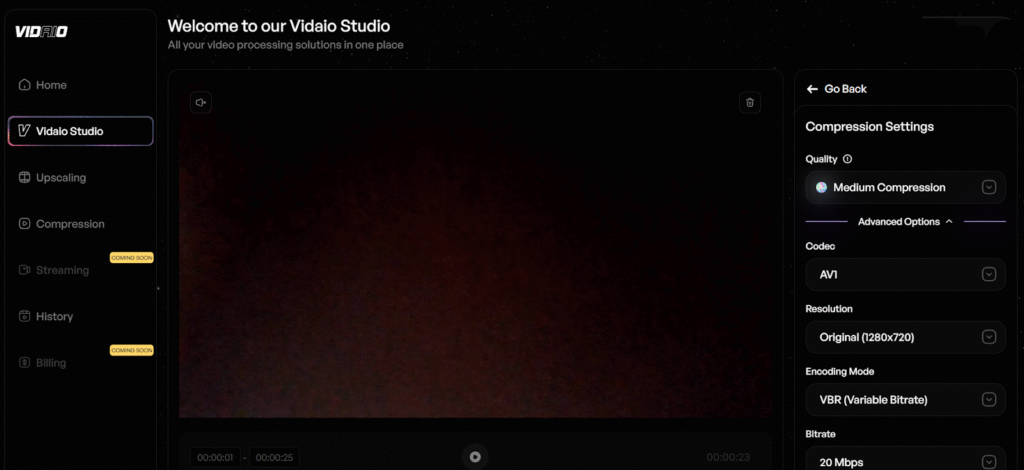
e. Run the processing job and download the result.
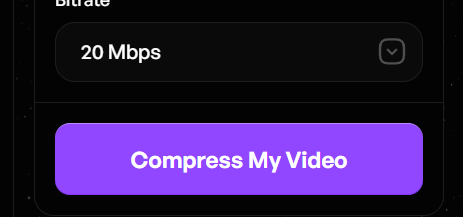
The interface keeps the focus on outcomes, not configuration overhead. Under the hood, the decentralized network handles the heavy lifting.
Why Vidaio matters on Bittensor
Vidaio is a strong example of what Bittensor subnets are meant to enable. It turns decentralized computers into a real product, aligns incentives between contributors and users, and demonstrates how open-source AI can compete on quality while remaining accessible and adaptable.
By building on Subnet 85, Vidaio is not just offering a tool. It is validating a model where infrastructure, intelligence, and value creation are shared across a network rather than locked behind a single provider.
Conclusion
Vidaio Studio is still in beta, but it already shows what the next generation of video processing can look like; simple to use, powered by AI and backed by decentralized infrastructure.
As more features roll out and the models continue to improve, Vidaio is positioning itself as a serious option for creators and businesses who want high-quality video processing without centralized constraints.
This is not just about better videos, it is about who controls the tools that shape digital media, and Vidaio is building that future on Bittensor.
Enjoyed this article? Join our newsletter
Get the latest Bittensor & TAO ecosystem news straight to your inbox.
We respect your privacy. Unsubscribe anytime.



Be the first to comment