
Anyone can compress a video, but the real challenge is preserving what the viewer actually sees. Shrinking file size is easy if you are willing to sacrifice clarity, motion smoothness, and fine detail.
However, the difficult part is maintaining perceptual quality while aggressively reducing bitrate.
That is where Vidaio stands apart.
Built on Bittensor Subnet 85, Vidaio applies content aware intelligence to video compression, optimizing not just for size, but for human visual perception.
The result is not simply smaller files; it is better quality at lower bitrates.
The Core Problem With Traditional Encoding
Traditional encoding pipelines are designed around fixed heuristics:
a. Predefined bitrate targets,
b. Generic compression rules, and
c. Static encoding profiles.
They treat all content similarly. A slow-moving interview and a fast-paced action sequence often receive the same structural assumptions. The encoder compresses frames based on mathematical thresholds, not contextual understanding.
This approach reduces size.
But it does not understand what matters visually, and that difference shows up in perceptual metrics.
Why Perceptual Quality Matters
While file size tells you how much data was removed, perceptual quality tells you how much visual integrity remains.
One of the most widely used perceptual benchmarks is VMAF (Video Multi-Method Assessment Fusion), a metric designed to approximate human viewing experience.
A higher score indicates that the compressed video remains visually close to the original.
This is where Vidaio’s results become difficult to ignore.
Real-World Comparisons
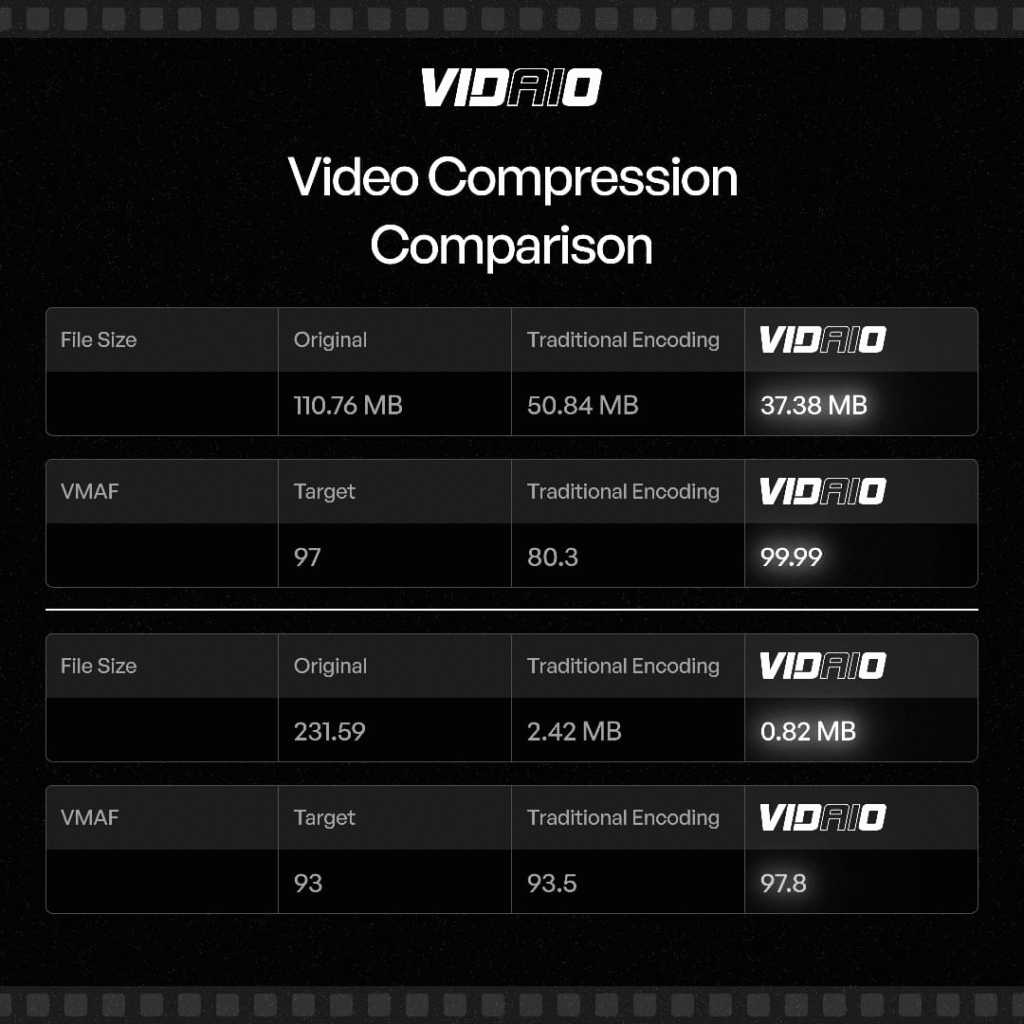
Let’s look at direct examples.
1. EXHIBIT 01
a. Original: 110.76 MB,
b. Traditional Encoding: 50.84 MB, and
c. Vidaio: 37.38 MB.
Vidaio produced a file nearly 25% smaller than traditional encoding.
Yet the perceptual difference is even more striking:
a. Vidaio VMAF score: 99.99, and
b. Traditional Encoding VMAF Score: 80.3.
A near perfect perceptual score at a substantially lower size. This is not incremental optimization, it is a structural improvement in compression logic.
2. EXHIBIT 02
a. Original: 231.59 MB,
b. Traditional Encoding: 2.42 MB, and
c. Vidaio: 0.82 MB.
Vidaio reduced the file to roughly one-third the size of traditional encoding.
Despite the aggressive compression, the perceptual quality score reached 97.8. That means the video retained strong visual fidelity even at extreme bitrate reduction.
This is what content aware compression looks like in practice.
What Makes Vidaio Different
Vidaio does not treat every frame equally. Instead, it evaluates content contextually:
a. Motion intensity,
b. Texture density,
c. Scene transitions, and
d. Visual importance.
By identifying which areas require higher fidelity and which can tolerate heavier compression, it allocates bitrate intelligently.
This dynamic allocation produces two simultaneous outcomes which are smaller files, and higher perceptual quality.
Traditional encoders optimize for average compression efficiency. Vidaio optimizes for how humans actually see.
The Broader Implications
Bandwidth is expensive, storage is expensive, and streaming at scale multiplies both costs dramatically.
If content-aware compression can:
a. Reduce file size by 25% or more,
b. Maintain VMAF scores near 100, and
c. Operate at lower bitrates without perceptual degradation.
Then the downstream implications are significant:
a. Lower CDN (Content Delivery Network) costs,
b. Faster content delivery,
c. Reduced mobile data consumption, and
d. Improved streaming reliability in low bandwidth regions.
The advantage compounds at scale.
Closing Perspective
Compression is not new, intelligent compression is.
Vidaio demonstrates that aggressive file reduction does not have to come at the expense of visual integrity.
The difference is not just “smaller output.”
It is smarter allocation, perceptual awareness, and measurable quality gains.
Vidaio represents a shift from generic encoding rules to context-driven optimization.
In a world where video dominates internet traffic, the winners will not be those who compress the most. They will be those who compress intelligently,
Vidaio is positioning itself in that category.
Enjoyed this article? Join our newsletter
Get the latest Bittensor & TAO ecosystem news straight to your inbox.
We respect your privacy. Unsubscribe anytime.


Be the first to comment