
The Bittensor ecosystem has grown fast; new subnets, shifting emissions, and the constant evolution of $TAO tokenomics. But with that growth comes complexity.
For many newcomers, staking and subnet participation can feel like decoding a language only insiders understand.
That’s exactly what Mentat Minds is working to change.
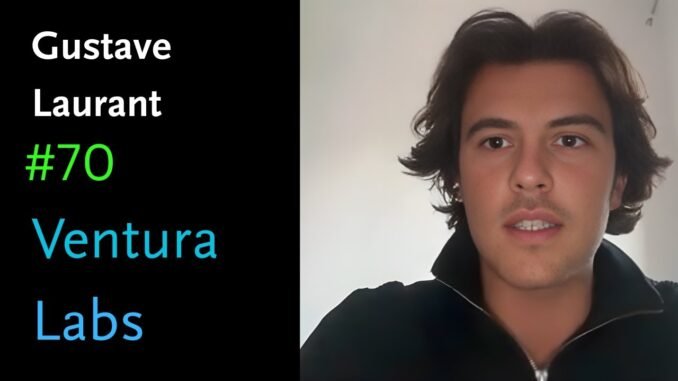
In a recent conversation (see video below) on the Ventura Labs Podcast, Gustave Laurant (Co-Founder of Mentat Minds) shared how the platform is simplifying subnet staking, bridging knowledge gaps, and helping users (from beginners to builders) feel at home inside Bittensor.
From the Early Days to Metant Plus
When Gustave last appeared on Ventura Labs, it was before the dynamic TAO era, long before emissions and subnet competition became everyday conversation. Back then, Mentat Mind was simply a bridge between $TAO holders and yield opportunities across the network.
Today, it’s evolved into Metant+, an intuitive platform designed to make subnet staking as easy as shopping online.
Here’s how it works:
a. Users connect their wallets and view their $TAO allocations between Root and various subnets.
b. They can explore categories like inference, prediction, or data and choose subnets they like, from teams they follow on X (Formerly Twitter) to projects they’ve discovered on podcasts.
c. With just a few clicks, they can balance their portfolio, dollar-cost average, or invest directly.
“Think of it like Amazon for subnets,” Gustave explained. “You can browse, mix, and allocate your $TAO however you want, without worrying about all the backend complexity.”
The Power of Proxy Staking
Behind this simplicity lies something clever, proxy staking. Mentat Minds was the first in the Bittensor ecosystem to roll it out, allowing users to delegate staking management to the platform.
When users choose a subnet mix, Mentat Minds dynamically adjusts their portfolio, continuously optimizing for the best APY across validators.
Everything happens in the background through a single “hotkey” system that automates performance tracking and rebalancing.
“People don’t have to manually check validator data or understand subnet mechanics,” Gustave said. “We handle the technical side, so users can focus on exposure and strategy.”
Helping Subnet Owners, Too
It’s not just users who benefit. Subnet owners often face a mountain of responsibilities like managing miners, balancing emissions, refining tokenomics, and ensuring decentralization.
To support them, Mentat Minds is developing tools that make subnet operation smoother. This includes features that help owners:
a. Decentralize their staking across multiple validators.
b. Maintain healthy competition between nodes.
c. Optimize returns without over-centralizing their networks.
Mentat Minds is also exploring collaborations with Bitstarter, a growing subnet incubator. The idea is to make it easier for new subnet founders to launch, learn, and scale without getting buried under technical details. “Anything that helps subnets flourish faster is good for everyone,” Gustave noted.
A Smarter Emission System and the Coming $TAO Halving
The conversation naturally drifted toward protocol-level changes, especially the upcoming emission updates and the first $TAO halving.
Both, Gustave believes, will reshape how value flows through Bittensor.
He explained that the new emission model is designed to reward growth momentum instead of static price levels. In other words:
a. Subnets that are growing and attracting $TAO inflow will receive more emissions.
b. Stagnant subnets will naturally lose emissions over time.
“It’s a fairer system,” Gustave said. “If your subnet keeps building and getting community support, you’re rewarded. If not, emissions slow down.”
He also pointed out that the $TAO halving (the first in Bittensor’s history) will likely reduce sell pressure and bring more balance to the market.
With emissions cut in half, the network could see stronger fundamentals and healthier price dynamics.
Education Before Expansion
Despite all the progress, Gustave believes education remains the biggest challenge.
“Everyone who understands Bittensor gets hooked,” he said. “But the path to understanding is still very hard.”
That’s where Mentat Minds’ mission truly shines. Beyond staking, the platform acts as an entry point, letting users get hands-on experience, even if they don’t yet grasp every technical layer. Gustave calls this learning by doing, a crucial step toward mass adoption.
His advice for new users is refreshingly simple:
a. Start small but start early. Begin with 90% Root, 10% Subnets, and watch how the market behaves.
b. Diversify through indexes. Mentat Minds offers curated subnet indexes like Mentat 5 and Mentat 15, similar to S&P 100 and S&P 500-style bundles respectively.
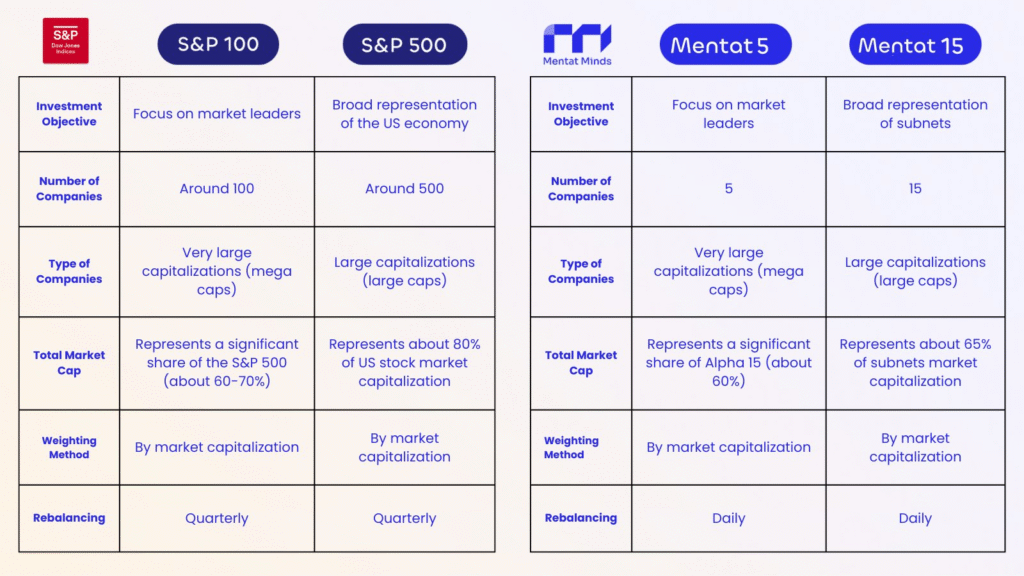
S&P Bundles vs Mentant Minds’
c. Increase gradually. As confidence and understanding grow, expand subnet exposure over time.
Building for the Future
Looking ahead, Mentat Minds’ focusing on two key goals:
a. Educating the next wave of subnet participants.
b. Supporting subnet owners with tools that simplify operations and improve validator decentralization.
For them, it’s not just about building a product, it’s about shaping a culture of understanding inside the Bittensor ecosystem.
“Launching a subnet isn’t easy,” Gustave reminded listeners. “It’s like running a startup with complex incentives, validators, and economics. But if we can make that process clearer and more accessible, the whole ecosystem benefits.”
Mentat Mind is positioning itself as that bridge; between $TAO holders and subnets, between complexity and usability, between curiosity and confidence.
And in an ecosystem as ambitious as Bittensor, that bridge might just be what helps the next generation of users find their footing.

Be the first to comment