
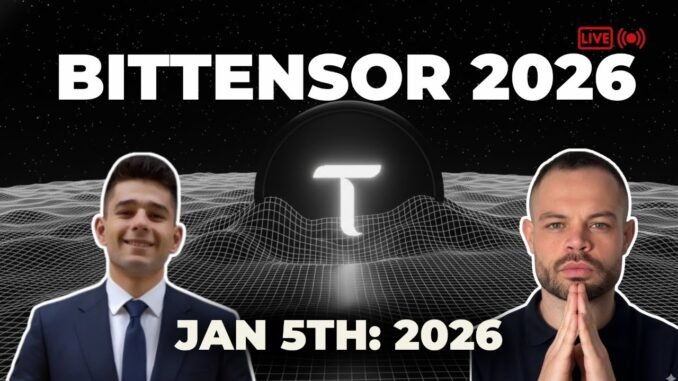
As Bittensor matures, the ecosystem is beginning to attract a different class of participant. Not just developers and early miners, but researchers, capital allocators, and educators trying to understand where decentralized AI creates durable value.
In this video chat, Gordon Frayne spoke with Rado of Trendsetter Capital, about his path from Bitcoin maximalism to full-time participation in Bittensor. The discussion covered mining, security, conviction, and what newcomers often misunderstand about the protocol.
Rather than promoting a thesis, the intellectual exchange focused on practical experience.
A Bitcoin Foundation That Shaped the Transition
Gordon began by asking Rado to trace his entry into crypto.
Rado described an early exposure to Bitcoin in 2014 that he initially ignored, followed by more hands-on involvement in 2016 through online gaming economies and early Ethereum use. What followed was not active trading, but long-term accumulation.
By 2021, Rado had developed a deep conviction in Bitcoin after studying macroeconomics, inflation, and monetary policy through long-form educational content. That framework, he explained, later made Bittensor easier to evaluate.
Gordon noted that many deeply engaged Bittensor participants share this background and to this, Rado agreed. Understanding Bitcoin as a system, rather than a trade, made it easier to approach Bittensor ($TAO) with patience and discipline.
Discovering TAO and Reassessing Priorities
Rado’s introduction to TAO came in early 2024, again through his brother. At the time, he was working full-time in real estate and initially limited his exposure to root staking, Dynamic TAO (dTAO) changed that.
As Gordon observed, the shift toward subnets forced participants to engage more actively. For Rado, the challenge was time as researching subnets properly required stepping away from a demanding career.
After a series of frustrating real estate transactions, he made a clean break. He paused client work, reassessed his priorities, and returned to Bittensor with full attention.
What stood out immediately was the lack of accessible education, that gap became the foundation for his content.
Lowering the Barrier for Newcomers
Gordon highlighted Rado’s ability to explain Bittensor without oversimplifying it.
Rado believes onboarding remains the ecosystem’s biggest challenge. Bittensor is conceptually dense, and most official resources assume technical familiarity.
He outlined three core principles for newcomers:
First, starting out with fundamentals: To understand what Bittensor ($TAO) is and how the protocol works before exploring subnets or mining.
Second, building conviction: Without understanding the market size, competitive landscape, and long-term vision, most participants treat TAO like a short-term trade.
Third, using AI tools as learning aids: Large language models can help interpret important dashboards such as TAOStats and TAO.App line by line, reducing cognitive overload.
Gordon agreed. Without guidance, many users disengage before reaching clarity.
Why Bittensor Mining is Different
The conversation then turned to mining and Gordon inquired how Bittensor mining differs from Bitcoin mining.
Rado described Bittensor as a digital economy rather than a single activity. Each subnet rewards a different type of work. Content creation, infrastructure, machine learning, liquidity provision, and strategy submission all qualify, depending on the subnet.
A critical distinction, he emphasized, is that miners earn subnet specific ‘$ALPHA’ tokens, not $TAO (Bittensor’s native token) directly.
To illustrate accessibility, Rado cited several lower barrier subnets, including content based mining, infrastructure focused subnets, and no-code strategy submission models.
Gordon added that liquidity-based mining is also emerging, though recent failures have highlighted the importance of security.
Security as Core Infrastructure
Security became a central theme of the conversation where both Gordon and Rado referenced the collapse of Subnet 67 (Tenex) as a turning point. Even experienced participants were affected.
Meanwhile, Rado explained why Bitsec was one of the first subnets he supported, noting that in a permissionless environment where anyone can launch a subnet, security must function as shared infrastructure.
He argued that audits, red-teaming, and public security signaling will increasingly differentiate credible projects. Gordon agreed, noting that security is now a prerequisite for serious capital participation.
Tools, Automation, and Information Advantage
Gordon also asked about Rado’s approach to tooling. Rado described a growing suite of lightweight automations, including AI summarized social feeds, Discord monitoring bots, and event-driven alerts tied to subnet activity.
The goal is not prediction, but awareness. Bittensor is highly event driven, and early signals often matter more than narratives.
In an ecosystem this young, even simple tools can create meaningful leverage.
Looking Ahead
Looking toward 2026, Gordon asked how Rado expects the ecosystem to evolve.
Rado anticipates fewer narratives and more measurable outcomes such as larger training runs, clearer benchmarks, and products with real users.
Both agreed that competition will intensify regardless of price direction. Incentives remain strong, and skilled participants will continue to enter the system.
A Balanced Strategy
To close, Gordon asked about strategy. Rado projected a balanced approach. Mining provides learning and steady exposure, subnet investing offers asymmetric upside through research, and trading remains tactical rather than emotional.
Selectivity, he emphasized, matters more than activity.
Conclusion
The conversation between Gordon Frayne and Rado reflects Bittensor’s current phase. Past experimentation, moving toward structure, but still early enough for motivated participants to find leverage.
Bittensor does not reward passivity. It rewards engagement, curiosity, and sustained effort.
For those willing to invest the time, the opportunity extends beyond price and into participation in an emerging decentralized AI economy.
Enjoyed this article? Join our newsletter
Get the latest Bittensor & TAO ecosystem news straight to your inbox.
We respect your privacy. Unsubscribe anytime.


Be the first to comment