

By: Jay Yow
Bitcoin, the pioneering cryptocurrency, has captivated the world since its inception in January 2009. At its core lies a clever economic design that ensures scarcity and controls inflation: the Bitcoin halving.
This event, which occurs roughly every four years, slashes the rate at which new Bitcoins are created, profoundly impacting the network’s supply dynamics and market value.
Drawing from insights in a recent discussion on the topic, let’s explore how halving works, its historical context, and why it remains a bullish force in the crypto ecosystem.
How Bitcoin Halving Works
Bitcoin operates on a decentralized network where miners validate transactions and secure the blockchain by solving complex mathematical puzzles—specifically, finding a SHA-256 hash that meets a certain difficulty threshold. In return for their computational efforts, miners receive newly minted Bitcoins as a “block reward,” along with transaction fees.
When Bitcoin launched, the block reward was 50 BTC per block. With approximately 144 blocks mined per day (one every 10 minutes on average), this translated to about 7,200 new Bitcoins entering circulation daily—or roughly 300 per hour and 5 per minute. In the early days, mining was accessible; you could even use a basic CPU on a home computer.
Hypothetically, a modern smartphone like today’s iPhones might have mined 10-30 Bitcoins per day back in 2009 due to the low difficulty.
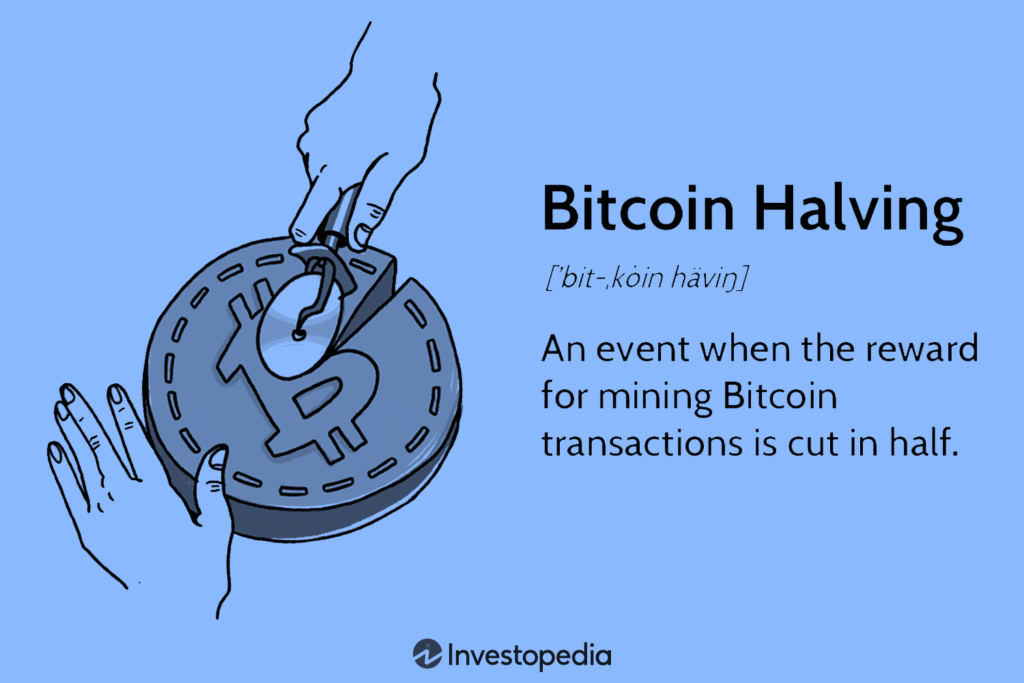
The halving mechanism is hardcoded into Bitcoin’s protocol: every 210,000 blocks (about four years), the block reward is cut in half. This creates a programmatic deflationary curve, ensuring that the total supply of Bitcoin will never exceed 21 million coins. The process will continue until around the year 2140, spanning roughly 130 years from Bitcoin’s start.
Why halve the reward instead of spreading it evenly over time? The design choice introduces scarcity in a step-like fashion, mimicking real-world resource extraction where early yields are abundant (like a gold rush) and taper off.
Alternatives could exist—such as gradual reductions—but the four-year cycle aligns intriguingly with societal rhythms, like political election cycles in countries such as the United States, where major shifts occur every four years.
A Brief History of Bitcoin Halvings
Bitcoin’s halvings mark key milestones in its evolution:
- 2009-2012 (Pre-First Halving): The initial era saw 50 BTC per block, leading to half of the total 21 million supply being mined in just four years. This was the “gold rush” period, with low difficulty and high rewards for early adopters.
- First Halving (End of 2012): Reward dropped to 25 BTC per block, reducing daily issuance to about 3,600 BTC.
- Second Halving (2016): Down to 12.5 BTC per block, or roughly 1,800 BTC daily.
- Third Halving (2020): Halved to 6.25 BTC, yielding about 900 BTC per day.
- Fourth Halving (2024): As of 2025, the current reward is 3.125 BTC per block, equating to 450 BTC emitted daily. This translates to an annual reward of around 164,000 BTC, valued at approximately $14.7 billion at a Bitcoin price of $90,000 (noting the asset’s volatility).
Each halving reduces the inflationary pressure on Bitcoin’s supply, reinforcing its scarcity.

From Digital Cash to Store of Value
Bitcoin’s creator, Satoshi Nakamoto, envisioned it as an “electronic cash system” to replace traditional currencies like the dollar. However, it has evolved primarily into a store of value—akin to digital gold—while still holding potential as a medium of exchange. Both roles tap into massive markets: store-of-value assets alone represent a $50-200 trillion opportunity.
The halving plays a pivotal role here by enforcing scarcity, drawing from Austrian economics principles. As the transcript notes, abundance erodes value, so constraining supply through halvings promotes price discipline. Miners, who expend vast computational power and electricity on SHA-256 hashing, are compensated handsomely—currently about $14 billion annually in dollar terms—but the diminishing rewards encourage efficiency and innovation in mining technology.

The Bullish Case for Halvings
Critics sometimes argue that halvings are bearish, as reduced rewards might discourage miners. However, history tells a different story. Each halving has preceded significant price appreciation, despite short-term volatility. Zooming out over 15 years, Bitcoin has outperformed every major asset class. For instance:
- In the last 15 years, Bitcoin achieved roughly a 200,000x return.
- Over the past decade, it delivered about a 500x gain.
- Compare that to Nvidia, a top-performing stock: around 500x in 15 years and 220x in the last 10.
This compounding effect underscores Bitcoin’s unique trajectory. Halvings amplify information asymmetry—early holders who understood and accumulated during low-price eras reaped enormous benefits. As adoption grows, with more users appreciating Bitcoin’s productive uses, the halvings continue to drive long-term value.
Looking Ahead
As we approach the next halving around 2028, Bitcoin’s supply will tighten further, potentially fueling new cycles of innovation and investment. While volatility remains a hallmark, the halving’s design ensures Bitcoin’s enduring appeal as a hedge against inflation and a cornerstone of the digital economy.
In summary, Bitcoin halving isn’t just a technical event—it’s a masterful economic lever that transforms code into scarcity, mirroring the finite nature of precious resources. For investors, miners, and enthusiasts alike, it remains a reminder of Bitcoin’s revolutionary potential.
Full video as explained by JJ:
Enjoyed this article? Join our newsletter
Get the latest Bittensor & TAO ecosystem news straight to your inbox.
We respect your privacy. Unsubscribe anytime.



Be the first to comment