
The subnet economy has grown faster than ‘its measurement tools’. Thus, within Bittensor, capital no longer concentrates solely in $TAO.
It disperses across dozens of subnet ‘$ALPHA’ tokens, each representing a distinct intelligence market. Yet until now, there has been no coherent way to answer a basic institutional question: How is the subnet economy performing as a whole?
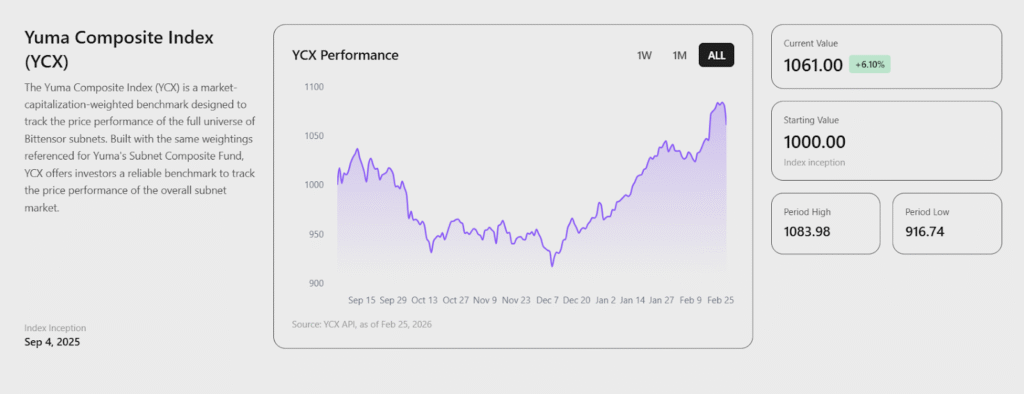
The launch of the Yuma Composite Index (YCX) by Yuma Group introduces the first serious benchmark designed to answer that question with structural rigor rather than narrative approximation.
From Fragmented Signals to Structured Measurement
Before YCX, observers relied on three imperfect proxies:
a. $TAO’s price, which reflects network-level value but not subnet dispersion,
b. Individual $ALPHA, which capture isolated volatility, and
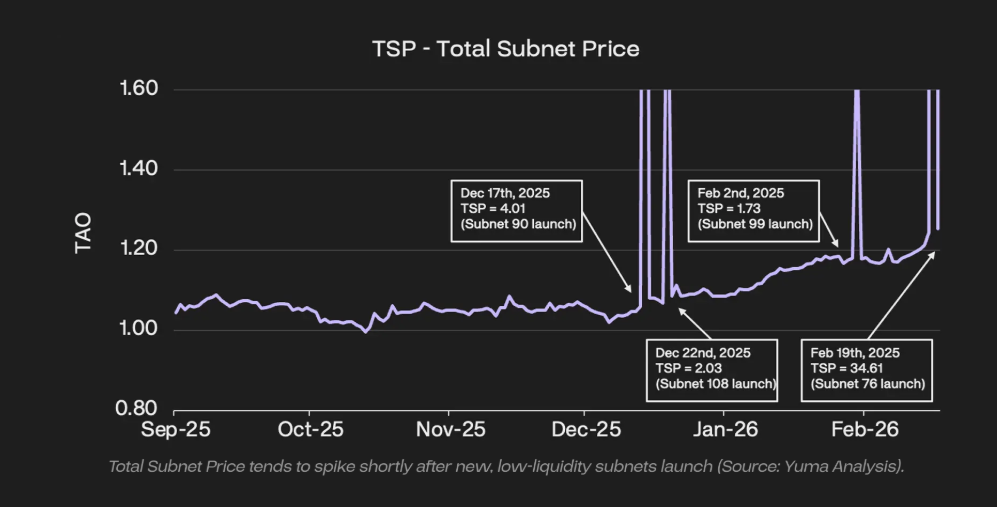
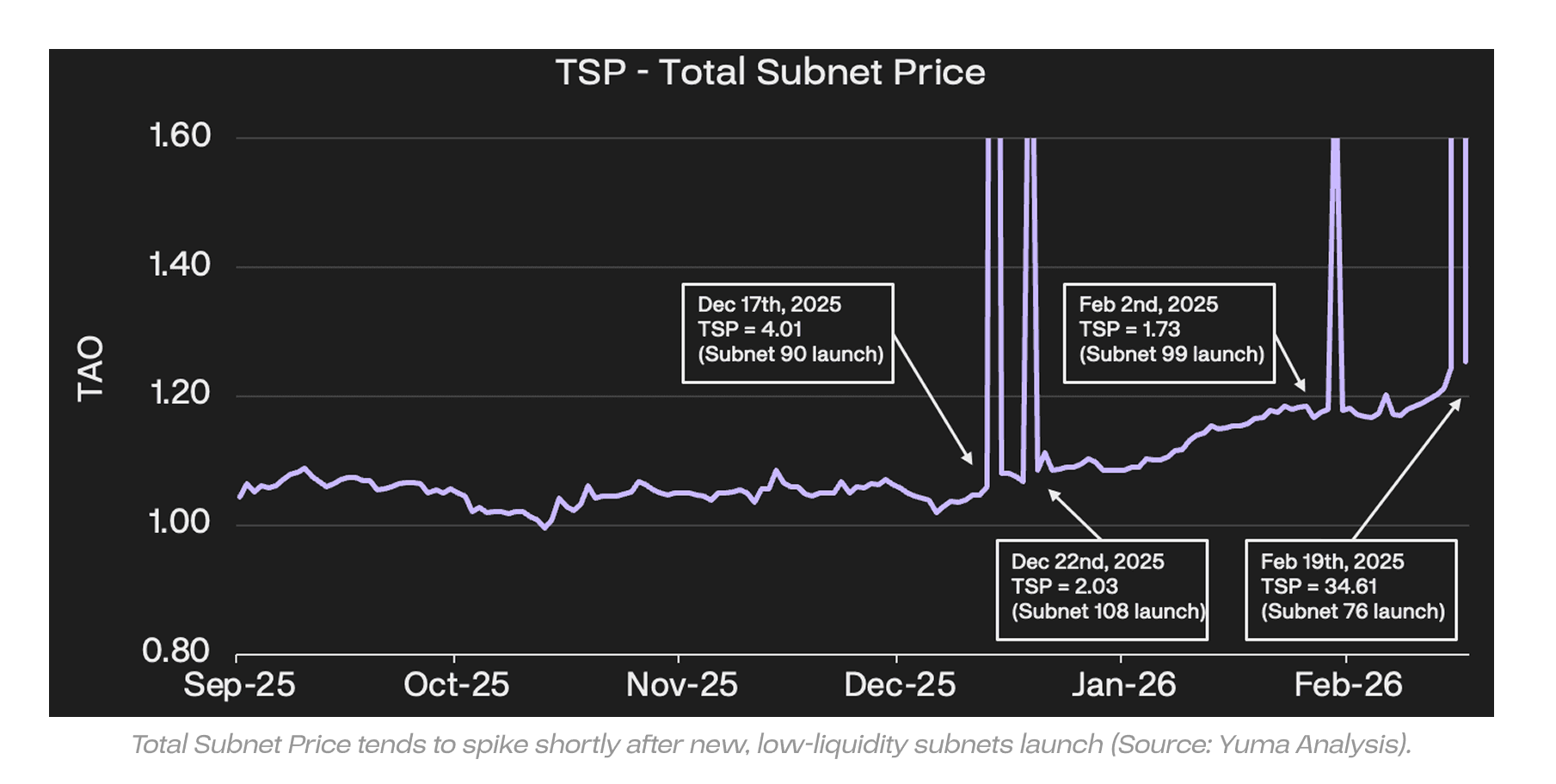
c. Total Subnet Price (TSP), a simple sum of one $ALPHA per subnet, which fails to account for market capitalization and distorts with every new launch.
Sadly, none of these could function as a benchmark.
YCX resolves this by applying a principle long settled in traditional markets: weight by economic reality, not nominal price.
The index is market-capitalization-weighted and constructed using two core variables:
a. Subnet ‘$ALPHA’ token value, and
b. Circulating supply.
By combining both, YCX reflects the actual economic weight of each subnet within the broader ecosystem. Larger subnets exert proportionate influence, while smaller subnets contribute accordingly.
This results in a real-time composite and effective view of aggregate subnet performance independent of $TAO.
Why Indices Matter
Financial systems mature when they become measurable. The NASDAQ Composite did not create technology companies, it made them legible to capital. Also, the Dow Jones Industrial Average did not industrialize America, it just benchmarked it.
YCX serves a parallel function for decentralized intelligence. To this, it provides:
a. A unified performance benchmark,
b. A comparative baseline for active managers,
c. A foundation for structured financial products, and
d. A signal of capital concentration across intelligence domains.
Since its inception in September 2025, the index launched at 1000, declined to ~916 (All-Time Low) during market contraction, and has since climbed to ~1083 (All-Time High), reflecting an ~8.10% increase from launch.
The trajectory is less important than the framework, and for the first time, subnet performance can be tracked as an aggregate market rather than a collection of anecdotes.
Capital Allocation, Not Just Price Action
An index does more than average numbers, it reveals conviction. YCX measures where sustained capital is accumulating across subnets, it shifts focus away from momentary volatility toward weighted capital structure.
The deeper signal is not whether a single subnet spikes, but whether capital is flowing toward:
a. Subnets producing externally verifiable utility,
b. Subnets demonstrating durable revenue or usage, or
c. Subnets aligned with long-term intelligence demand.
Or even whether allocation is drifting toward short-term incentive dynamics. YCX transforms that question from speculation into data.
Building the Financial Layer
The index also anchors two structured (and important) investment vehicles:
a. Yuma Subnet Composite Fund
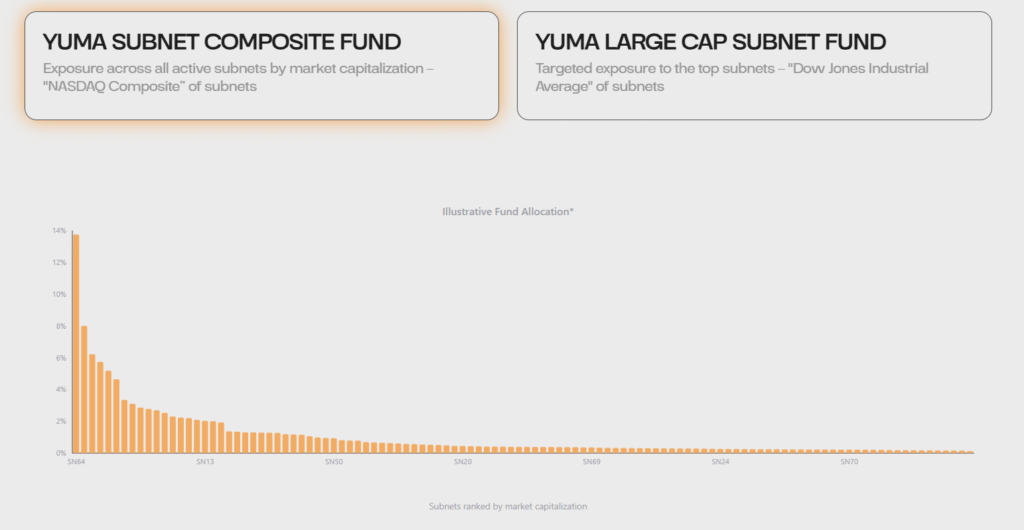
This gives a broad exposure and simplified insight across all active subnets by market capitalization, conceptually analogous and similar to a composite-equity benchmark.
b. Yuma Large Cap Subnet Fund
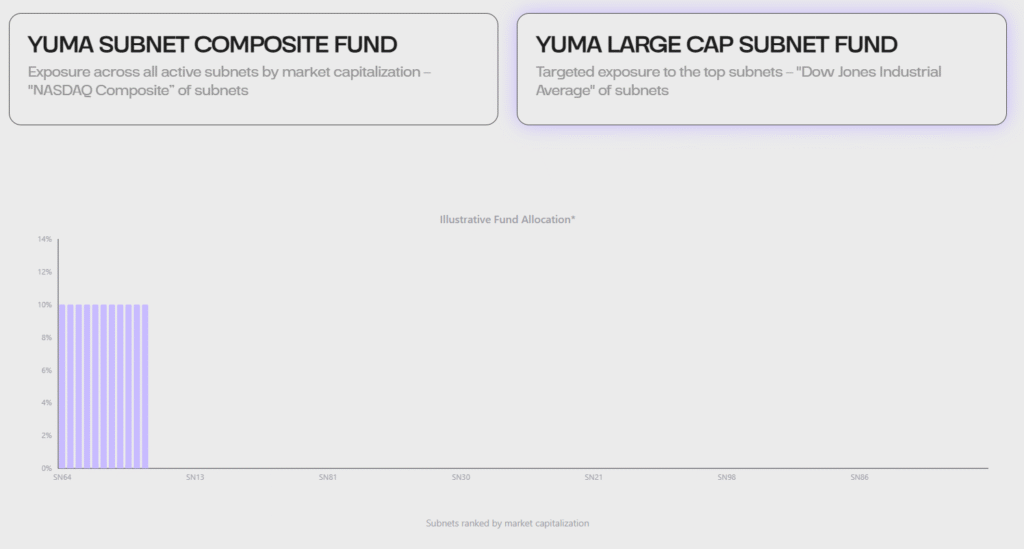
This chart gives a concentrated exposure to the largest subnets by market cap, focusing on established ‘leaders’ within the ecosystem.
Historically, benchmarks precede institutional participation since asset managers require standardized reference points to evaluate risk, measure ‘alpha’, and construct systematic allocation strategies.
Without an index, capital hesitates, and with one, allocation frameworks become possible.
The Structural Implication
Following the dTAO (Dynamic TAO) upgrade, value within Bittensor is no longer monolithic. It is distributed across $ALPHA that represent specialized intelligence markets (Thus, measuring only $TAO is insufficient!).
YCX recognizes that the subnet economy is no longer experimental infrastructure, it is an investable market structure, and that shift carries consequences.
Markets that develop benchmarks tend to develop funds, markets that develop funds tend to attract professional capital, and markets that attract professional capital tend to institutionalize.
While the Yuma Composite Index does not guarantee that outcome, it makes it feasible.
For the first time, the subnet economy has a compass.



Be the first to comment