
By: Aayushman H Narayan (@slayercoredev)
The evolution of the eye was a key turning point for the human species.
It dramatically increased our ability to absorb information about the physical world, work with objects by co-ordinating our body parts together and describe what we saw around us to each other, thus inducing the formation of language. With language, we evolved the ability to work seamlessly in larger groups and onwards we went towards seeking knowledge, disseminating them orally over large distances and creating ever increasing socio-economic complexity. Now what does all of this have to do with Score, subnet 44 on Bittensor?
Score is giving AI eyes.
Let’s take a step back. Look around you. What do you see? Your laptop, a coffee mug, a smartphone, papers, books, earpods and so much more. Now if you can imagine computers actively processing all the written content on the internet and giving us answers about whatever we seek to know, then it stands to reason that giving computers the ability to see and absorb information from the physical world would allow machines and ourselves the ability to seek… much more. If there were a video in your room right now and it was streaming to Score’s miners and validators, it would “read” your room and probably send you notifications about where your car keys are. Similarly, a university would receive a stream of inputs like how many students were studying in the library at any moment or accurately describing who really caused that brawl in the mess.
Improving Efficiencies and Unlocking New Markets
Bittensor’s vision of decentralized intelligence dictates the creation of useful digital commodities that can represent & generate the world’s units of computed intelligence in an economically distributed fashion. Score achieves this vision by distilling video intelligence from the dynamic complexity of football (soccer) into understandable insights that are useful for players and professionals to better understand the game.
Football is an ever evolving, flowing canvas of movement in a definite space co-ordinate with 22 players, a referee, a lineman and a ball constantly reading each other, following a specific set of rules, trying to attack & defend. Score is incentivizing its miners and validators to process frame by frame of football video footage, as fast and accurately as possible, at 1/100th the cost of human annotation, tracking and detection systems. Currently it takes FIFA certified human football analysts hours to annotate each game. Score technically democratizes data annotation to anyone in the world who requires it at a much higher quality at a fraction of the costs and most importantly in a few minutes. For example, a 90 minute soccer game can be annotated on Score in 2 minutes, potentially a hundred fold plus improvement.
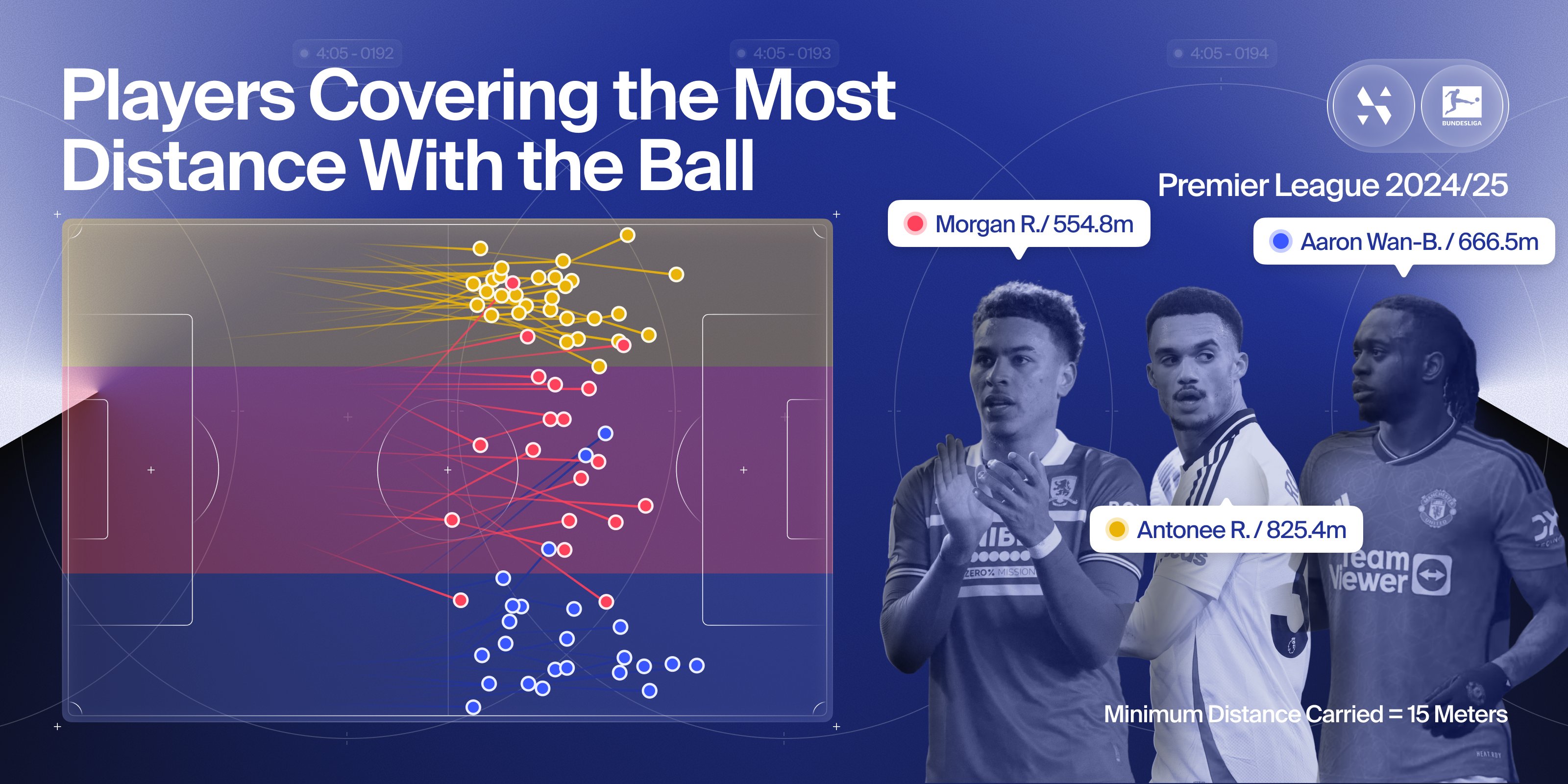
This allows Score to theoretically distill video intelligence for… anything. Where there is a video, Score’s miners and validators can annotate, track and detect objects and movement frame by frame to generate the language about “what happened” exactly like a sharp pair of human eyes watching over the world’s videos and generating insights in real time.
The Vision Value Creation Stack
The subnet can be visualized as a stack of 4 elements, each connected to the other:
- Annotation of video data
- Pretraining of simulated AI models
- The Universal Vision Layer
- Apps utilizing vision AI
Video: Score using optical flow to extract moving pixels
Thinking from this perspective of a stack, any video can be transformed into intelligence by creating the incentive mechanism that allows miners from anywhere in the world to compete with each other and refine their outputs, thus constantly improving the overall performance benchmarks of the subnet, while outcompeting any closed video intelligence system. With this approach, any business or app developer who is interested in transforming their video intelligence into a valuable real-time asset that works for them 24/7 is technically a Score customer.
Using Sports to go-to-market and prove the viability of the technology potentially unlocks the gateway to much, much more, including the creation of entirely new markets that were not possible before. Developers and engineers can potentially combine lots of use cases that previously would have been hindered because of the high cost of video analysis. If you’re a developer looking to build and innovate on a use case that is potentially suitable for video analysis, Score is your best bet. In fact, if your use case is built on actively collecting video footage and sending them to Score, you might as well accumulate Score as part of your digital treasury strategy (NFA) for future upside.
Enjoyed this article? Join our newsletter
Get the latest Bittensor & TAO ecosystem news straight to your inbox.
We respect your privacy. Unsubscribe anytime.



Be the first to comment